

- Company
- Products
- Catalogs
- News & Trends
- Exhibitions
LED20G FIX • SINGLE AND DUAL
LED20G FIX • SINGLE AND DUAL
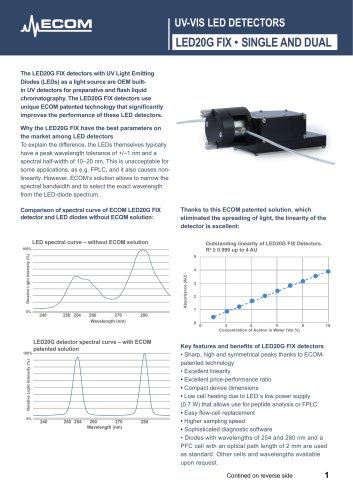
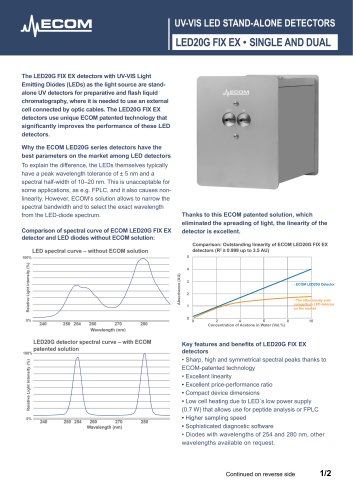
- ECOM's technology allows for narrowing the spectral bandwidth and selecting precise wavelengths, improving linearity and performance.
- Sharp, high, and symmetrical peaks are achieved due to the patented technology.
- Excellent linearity with R² ≥ 0.999 up to 4 AU.
- Compact design with low power consumption (0.7 W), reducing cell heating and making it suitable for peptide analysis or FPLC.
- Easy flow-cell replacement and higher sampling speed.
- Equipped with sophisticated diagnostic software.
- Standard diodes with wavelengths of 254 and 280 nm, with other options available upon request.
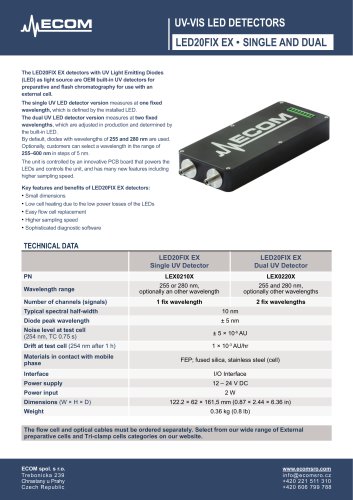
- Single UV Detector: Part number LEG0210X, wavelength range of 254 or 280 nm, 1 fixed wavelength channel.
- Dual UV Detector: Part number LEG0220X, wavelength range of 254 and 280 nm, 2 fixed wavelength channels.
- Typical spectral half-width of 4 nm and wavelength accuracy of ± 1 nm.
- Noise level at test cell (254 nm, TC 0.75 s) is ±10 × 10-6 AU.
- Drift at test cell (after 1 hour) is 1 × 10⁻³ AU/hr.
- Materials in contact with mobile phase include FEP, fused silica, and stainless steel.
- Interface options include RS232 and I/O Interface.
- Power supply requirements are 12–24 V DC with a power input of 2 W.
- Dimensions are 193 × 70 × 40 mm (7.60 × 2.76 × 1.57 in) and weight is 0.66 kg (1.46 lbs).
- Supplied with the unit by default, with a volume/optical path of 60 μl / 2 mm.
- Cell connection uses tubing with OD = 1/8", thread 1/4"–28.
- Maximum flow rate is 500 ml/min.
Catalog excerpts

LED20G FIX • SINGLE AND DUAL The LED20G FIX detectors with UV Light Emitting Diodes (LEDs) as a light source are OEM builtin UV detectors for preparative and flash liquid chromatography. The LED20G FIX detectors use unique ECOM patented technology that significantly improves the performance of these LED detectors. Why the LED20G FIX have the best parameters on the market among LED detectors To explain the difference, the LEDs themselves typically have a peak wavelength tolerance of +/–1 nm and a spectral half-width of 10–20 nm. This is unacceptable for some applications, as e.g. FPLC, and it also causes nonlinearity. However, ECOM‘s solution allows to narrow the spectral bandwidth and to select the exact wavelength from the LED-diode spectrum. Thanks to this ECOM patented solution, which eliminated the spreading of light, the linearity of the detector is excellent: Outstanding linearity of LED20G FIX Detectors. R² ≥ 0.999 up to 4 AU 5 4 Comparison of spectral curve of ECOM LED20G FIX detector and LED diodes without ECOM solution: 6 4 8 2 Concentration of Aceton in Water (Vol.%) Key features and benefits of LED20G FIX detectors • Sharp, high and symmetrical peaks thanks to ECOMpatented technology • Excellent linearity • Excellent price-performance ratio • Compact device dimensions • Low cell heating due to LED´s low power supply (0.7 W) that allows use for peptide analysis or FPLC • Easy flow-cell replacement • Higher sampling speed • Sophisticated diagnostic software • Diodes with wavelengths of 254 and 280 nm and a PFC cell with an optical path length of 2 mm are used as standard. Other cells and wavelengths available upon request.
Open the catalog to page 1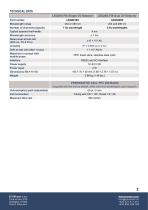
Trebonicka 239 Chrastany u Prahy Czech Republic
Open the catalog to page 2All ECOM catalogs and technical brochures
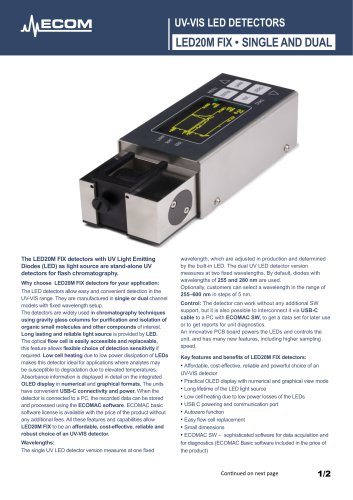 LED20M FIX • SINGLE AND DUAL
2 Pages
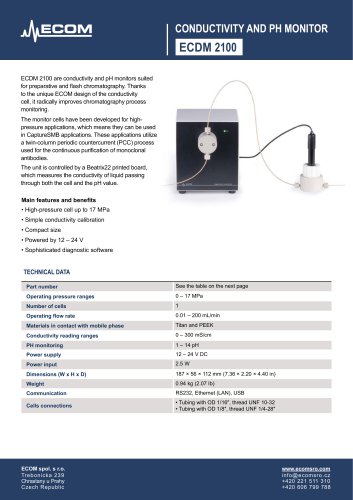 ECDM 2100
2 Pages
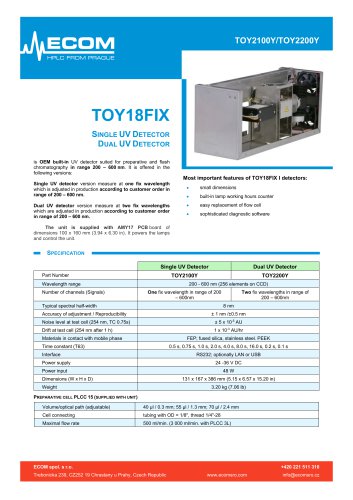 TOY18FIX
1 Page
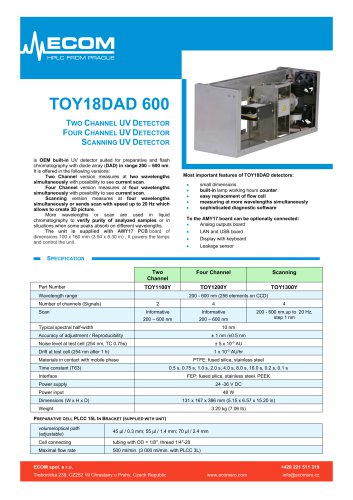 TOY18DAD 600
1 Page
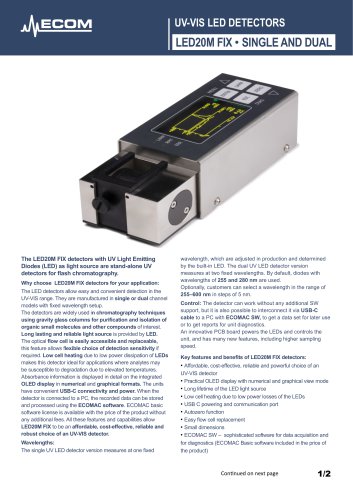 UV-VIS LED DETECTORS
2 Pages
 ECD2600
1 Page
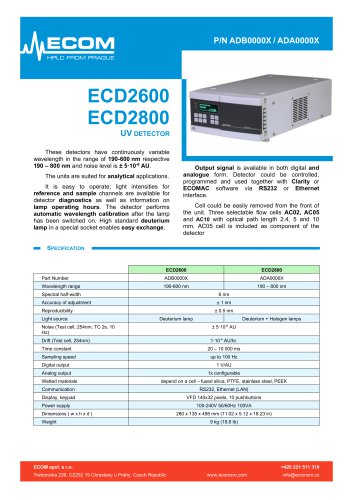 ECD2600 ECD2800
1 Page
 ECA AMINO 500
2 Pages
 ECS03
ECS031 Page
 ECS02
ECS021 Page
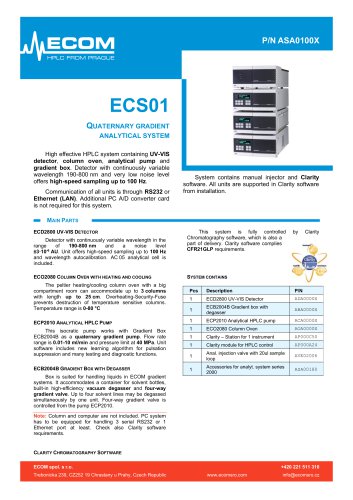 ECS01
ECS011 Page
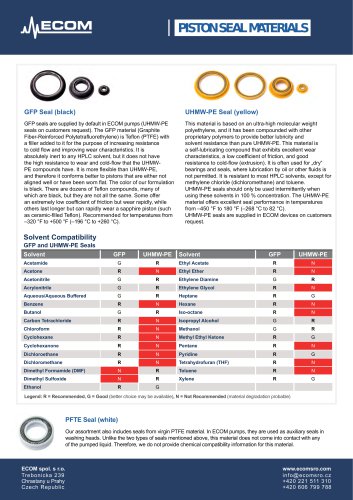 GFP Seal
1 Page
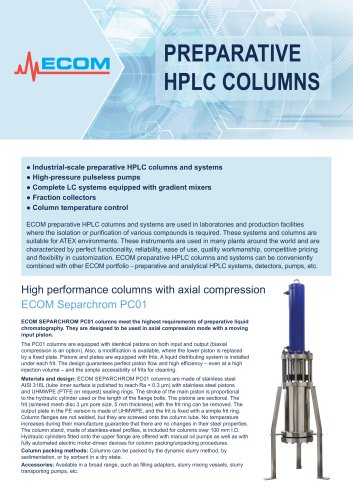 PREPARATIVE HPLC COLUMNS
4 Pages
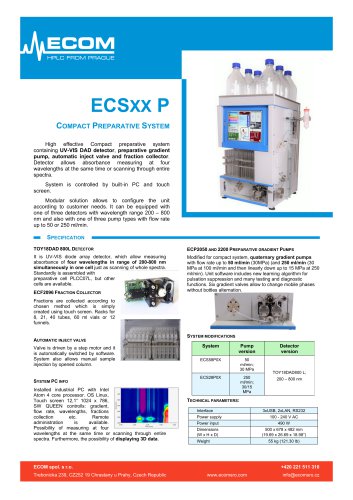 ECSXX P
1 Page
 ECOM Product & Company Catalog
24 Pages
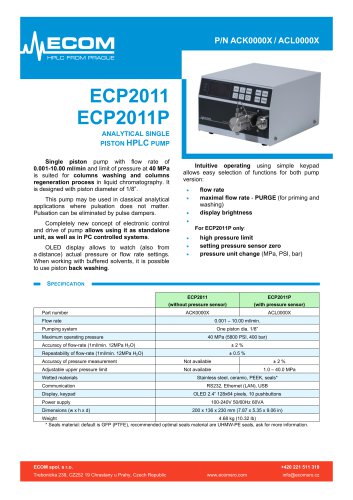 ACK0000X / ACL0000X
1 Page
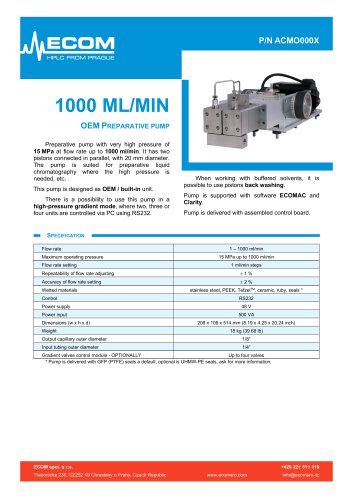 ACMO000X
1 Page
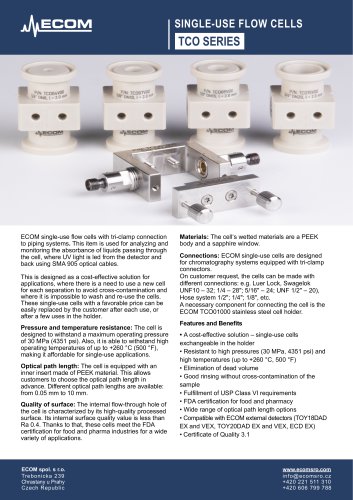 TCO series
2 Pages
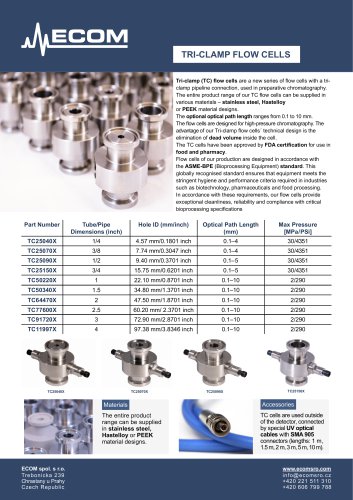 TRI-CLAMP FLOW CELLS
1 Page
- Pump
- Industrial pump
- Valve
- Pump with electric motor
- Stationary pump
- Seawater pump
- Manual valve
- Self-priming pump
- Chemical pump
- Stainless valve
- Control valve
- Kiln
- Stainless steel pump
- Suction pump
- Pump for the chemical industry
- Electric furnace
- Automation software solution
- Analysis software solution
- High-speed pump
- Piston pump