
- Catalogs
- ECM Technologies
- Chrysler Group: low-pressure carburizing fits in with process improvement


- Company
- Products
- Catalogs
- News & Trends
- Exhibitions
Chrysler Group: low-pressure carburizing fits in with process improvement

Chrysler Group: low-pressure carburizing fits in with process improvement
The document outlines the implementation and benefits of low-pressure carburizing technology at Chrysler Group's Indiana Transmission Plant II (ITP2) in Kokomo, Indiana. Since 2003, this technology has been used to treat over three million transmission components annually, enhancing quality and productivity.
Low-Pressure Carburizing Process
Chrysler Group adopted low-pressure carburizing to improve transmission component quality and reliability. Initial tests from 2001 to 2003 led to the installation of the first unit in 2003, with a second added in 2005, boosting productivity by 20%.
Equipment Reliability and Productivity
The goal was to enhance long-term quality and reduce distortion via gas quenching, achieving a 10% productivity gain. Consistent case-depth uniformity further increased productivity by 10-15%.
Continuous Process Improvement
Chrysler Group's shift from atmospheric to low-pressure carburizing reflects their commitment to process improvement.
Global Adoption and Applications
ECM, a low-pressure carburizing specialist, has seen global adoption of this technology. In North America, 80% of installations use gas quenching, while oil quenching is more common in Japan. The document notes collaborations with companies like Ford and Mahindra.
Environmental and Cost Benefits
Gas quenching eliminates the need for component washing, reduces chemical use, and minimizes effluent treatment, improving product quality and reducing costs.
Conclusion
The document highlights the advantages of low-pressure carburizing in enhancing component quality, productivity, and environmental sustainability, with Chrysler Group's experience serving as a successful case study.
Advancements in Carbonitriding
The document also discusses advancements in industrial validation procedures for high-temperature, low-pressure carbonitriding processes aimed at enhancing mechanical properties through nitrogen enrichment.
Specifications and Procedures
Goldsteinas plans further tests at higher temperatures, with micrographic analysis to understand nitrogen's role in improving mechanical properties. The process aims for mass production with minimal adaptation, such as adding an ammonia supply system.
Key Metrics
- Nitrogen enrichment over a thickness of more than 300 µm.
- Bending fatigue strength improved by 34%.
- At 960°C, nitrogen penetration up to 1mm.
- At 960°C, nitrogen surface content between 0.15 and 0.2%.
Testing and Results
Fatigue strength testing at PSA shows promising results, with tests involving alternating injections of nitrogen and ammonia during diffusion phases.
Future Applications
The study aims to validate the process on real components in other manufacturers' plants, with ECM's ICBP installations potentially performing carbonitriding faster and more effectively than conventional methods.
Conclusion
ECM and PSA are leading in high-temperature, low-pressure carbonitriding, achieving results beyond existing references.
Catalog excerpts
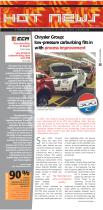
Quar terly no. 1 - July 2006 A MAGAZINE FROM ECM, SPECIALIST IN LOW-PRESSURE CARBURIZING inside pages Chrysler Group: low-pressure carburizing fits in with process improvement Low-pressure carbonitriding: tests with PSA back page I heartily thank Chrysler Group and Delphi for being so readily available to our editorial team for this first edition, and also PSA, for its cooperation during the carbonitriding tests. The productivity of our installations is continuously improving: between 20 and 33% in five years depending on the application. But this dynamic impetus would not be possible without your trust: the real measure of our performance is the quality of your components and the productivity of your processes. Our installations are much more than simple products: each of them provides a technological solution to your expectations. A solution that we want to define with you by participating at the earliest possible stage in the design of your future programs. Laurent Combaz ECM, Chief Executive Officer of ECM's low-pressure installations in service in Europe are equipped with gas quench. In North America, gas quench is fitted to 80% of ECM's installations. In Japan, oil quenching still prevails, on more than 80% of ECM installations. Photo: DaimlerChrysler More than 15% of new casehardening programs are today opting for low-pressure carburizing and three-quarters of the installations currently in service throughout the world are supplied by ECM. We feel that such experience should be shared with you and we are therefore pleased to be able to invite you, four times a year, to read the columns of this magazine. Chrysler 300C: several transmission components carburized under vacuum In 2003, the Chrysler Group commissioned its first low-pressure carburizing unit at its ITP2 site (Indiana, USA). The process has proven its worth by the reliability and quality of the parts produced. The manufacturer has set a course for a controlled change in favor of this technology. Today, the plant carburizes under vacuum more than three million transmission components every year. From September 2005, the process ince 2003, Chr ysler was extended to cover the production Group has gone from of pinion gears for the W5A580 transzero to more than three mission. A second carburizing unit has million parts treated per year since been installed. Quality targets using the low-pressure carburizhave been reached and the car manuing process in its Indiana facturer has noted a 20% increase in Transmission Plant II (ITP2) in productivity. Kokomo, Indiana. This sudden growth is the result of a policy of Equipment reliability continuous improvement of the At the outset, Chrysler Group had fixed manufacturing processes at a realistic targets, in line with its indussite that, last year alone, protrial logic. In the beginning, the goal duced 400,000 W5A580 autowas to improve quality for the long run matic transmissions designed for as benchmarks demonstrated potenDodge, Chrysler or Jeep® vehitial to increase surface cles. After a The manufacturer quality and decrease disseries of test campaigns, underaims at long-term tor tion thanks to gas quenching. For the first taken between quality installation, the financial 2001 and 2003, target was to break even, as neither Chr ysler Group confirmed an actual uptime nor maintenance cost improvement in quality of parts. data were available. However, due to The ITP2 plant acquired its first its policy of continuous reevaluation of low-pressure unit and launched processes, the manufacturer was able this carburizing process on the to confirm the reliability of the ICBP in input/output shaft production line. Continued next page >
Open the catalog to page 1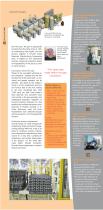
Continued from page 1 ECM Japan celebrates its first birthday A six-cell ICBP with gas quenching: 20% productivity increase in carburizing the ITP2 plant. The gain in productivity resulting from this factor alone is 10%, as estimated by Dave Kopka, tool and process engineer in Chrysler Group Advanced Manufacturing Engineering team. In addition to this productivity increase, enhanced component quality and repeatability of the process came as extra bonuses. Consistency within the load Thanks to the case-depth uniformity on the component – between the root and the pitch line of the pinion teeth...
Open the catalog to page 2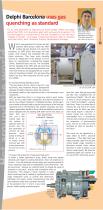
For its new generation of high-pressure diesel pumps, Delphi has equipped all the ICBPs in its Barcelona plant with gas quenching systems. The tier-one supplier is currently one of the rare companies to use two technologies in tandem – oil and gas. Prospective analysis, after an interview with Raul Perez, Heat Treatment Process Development Manager. Raul Perez, Heat Treatment Process Development Manager: "The main reason for this choice is the cost" ith its new generation of common rail highpressure diesel pumps, Delphi has taken another big step forward in its search for excellence. Its DFP3...
Open the catalog to page 3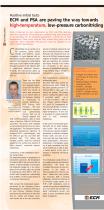
ECM and PSA are paving the way towards high-temperature, low-pressure carbonitriding Tests conducted on real components by ECM and PSA demonstrate the superiority of low-pressure carbonitriding over atmospheric technologies for all standard applications. Carried out at high temperature, these tests indicate that productivity gains can be expected. Once validated, the process could be adapted to all ECM's ICBP installations. With success: the metallurgical analysis, performed by the laboratory Etudes Métallurgiques et Traitement Thermique de Lyon (France), indicated nitrogen enrichment over a...
Open the catalog to page 4All ECM Technologies catalogs and technical brochures
 Vacuum furnace-CRISTAL
2 Pages
 ICBP ECO
2 Pages
 Carbonitriding lines
2 Pages
 NUCLEAR APPLICATIONS
2 Pages
 File Vacuum furnace
2 Pages
 Induction furnaces - VIM
2 Pages


- Kiln
- Chamber kiln
- Electric furnace
- Heat treatment kiln
- Laboratory kiln
- Combustion kiln
- Stainless steel kiln
- Gas kiln
- Tunnel kiln
- Industrial kiln
- Controlled atmosphere oven
- Vacuum oven
- High-temperature oven
- Automatic kiln
- Programmable oven
- Forced convection oven
- Annealing furnace
- Continuous oven
- Thermal kiln
- Horizontal kiln