
- Catalogs
- EBRO ARMATUREN Gebr. Bröer GmbH
- CYCLE LOCK SYSTEM SOLUTION


CYCLE LOCK SYSTEM SOLUTION

CYCLE LOCK SYSTEM SOLUTION
This document outlines the specifications and functionalities of the Cycle Lock System designed for handling bulk materials and powdered media. It includes an automation unit for venting and bleeding, suitable for various industrial applications.
- Nominal widths range from DN 50 to DN 600.
- Connection options include PN 6, 10, 16.
- Chamber volume is customizable.
- Temperature range: 0°C to +55°C.
- Maximum operating and differential pressure: 10 bar.
- Supply air requirement: 6 bar.
- Compatible with all EBRO valves, allowing for versatile applications.
- Integrates easily into existing control systems with conventional signal technology.
- Remote access available via Ethernet or optionally via WLAN.
- Features self-learning adaptation for process fluctuations and intelligent service management for preventative maintenance.
- Reports changes in valve activation times due to blockages or wear.
- Supports stand-alone operation and all standard field bus interfaces.
- Control unit is detachable and suitable for ATEX Zone 1/21.
- Dosing and discharging bulk goods.
- Pneumatic conveying technology.
- Power plant technology.
- Weighing technology.
- Bagging plants.
- Power supply: 230 V / 50Hz.
- Operation and visualization via a 4” touch panel.
- Protection class: IP 65.
- Temperature range for lock: -20°C to 70°C; for control: 0°C to 55°C.
- Utilizes a Phönix PLC with a touch panel for process operation and visualization.
- Main screen allows easy monitoring and mode selection.
- Manual operation and parameter adjustments available in the main menu.
- Process times can be flexibly adapted to specific requirements.
- Isolation valves with pneumatic rotary actuators and stop position monitoring.
- Filling pipe for interim storage, customizable in geometry and coating.
- Control unit with visualization via touch panel for dynamic applications.
- Optional filling level sensor for precise material volume control.
- Bypass valves for pressure compensation to reduce wear and prevent material blowout.
Catalog excerpts
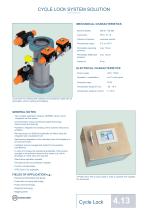
CYCLE LOCK SYSTEM SOLUTION MECHANICAL CHARACTERISTICS Nominal widths: customer specific Temperature range: Permissible operating pressure: Permissible differential pressure: ELECTRICAL CHARACTERISTICS Power supply: Operation / visualisation: Protection class: Temperature range for lock: Temperature range for control: Cycle locks for holding bulk materials and powdered media with an automation unit for venting and bleeding. GENERAL NOTES - Very variable application because all EBRO valves can be integrated into the system - Communication using conventional signal technology (binary inputs and outputs) - Possible to integrate into existing control systems without any problems - Remote access via Ethernet (optionally via Wlan) using the integrated web visualisation tool - Self-learning adaptation of the activation times to fluctuations in the process values - Intelligent service management system for preventative maintenance - In order to increase the operational availability of the system, changes in the activation times for the valves (e.g. due to blockages or valve wear) are reported - Stand-alone operation possible - All standard field bus interfaces available - Control unit detachable - ATEX Zone 1/21 applicable FIELDS OF APPLICATION e.g.: - Dosing and discharging bulk goods - Pneumatic conveying technology A Phönix PLC with a touch panel is used to operate and visualise the processes. - Power plant technology - Weighing technology - Bagging plants Cycle Lock
Open the catalog to page 1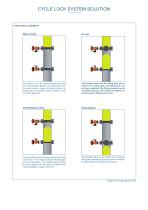
CYCLE LOCK SYSTEM SOLUTION FUNCTIONAL SCHEMATIC INITIAL STATE The medium is in the current process and shut off on the inlet side. Before every individual cycle, the output valve is opened for safety reasons to ensure that any possible residual media can fall out of the filling pipe. The medium falls into the filling pipe and is held on the output side. The filling time can be freely selected. The filling process can be cancelled based on the volume of material required using a filling level sensor. INTERMEDIATE STATE Once the filling level has been reached, the inlet valve closes. The medium...
Open the catalog to page 2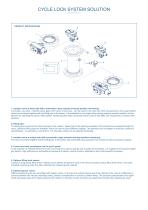
CYCLE LOCK SYSTEM SOLUTION PRODUCT SPECIFICATION 1. Isolation valve at input side with a pneumatic rotary actuator and stop position monitoring: In principle, any valve – butterfly valve, gate, pinch valve or ball valve – can be used for the cycle lock. Both components (in this case butterfly valves) are screwed together with the filling pipe in the factory. It is preferable to use single-acting (spring-reset) pneumatic actuators of type EB-SYS for operating the valves. Stop position monitoring takes place using limit switch boxes of type SBU with mechanical or inductive limit switches. 2. Filling...
Open the catalog to page 3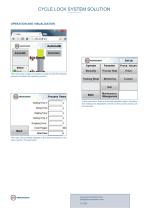
CYCLE LOCK SYSTEM SOLUTION OPERATION AND VISUALISATION The main screen makes it possible to easily monitor the ongoing process and select the operating modes. In the main menu, there is a manual operation option, all parameter settings are adjustable and the current process values can be observed. The cycle can be flexibly adapted to the relevant process in the menu section “Process times”.
Open the catalog to page 4All EBRO ARMATUREN Gebr. Bröer GmbH catalogs and technical brochures
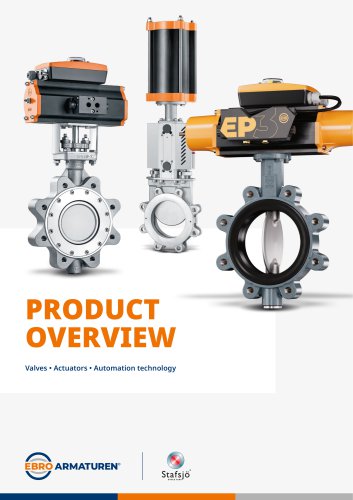 PRODUCT OVERVIEW
8 Pages
 WATER- AND WASTEWATER TECHNOLOGY
12 Pages
 PNEUMATIC ACTUATOR SC
4 Pages
 KNIFE GATE VALVE MV
9 Pages
 KNIFE GATE VALVE WB 11
8 Pages
 KNIFE GATE VALVE WB 12
7 Pages
 KNIFE GATE VALVE WB14
8 Pages
 KNIFE GATE VALVE XV
9 Pages
 DOUBLE CHECK VALVE DC
2 Pages
 SWITCH BOX SBU
3 Pages
 MANUAL OPERATION
2 Pages
 BUTTERFLY VALVE Q 011
4 Pages
 IMPELLER VALVE FS-M
2 Pages
 THROTTLE VALVE CK-M
2 Pages
 BUTTERFLY VALVE CK
2 Pages
 PLASTIC BUTTERFLY K 016
2 Pages
 CONTAINER VALVE BE 50/BE 80
2 Pages
 INFLATABLE SEAT INFLAS
4 Pages
 WAFER TYPE CHECK VALVE RSK
4 Pages
 PINCH VALVE QV
2 Pages
 F 012-DE
4 Pages
 HP 111-E
4 Pages
 K016
K0162 Pages
 CYCLE LOCK
4 Pages


- EBRO ARMATUREN manual valve
- Stainless valve
- EBRO ARMATUREN control valve
- Water valve
- EBRO ARMATUREN pneumatic valve
- Threaded valve
- Regulating valve
- EBRO ARMATUREN flange valve
- EBRO ARMATUREN shut-off valve
- Linear actuator
- Electric valve
- EBRO ARMATUREN lever valve
- Digital I/O
- Gas valve
- IO module
- EBRO ARMATUREN valve with handwheel
- EBRO ARMATUREN pneumatically-operated valve