
- Catalogs
- Eaton Commercial Controls
- Eaton E32 3-switch modules


Eaton E32 3-switch modules

Eaton E32 3-switch modules
The Eaton eSM hardware system includes a master module that connects to other ECUs via SAE J1939 CAN 2.0b and communicates with Eaton expansion modules using LIN 2.0. Each master can support up to seven expansion modules. Key features include a center indicator with up to four colors, long-life switches, easy address assignment, and immunity to power disturbances.
These modules feature two laser-etched icons and one indicator per switch, with icons having one backlight color and indicators up to four colors. Lighting is controlled by CANbus messages, with various flash modes available. Rocker circuits offer multiple configurations for different actions.
The master module has a black back cover, while the expansion module is gray. Both have connections for Vbat, COMMON, and LIN. The master module also includes CAN high and low connections and system awake output.
Normal mode activates all features, while sleep mode reduces power consumption. The system can wake from sleep via CAN message or switch press, with specific functions programmable to wake the system.
Each module has an address for identification on the data bus. Master modules have a CAN address, while expansion modules have a local address. Address assignment can be done via switch press or CAN message.
Faults during address assignment are indicated by flashing LEDs and require a correct cycle to clear. Common faults include timeouts, missing or too many modules, and configuration mismatches.
This feature allows a master to be swapped into a system and automatically configure expansion modules. It requires a system configuration request and response within 500 ms at power-up.
A single expansion module can be swapped into a system, and the master will automatically assign the correct address without a CANbus command. The module must have address FFh, and only one module can be swapped at a time. This feature is useful in service settings to replace a module without running a complete address assignment cycle.
The master module has a digital output configurable in two ways: active for four seconds when a wake-on-button press occurs or active when commanded by a CAN message.
The system includes a hardware watchdog that resets and reports faults if the code execution stops.
The master module features basic CAN diagnostics, storing and sending counts of CAN controller state changes upon request.
Each device contains manufacturing, part number, and revision information accessible via a CAN message request. This includes hardware and software part numbers, version numbers, manufacturing dates, and serial numbers.
The master reports system faults on the CANbus.
Eaton messages are J1939 CAN messages with a 29-bit header and 8 bytes of data. The header identifies the source and destination of the information. Messages follow the CAN 2.0b specification.
The data portion consists of a data descriptor and message data. The data descriptor identifies the type of data, allowing a single J1939 address to handle all message needs for a master and its expansion modules.
Messages are identified as hex, decimal, or binary. Diagnostic fault messages indicate which device is sending the fault, and system messages are used for various functions like entering sleep mode or requesting configuration.
Status messages report address assignment completion and request system configuration from the electronic control module.
These messages identify the types of expansion modules attached to the master.
This document provides technical specifications and operational guidelines for Eaton E32 3-switch modules, detailing module types, CAN communication protocols, switch press messages, wake system procedures, indicator lighting, icon LED control, and troubleshooting steps.
The document lists various module types including E32 rocker switch master and expansion, E31 keypad master and expansion, and E33 sealed rocker switch master and expansion. Each type is assigned a specific code for identification.
The document outlines the CAN address headers for receiving and broadcasting messages, specifying the data byte coding for master and expansion modules. It includes details on switch press messages and wake system procedures, with binary values indicating switch positions and wake commands.
Instructions are provided for controlling indicator and icon LEDs, including brightness levels and flash formats. The document specifies how these settings are retained or reset in different modes.
The document lists operational and storage temperature ranges, voltage requirements, protection degree, mechanical shock and vibration standards, and electrical/mechanical life expectancy. It also includes details on sleep current draw and load dump specifications.
Common issues and solutions are provided, such as addressing CAN message problems, expansion module flashing, and LED behavior. The document advises on setting module addresses and resolving configuration faults.
Catalog excerpts

Effective October 2012 Supersedes March 2011 Eaton E32 3-switch modules Description Contents Description 1 System description . . . . . . . . . . . . . . . . . . . . 2 2 Rocker switch modules . . . . . . . . . . . . . . . . . 2 2.1 Lighting . . . . . . . . . . . . . . . . . . . . . . . . 2 2.2 Rocker circuits . . . . . . . . . . . . . . . . . . . 2 2.3 Dimensions and cutout . . . . . . . . . . . . 3 2.4 Connections: Master . . . . . . . . . . . . . . 3 2.5 Connections: Expansion . . . . . . . . . . . 3 2.6 Connector . . . . . . . . . . . . . . . . . . . . . . 4 3 Modes of operation . . . . . . . . . . . . . . . . . . . . 4 3.1 Normal mode . . . . . . . . . . . . . . . . . . . . 4 3.2 Sleep mode . . . . . . . . . . . . . . . . . . . . . 4 3.3 Wake on CAN message. . . . . . . . . . . . 4 3.4 Wake on switch press . . . . . . . . . . . . . 4 4 Switch reporting . . . . . . . . . . . . . . . . . . . . . . 4 5 Module address . . . . . . . . . . . . . . . . . . . . . . . 4 5.1 Master address . . . . . . . . . . . . . . . . . . 4 5.2 Master addressing . . . . . . . . . . . . . . . . 4 5.3 Expansion module address . . . . . . . . . 4 5.4 Expansion switch press addressing . . . . . . . . . . . . . . . . . . . . 4 5.5 Address assignment faults . . . . . . . . . 5 5.6 Expansion address by CAN message . . . . . . . . . . . . . . . . . 5 5.7 Indicator module address assignment. . . . . . . . . . . . . . . . . . . . 5 5.8 Master service swap . . . . . . . . . . . . . . 5 5.9 Expansion service swap . . . . . . . . . . . 5 6 Master module digital output . . . . . . . . . . . 5 7 Watchdog . . . . . . . . . . . . . . . . . . . . . . . . . . . . 6 8 CAN controller diagnostics. . . . . . . . . . . . . . 6 9 Part number and revision information . . . . 6 10 System faults . . . . . . . . . . . . . . . . . . . . . . . . . 6 11 Message structure . . . . . . . . . . . . . . . . . . . . . 6 11.1 Messages sent to Eaton master . . . . . 6 11.2 Messages sent by Eaton master . . . . . 6 11.3 CAN 2.0b 29 bit header . . . . . . . . . . . . 7 11.4 Data portion of message . . . . . . . . . . . 7 12 EATON CAN messages . . . . . . . . . . . . . . . . . 8 12.1 Diagnostic fault messages . . . . . . . . . 8 12.2 System message . . . . . . . . . . . . . . . . . 8 12.3 Status message . . . . . . . . . . . . . . . . . . 9 12.4 Module types on master . . . . . . . . . . . 9 12.5 Switch press messages . . . . . . . . . . . . 9 12.6 Wake system on switch press . . . . . . 9 12.7 Indicator lighting . . . . . . . . . . . . . . . . 10 12.8 Icon LED control . . . . . . . . . . . . . . . . 10 12.9 Indicator and icon brightness level . . 11 12.10 Digital output control . . . . . . . . . . . . . 11 12.11 Special function messages . . . . . . . . 11 13 Environmental and electronic specifications . . . . . . . . . . . . . . . . . . . . . . 11 14 Troubleshooting . . . . . . . . . . . . . . . . . . . . . . 12
Open the catalog to page 1
System description The Eaton eSM hardware system is designed with a master module that connects to other ECUs via SAE J1939 CAN 2.0b. The master communicates with Eaton expansion modules using LIN 2.0. Each master can support up to seven expansion modules. Features Center indicator has up to four colors for status information Long life switches: 500,000+ cycles Easy address assignment All lighting is controlled by CANbus message. Off On Slow flash 1 Hz Fast flash 2 Hz Short flash 200 ms On/800 ms Off Long flash 800 ms On/200 ms Off Wake/Sleep flash 250 ms On/4000 ms Off Immune to SAE J1455 and...
Open the catalog to page 2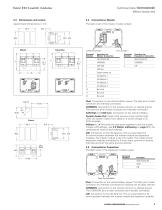
Technical Data TD07002002E Effective October 2012 Connections: Master The back cover of the master module is black. Expansion Terminal Number Function for Master Connector Terminal Number Function for Expansion Connector Vbat: Connection to the vehicle battery power. The Vbat pins of each connector are internally connected. COMMON: Connection to the vehicle common or chassis ground. The common pins of each connector are internally connected. CAN High and CAN Low: Connection to the vehicle CANbus. System Awake Out: Output that sources current (active high) when the system wakes from sleep on a...
Open the catalog to page 3
Tyco Part Number Housing, 3-pin Housing, 12-pin Cover, 12-pin Terminal 20 AWG Terminal 22 AWG Terminal 24–28 AWG Connector Eaton Part Number 1-1718346-1 1394048-1 2-1355524-3 5-963715-1 (Strip form) 963729-1 (Loose piece) 5-928999-1-1 (Strip) 963726-1 (Loose piece) 1355717-1 (Strip) 1355718-1 (Loose piece) Normal mode In normal mode all operational features of the product are active. Sleep mode The system has a power saving sleep mode. The modules are put into sleep mode by CAN message. Sleep mode reduces current draw on the battery. During sleep mode: Module address Each module has an address...
Open the catalog to page 4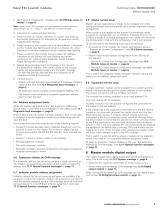
Technical Data TD07002002E Effective October 2012 3. Send second configuration message (see 12.4 Module types on master on page 9). Note: Above three CAN messages must be received in order and with a delay between 20 ms < delay < 1 sec (500 ms is recommended). 4. Indicators on master will start flashing. 5. Press a switch on master, indicators on master stop flashing and remain continuous On. Indicators on all expansion switch modules start flashing. 6. Press a switch on the module that is to have address 1. Indicators on this module stop flashing and remain continuous On, while Indicators on...
Open the catalog to page 5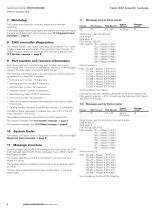
The master and expansion modules implement a hardware watchdog. Source Address Message Length If the code stops executing properly the system will reset and report the fault using diagnostic fault message (see 12.1 Diagnostic fault messages on page 8). The master module has a basic CAN diagnostics feature. The master module stores the counts of the CAN controller state changes. The master module sends the counts when it receives a request (see 12.2 System message on page 8). Part number and revision information Each device contains manufacturing, part number and revision information. This information...
Open the catalog to page 6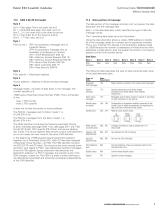
Technical Data TD07002002E Effective October 2012 Byte 0 bit 0 = Data page: This is not used, set to 0 bit 1 = Extended data page: Not used, set to 0 bits 2…3 = Low order bits of the three bit priority bit 4 = High order bit of the three bit priority bits 5…7 = Not used, set to 0 Byte 1 PDU format = (EFh) for proprietary messages sent to a specific device (FFh) for proprietary message sent as broadcast to all devices on network DFh—STOP BROADCAST (DM 13) D9h—Memory Access Request (DM 14) D8h—Memory Access Response DM(15) D7h—Binary Data Transfer (DM 16) D6h—Boot Load Data (DM 17) D4h—Data Security...
Open the catalog to page 7All Eaton Commercial Controls catalogs and technical brochures
 Toggle Switches
35 Pages
 Toggle switch accessories
4 Pages
 Rockers
104 Pages
 Low voltage busway
49 Pages
 Electronic Products
17 Pages
 Eaton E31 keypad modules
12 Pages
 Dimmers and Wipers
6 Pages
 Special Devices
10 Pages
 Pushbuttons
23 Pages


Archived catalogs
 eMobility
25 Pages
 eMobility
56 Pages
 Buildings solutions
8 Pages
 Toggle Switches
29 Pages
 Pushbutton Switches
13 Pages
 Switches - 3100-3200 Series
4 Pages
 Switches - 1600-2600 Series
6 Pages
 Switches - 1500-2500 Series
4 Pages


- Single-pole switch
- Push-button switch
- Technology switch
- Multipole switch
- Electromechanical switch
- Safety electric switch
- Rotary electric switch
- IP67 switch
- Plastic switch
- Bipolar switch
- Hermetic switch
- Technology push-button switch
- Electromechanical push-button switch
- Illuminated switch
- AC electric switch
- On/off switch
- Lever switch
- DC switch
- Heavy-duty switch