
- Catalogs
- EagleBurgmann
- QFT1000


QFT1000

QFT1000
Catalog excerpts

amemberof BCSl and FREUDENBERG RELY ON EXCELLENCE Advantages • Excellent value for money • Transparent polyethylene: fluid level is read off directly on the quench fluid tank • Resistant to a wide range of quench media • Quickly and easily installed • Combined filling and ventilation filter in the quench fluid tank for reliable operation Features Quench fluid supply systems are used to supply single or tandem mechanical seals. They act as a convenient fluid reservoir. The exchange of fluid takes place by the thermosiphon principle or by forced circulation, e.g. with a pumping screw. The QFT1000 is made of transparent polyethylene, complete with clips made of stainless steel. The QFT1000 is resistant to water, glycerine, glycols and methanol; not resistant to mineral oils and toluene. Supply of mechanical seal based on API 682 / ISO 21049, Plan 51. Notes Install the quench fluid tank approx. 1 ... 2 m (3.3 ... 6.6 ft) above the mechanical seal. Install connection pipes to the mechanical seal with low flow resistance. Pipes must vent automatically in the direction of the tank. It is imperative that air pockets are prevented. The minimum filling level must always be above the connection socket at the side (in the case of the thermosiphon principle). Quench fluid systems can be operated in two different modes. Recommended applications • Chemical industry • Food and beverage industry • Pharmaceutical industry Functional description Quench fluid systems are employed: • to absorb leakage • to monitor the leakage rate (e.g. through periodic reading of the level in the tank) • to lubricate and to cool the outboard mechanical seal in a tandem arrangement • to prevent icing • to protect against dry running • to stabilize the lubricating film • to exclude air from the media in order to prevent a reaction with oxygen in the air eagleburgmann.com [email protected] All technical specifications are based on extensive tests and our many years of experience. The diversity of possible applications, however, means that they can serve only as guide values. We must be notified of the exact conditions of application before we can provide any guarantee for a specific case. This is subject to change.
Open the catalog to page 1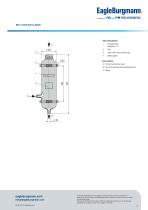
eagleburgmann.com [email protected] Item Description 1 Storage tank (capacity 4 l) 2 Clip 3 Inlet filter with vented cap 4 Name plate Connections A To the mechanical seal B From the mechanical seal (optional) C Filling All technical specifications are based on extensive tests and our many years of experience. The diversity of possible applications, however, means that they can serve only as guide values. We must be notified of the exact conditions of application before we can provide any guarantee for a specific case. This is subject to change.
Open the catalog to page 2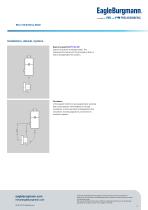
eagleburgmann.com [email protected] Dead-end quench (API Plan 51): Quench fluid from an elevated tank. The characteristic feature of this principle is that no heat is dissipated by the system. Circulation of the quench fluid from an elevated tank; external tank, pressureless; thermosiphon or forced circulation. In this case heat is dissipated by the circulation. Cooling capacity by convection is minimal, however. All technical specifications are based on extensive tests and our many years of experience. The diversity of possible applications, however, means that they can serve only as guide...
Open the catalog to page 3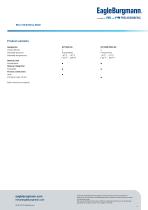
Product variants Designation Volume (liters) Allowable pressure Allowable temperature Material, tank Polyethylene Material, filling filter Polyamide Process connections Hose Fitting for tube, 10 mm Other Versions on request. eagleburgmann.com [email protected] All technical specifications are based on extensive tests and our many years of experience. The diversity of possible applications, however, means that they can serve only as guide values. We must be notified of the exact conditions of application before we can provide any guarantee for a specific case. This is subject to change.
Open the catalog to page 4All EagleBurgmann catalogs and technical brochures
 Acouseal expansion joint
3 Pages
 APItex-S
3 Pages
 LMF1
LMF13 Pages
 Gasket cutter 9614
1 Page
 Statotherm 1P 9593/1P
1 Page
 Elastic Tankpak 6756
1 Page
 Burachem Blue 9655/B
1 Page
 Burasil Basic 9544/B
1 Page
 BuraGlas 9480
1 Page
 BuraTAL HT 9650/HT
1 Page
 BuraTAL-Flex 6070
1 Page
 Espey Magna500+
2 Pages
 Araflon 6426
2 Pages
 SPN
SPN2 Pages
 SP23 Pressure gauge
2 Pages
 MAA Magnetic separator
3 Pages
 eSPU6 Circulation pump
2 Pages
 WDK
WDK2 Pages
 DHE Pressure accumulator
2 Pages
 TS1000
5 Pages
 DRU2000
4 Pages
 Type 4600
4 Pages
 AD510 / AD520
3 Pages
 AX05
AX053 Pages


