
- Catalogs
- Eagle Eye Power Solutions
- IBEX-Procedures for Testing


IBEX-Procedures for Testing

IBEX-Procedures for Testing
The document outlines procedures for testing and saving data using the IBEX system, emphasizing the use of Exmons battery management software to optimize the process. It highlights the importance of using a laptop for tests exceeding the IBEX's storage capacity.
Before using the IBEX, configure battery banks in the Exmons software. This setup allows the IBEX to act as a data transfer tool, minimizing the need for it to store detailed battery information. Users should set up the Root Group, Sites, and Banks in the Data Repository and enter necessary bank and alarm information.
While bank and alarm information can be managed in the software, saving this data on the IBEX can prevent errors and confusion. Configure the IBEX memory for the correct number of cells per bank and optionally set alarm and bank information using Exmons software.
With the IBEX configured, select a bank and begin measurements. Ensure the bank name corresponds with the software's bank setup. Verify the measurement data before leaving the test site.
Transfer test data from the IBEX to Exmons by dragging data from IBEX banks to the software's Data Repository. The established folder structure facilitates future data transfers.
The process involves four main steps: setting up the software, setting up the IBEX, taking measurements, and saving data to the software. Steps one and two are initial setups, while steps three and four are repeated for each test.
Catalog excerpts

IBEX-Series Procedures for Testing Overview The following procedures will help minimize the time needed to test and save data using the IBEX. The most complete method starts and ends with the Exmons battery management software. While testing it is possible that the memory on the IBEX will become full and the test data will need to be saved in the software before continuing. With the availability of laptop computers, it is recommended that a computer be brought along testing for trips which require more tests than the IBEX can store. Step 1 – Setting up Battery Banks in the Software Before using the IBEX you can setup all of the battery banks you plan on testing in the software. With this method, the IBEX is simply used as a tool to move battery data from the batteries into the software. Having the software configured on the frontend allows for greater testing flexibility by allowing the IBEX to store as little information about the batteries as necessary. Although it is up to the user, the IBEX can be left entirely generic, as long as the bank size matches that being tested (see step 2). All of the bank information and alarm values can defined in the software. This step is especially useful if testing more banks than the memory of the IBEX can store. In Exmons: 1. Folder structure: Setup the Root Group, Sites, and Banks in the Data Repository. See page 4 in the Exmons manual. 2. Bank & Alarm info: Enter necessary Bank and Alarm Information, if you do not know the alarm settings they can always be modified later. See page 5 in the Exmons manual. At this point the software is setup to receive measurement data from the IBEX.
Open the catalog to page 1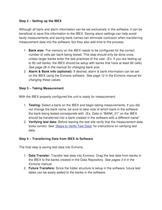
Step 2 – Setting up the IBEX Although all bank and alarm information can be set exclusively in the software, it can be beneficial to save this information to the IBEX. Saving alarm settings can help avoid faulty measurements and saving bank names can eliminate confusion when transferring measurement data into the software, but they also add time to the process. 1. Bank size: The memory on the IBEX needs to be configured for the correct number of cells per bank being tested. This step should only be done once, unless larger banks enter the test practices of the user. (Ex. If you are testing up...
Open the catalog to page 2
Review In review, there are four steps to using the IBEX efficiently 1. 2. 3. 4. Setting up the software Setting up the IBEX Taking measurement Saving data to the software If the workload for the IBEX is fixed, step one and two only need to be done once, from there step 3 and 4 are repeated every time tests are needed to be made.
Open the catalog to page 3All Eagle Eye Power Solutions catalogs and technical brochures
 NERC PRC-005-02
2 Pages
 DCPS-Shelf-6KW
2 Pages
 DCPS-Shelf-9KW
1 Page
 SC-1000
2 Pages
 SC-1500
2 Pages
 SC-2000
2 Pages
 RM-48-2K
2 Pages
 RM-48-3K
2 Pages
 RM-48-KA
1 Page
 MIS-1000
3 Pages
 MIS-2000-series
3 Pages
 MIS-3000-series
3 Pages
 MIS-4000-series
3 Pages
 MIS-5000-series
3 Pages
 SIS-1000-series
2 Pages
 ENC-1000 Enclosure
1 Page
 ENC-2000
1 Page
 BMS-Series Catalog
19 Pages
 LB-AC-Digital
1 Page
 LB-60-30 AC Load Bank
1 Page
 BTM-Series
1 Page
 VM-100 Voltage Monitor
1 Page
 VGM-100 Voltage Monitor
1 Page
 Eagle Eye 2017 Product Catalog
51 Pages
 Eagle Eye Motive Power Catalog
12 Pages
 SLB-Series DC Load Banks
3 Pages
 LB-Series AC Load Banks
1 Page
 LB-60-100 AC Load Bank
1 Page
 BQMS
BQMS2 Pages


Archived catalogs
 SG-Ultra Max
1 Page
 SG-1000
1 Page
 SG-100M
1 Page
 AT10.1 - AT30
1 Page
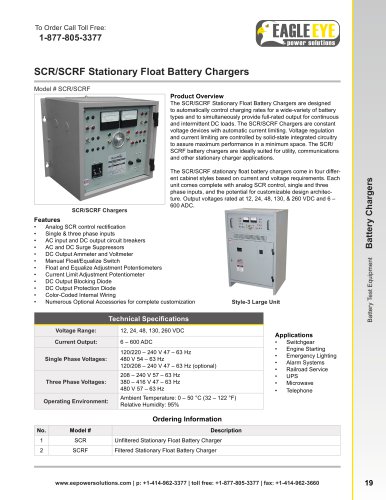 SCR-SCRF
1 Page
 LB-1000
1 Page
 DC Load Bank
3 Pages
 Eagle Eye SG-5000BT
2 Pages
 HGD-3000
1 Page
 SG-5000BT Product Brochure
6 Pages
 DC SLB-Series
3 Pages


- Power supply unit
- DC power supply
- AC/DC power supply
- Data logger
- Gas detector
- Battery charger
- USB datalogger
- Data-logger with screen
- Voltage testing system
- Lead battery
- Regulated power supply
- Lead battery charger
- Programmable datalogger
- Resistance tester
- Automatic battery charger
- Temperature monitoring module
- Lead-acid battery charger
- Mobile battery charger
- Battery testing system
- Hydrometer