
- Catalogs
- e2v scientific instruments
- EV12AS350A

EV12AS350A

EV12AS350A
- The ADC features a 12-bit resolution with a 5.4 Gsps conversion rate using four interleaved cores.
- It requires a single 5.4 GHz differential symmetrical input clock and supports a 1000 mVpp analog input, which can be AC or DC coupled.
- Two conversion modes are available: interleaved cores with staggered output and simultaneous sampling with aligned outputs.
- It uses an LVDS output format and a digital interface with SPI for various configurations.
- Power supplies include 4.8V, 3.3V, and 1.8V, with a power dissipation of 6.7 W, housed in an EBGA380 package measuring 31x31mm.
- The analog input bandwidth is 4.8 GHz, with a latency of 26 clock cycles.
- Single tone dynamic performance varies with frequency and input power, with ENOB ranging from 7.0 to 9.0 bits.
- Dual tone dynamic performance with IMD up to 72 dBFS and NPR performance with a notch frequency of 1300 MHz and NPR of 48 dB.
- Suitable for high-speed data acquisition, direct RF down conversion, ultra-wideband satellite digital receivers, and more.
- Includes ADX4 IP-core for time-interleaved ADC mismatch error correction, improving SFDR beyond 70 dBFS, available for evaluation on the EV12AS350-ADX4-EVM evaluation board.
- Details absolute maximum ratings, recommended conditions of use, and electrical characteristics.
- The ADC consists of four interleaved 12-bit cores clocked by a 5.4 GHz external input clock, with an internal clock circuit dividing the external clock to generate sampling clocks for each core.
- Calibration settings are pre-programmed and adjustable via SPI for optimal performance, with SPI providing digital control for various ADC functions and test modes.
The document outlines the specifications and timing characteristics of the EV12AS350A ADC by Teledyne e2v, emphasizing recalibration of offset, gain, and phase adjustments to maintain performance over the ADC's lifetime.
Timing and Switching Characteristics
Typical values are provided for specific supply voltages and conditions, detailing aperture delay, jitter, and output rise and fall times.
Tables and Figures
Includes tables with detailed timing characteristics, SPI timing characteristics, and digital output coding, along with figures illustrating timing diagrams for different operational modes.
Digital Output Coding
The ADC digital output coding table describes the binary output for various differential analog input voltage levels.
Definitions and Terms
Includes a glossary of terms related to ADC performance metrics, providing clarity on performance parameters and their significance.
Specifications Outlines various delay parameters and explains the Voltage Standing Wave Ratio (VSWR) as a measure of input reflection loss.
Pin Description Includes a detailed pinout view and table, describing the function and direction of each pin.
Theory of Operation Provides an overview of the device's functional description, detailing power supplies, input and output signals, and synchronization signals.
Key Points Highlights the device's operation with multiple power supplies, differential analog input and output data channels, and the importance of the SPI interface for device configuration and data communication.
Details configurations via OTP or SPI registers, including ADC synchronization, core ADCs calibration, interleaving calibration, and various modes.
Reset and Startup Procedure
Describes the reset procedure and startup sequence, including synchronization of data-ready signals.
ADC Synchronization
Achieved through the SYNC signal, with specific timing requirements.
Data Ready Reset Length Programming
Emphasizes the importance of precise timing in programming the reset length.
ADC Calibration
Describes core ADCs INL calibration and interleaving calibrations for different temperature ranges.
Calibration Registers
Provides detailed descriptions of various calibration registers and procedures for adjusting them.
Outlines procedures for modifying the CM_IN value via the Master SPI register and describes various registers.
Test Modes
Describes Flash and Ramp test modes for debugging and testability.
PRBS Mode
Details the Pseudo Random Bit Sequence mode for test mode or data scrambling.
Chip Identification and CRC Status
Describes the CHIP_ID register and CRC status checks.
OTP Status
Indicates OTP cell readiness.
Parity and In Range Bits
Describes parity bit calculation and In Range bit function.
Temperature Monitoring
Provides a diode system for monitoring junction temperature.
Characterization Results
Includes performance metrics such as INL performance, ADC output bandwidth, and FFT performance.
Temperature Interpolation Impact Evaluates the impact on FFT performance metrics.
IMD3 Performance Measures Intermodulation Distortion at 5.4Gsps.
VSWR Measurement Measures Voltage Standing Wave Ratio.
FFT Performance with ADX4 IP Compares ADC output spectrum with and without ADX4 IP.
Application Information Provides recommendations for bypassing, decoupling, and grounding.
Power-up Sequencing Outlines proper power-up sequencing.
Analog and Clock Inputs Provides implementation details for differential analog and clock inputs.
Digital Outputs Describes LVDS compatible digital outputs.
Synchronization Procedures Details procedures for synchronization with FPGA and multi-ADC applications.
Package Information Details thermal and moisture characteristics.
Ordering Information Provides component ordering details.
Catalog excerpts

12-bit 5.4Gsps Analog to Digital Converter ■ Dual tone dynamic performance: Applications ■ High Speed Data Acquisition ■ Direct RF Down conversion ■ Ultra Wideband Satellite Digital Receiver ■ 16 Gbps pt-pt microwave receivers ■ High energy Physics ■ Automatic Test Equipment ■ High Speed Test Instrumentation ■ LiDAR (Light Detection And Ranging) ■ Software Design Radio Performance improvement IP ADX4 is an IP-core for time-interleaved ADC mismatch error correction. In time-interleaved operating mode, ADX4 increases SFDR by wideband suppression of time-interleaving aliasing spurs due to ADC mismatch beyond 70 dBFS. ADX4 is available for evaluation on EV12AS350-ADX4-EVM evaluation board and can be licensed for production use. It is available for implementation on a wide range of FPGAs and with standard-cell design for ASICs. ADX4 IP can be activated on all parts having the ADX4 suffix in their part number. In addition, another IP designed specifically to improve the coding error rate of EV12AS350 is also available. The EV12AS350-ADX4-EVM evaluation module pre-loaded with these IP-cores is available for fast performance evaluation. Figure 1. ADX4 IP-core used with EV12AS350A Whilst Teledyne e2v Semiconductors SAS has taken care to ensure the accuracy of the information contained herein it accepts no responsibility for the consequences of any use thereof and also reserves the right to change the specification of goods without notice. Teledyne e2v Semiconductors SAS accepts no liability beyond the set out in its standard conditions of sale in respect of infringement of third party patents arising from the use of the devices in accordance with information contained herein. Teledyne e2v Semiconductors SAS, avenue de Rochepleine 38120 Saint-Egreve, France Holding Company: Teledyne e2v Semiconductors SAS Telephone: +33 (0)4 76 58 30 00 Contact Teledyne e2v by e-mail: [email protected] or visit www.teledvne-e2v.com for global sales and operations centers. 1 1160I- April 2018 Teledyne e2v Semiconductors SAS 2018 Teledyne e2v reserves the right to change or modify specifications and features
Open the catalog to page 1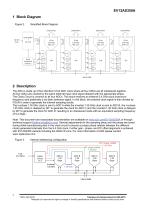
EV12AS350A 1 Block Diagram Figure 2. Simplified Block Diagram 2 Description The ADC is made up of four identical 12-bit ADC cores where all four ADCs are all interleaved together. All four ADCs are clocked by the same external input clock signal delayed with the appropriate phase. The Clock Circuit is common to all four ADCs. This block receives an external 5.4 GHz clock (maximum frequency) and preferably a low jitter sinewave signal. In this block, the external clock signal is then divided by FOUR in order to generate the internal sampling clocks: The in-phase 1.35 GHz clock is sent to ADC A...
Open the catalog to page 2
Notes: 1. For simplification purpose of the timer circuit, the temporary order of ports for sampling is A C B D, therefore sampling order at output port is as follows: A: N N + 4, N + 8, . . The T/H (Track and Hold) is located after the internal 100 ohms impedance and before the ADC cores. This block is used to track the data when the internal sampling clock is low and to hold the data when the internal sampling clock is high. The ADC cores are identical for the four ADCs and each can be powered ON or DOWN individually. Each one includes a quantifier block as well as a fast logic block...
Open the catalog to page 3
Notes: TJ refers to the junction temperature at the hot spot (refer to Figure 28 for diode temperature measurement). 1160I- April 2018 Teledyne e2v Semiconductors SAS 2018 Teledyne e2v reserves the right to change or modify specifications and features without notice at any time
Open the catalog to page 4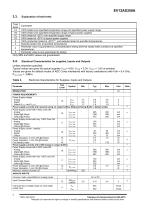
1160I- April 2018 Teledyne e2v Semiconductors SAS 2018 Teledyne e2v reserves the right to change or modify specifications and features without notice at any time
Open the catalog to page 5
1. Maximum currents are obtained with maximum supplies and maximum temperature 2. Maximum number of power-up is limited by the maximum number of OTP reading. 3. The DC analog common mode voltage is provided by ADC. CMIRef can be adjusted thanks to SPI. 1160I- April 2018 Teledyne e2v Semiconductors SAS 2018 Teledyne e2v reserves the right to change or modify specifications and features without notice at any time
Open the catalog to page 6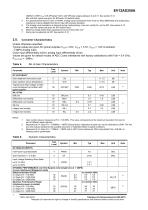
CMIRef= 0.656*VccA+(16-SPIcode)*12mV with SPIcode ranging between 0 and 31. See section 5.14 Min and Max values are given for SPIcode=16 (default value) 4. For optimal performance in term of VSWR, analog input transmission lines must be 100Q differential and analog input resistance must be digitally trimmed to cope with process deviation. 5. The Analog input impedance is trimmed during manfucaturing. User can modify RIN via the SPI. See section 5.13. Min and Max values are given for SPI default value. 6. Maximum single ended load capacitance has to be less than 5 pF 7. Swing can be adjusted via...
Open the catalog to page 7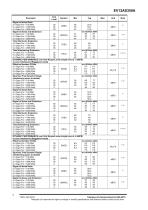
1160I- April 2018 Teledyne e2v Semiconductors SAS 2018 Teledyne e2v reserves the right to change or modify specifications and features without notice at any time
Open the catalog to page 8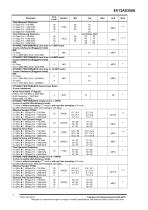
1160I- April 2018 Teledyne e2v Semiconductors SAS 2018 Teledyne e2v reserves the right to change or modify specifications and features without notice at any time
Open the catalog to page 9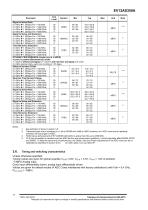
1. See definition of terms in section 3.8. 2. Theoretical gain due to averaging is +1 bit on ENOB and +6dB on SNR. However, as 4 ADC cores are not perfectly matched, the actual gain is lower. 3. Performance enhancement of EV12AS350 with ADX4 is active from DC up to 2300 MHz. 4. TILD may be subject to variation over the ADC life time and environment conditions. It could potentially affect ENOB, SFDR and SInAd. To keep the same level of performance, the Offset, Gain and Phase adjustments of the ADC cores can be recalibrated as described in section 5.8.5. An other option is to use ADX4 IP. 3.6....
Open the catalog to page 10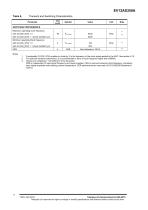
Table 6. Transient and Switching Characteristics 1. Functionality CLOCK_DIV2 enables to divide by 2 in the frequency of the clock signal applied to the ADC. See section 5.10. 2. For optimum dynamic performance, it is recommended to have a clock frequency higher than 500MHz 3. Output error amplitude > 128 LSB (3% of the full-scale). CeR is independent of input signal frequency and power supplies. CER is improved reducing clock frequency, increasing input signal amplitude and reducing junction temperature. CER performance are improved on EV12AS350B (Addendum 1201A). 1160I- April 2018 Teledyne...
Open the catalog to page 11All E2v scientific instruments catalogs and technical brochures
 Emerald 8M/12M/16M
2 Pages
 Snappy 2M
2 Pages
 EV12AD550B
49 Pages
 EV12AD550
49 Pages
 EV12AD500A
48 Pages
 EV12AQ600
57 Pages
 VEGA™ - CIS113
28 Pages
 DiViiNA® LM1
8 Pages
 ELiiXA+ 16k mono and colour
2 Pages
 CCTWTs N10503
4 Pages
 ELiiXA® 4S
2 Pages
 ELiiXA+ 8k/4k pixels
2 Pages
 AT84AD001B Dual 8-bit 1 Gsps ADC
68 Pages
 Compact modulator
2 Pages
 MP-7217 & VQ548MP
4 Pages
 High-power pulsed thyratrons
2 Pages
 Imaging brochure
11 Pages
 AViiVA® UM8
2 Pages
 AViiVA® UM4
2 Pages
 AViiVA® UM2
2 Pages
 AViiVA® UC2
2 Pages
 AViiVA® SM2
2 Pages
 AViiVA® SC2
2 Pages
 AViiVA® EM4
2 Pages
 AViiVA® EM2
2 Pages
 AViiVA® EM1
2 Pages
 StellarMini?
4 Pages
 ELiiXA® UC4/UC8
2 Pages
 ELiiXA® 3V
2 Pages
 DiViiNA® LM2
2 Pages
 EV76C454
2 Pages
 Inductive output tubes
2 Pages


- Visible imager
- CMOS camera module
- Full-color camera system
- Monochrome camera module
- Image processing camera module
- GigE Vision camera
- Compact imager
- HD camera module
- Signal amplifying integrated circuit
- Generator
- Transceiver module
- High-speed camera module
- CCD video camera
- High-performance imager
- Smart camera
- Spark optical emission camera module
- Machine vision video camera
- High-sensitivity video camera
- Processor
- Camera Link video camera