
- Catalogs
- e2v scientific instruments
- AT84AD001B Dual 8-bit 1 Gsps ADC

AT84AD001B Dual 8-bit 1 Gsps ADC

AT84AD001B Dual 8-bit 1 Gsps ADC
- Dual 8-bit ADC with a sampling rate of 1 Gsps per channel, extendable to 2 Gsps in interleaved mode.
- Output options include single or 1:2 demultiplexed LVDS format.
- Compatible with differential or single-ended 50Ω PECL/LVDS clock inputs.
- Operates on a 3.3V power supply for both analog and digital, with a 2.25V output supply.
- Available in LQFP144 or LQFP-ep 144L green packages.
- Temperature ranges: 0°C to 70°C (commercial) and -40°C to 85°C (industrial).
- Includes a 3-wire serial interface for various controls and adjustments.
- Low power consumption of 0.7W per channel, with 120 mW in standby mode.
- 1.5 GHz full power input bandwidth.
- Signal-to-noise ratio (SNR) of 42 dB, total harmonic distortion (THD) of -51 dBc, and spurious-free dynamic range (SFDR) of -54 dBc at 1 Gsps.
- Low bit error rate of 10-13 at 1 Gsps.
- Suitable for digital oscilloscopes, communication receivers, direct RF down conversion, high-speed data acquisition, and radar/ECM.
The AT84AD001B is a dual 8-bit ADC designed for high-speed applications, featuring low power consumption and high digitizing accuracy. It includes dual on-chip track/holds and a demultiplexer, facilitating easy integration into dual-channel applications. The 3-wire serial interface reduces the need for external components, enhancing system flexibility.
Functional DescriptionThe ADC is based on high-speed BiCMOS technology, featuring a front-end analog multiplexer, sample and hold, and an 8-bit flash-like architecture. It includes a switchable demultiplexer and LVDS output buffers. The device supports various adjustments via a 3-wire serial interface, including gain control, clock selection, and calibration functions.
Typical Applications- Satellite receivers and dual-channel digital oscilloscopes are highlighted as typical applications, showcasing the ADC's versatility in handling high-frequency signals.
- Operates with a 3.3V analog and digital supply, and a 2.25V output supply.
- Full-scale differential input voltage is 500 mVpp.
- Features include a 1.5 GHz full power input bandwidth and a gain flatness of 500 MHz.
- Signal-to-noise ratio and effective number of bits are maintained across various frequencies, with specific values provided for different conditions.
- Interleaved mode supports a maximum equivalent clock frequency of 2 Gsps.
- Maximum operating clock frequency is 1 Gsps, with specific timing characteristics detailed for various modes.
This document provides technical specifications and performance data for the AT84AD001B, a semiconductor device by e2v semiconductors SAS. It includes dynamic performance metrics, control features, and calibration procedures.
2. Dynamic Performance
- ENOB (Effective Number of Bits): Varies with input frequency, showing a range from 5.0 to 8.0 bits as frequency increases from 0 to 1000 MHz.
- SFDR (Spurious-Free Dynamic Range): Decreases from -35 dBc to -65 dBc with increasing input frequency.
- THD (Total Harmonic Distortion): Also decreases with frequency, indicating higher distortion at lower frequencies.
- SNR (Signal-to-Noise Ratio): Ranges from 30 to 50 dBc, improving with higher input frequencies.
3. Reconstructed Signals and Spectrum
Figures illustrate signal reconstruction at various frequencies and modes, highlighting the impact of interleaving and demultiplexing on signal quality.
4. Performance Sensitivity
Performance metrics such as ENOB, SFDR, THD, and SNR are sensitive to power supply variations and ambient temperature changes. Optimal performance is achieved with specific voltage settings and temperature ranges.
5. Test and Control Features
- 3-wire Serial Interface: Allows control of various settings including gain, offset, and mode selection. The interface supports a maximum clock frequency of 50 MHz.
- Calibration: Internal digital calibration reduces offset and gain mismatches between ADC cores. Calibration is initiated via the 3-wire interface.
- Built-In Test (BIT): Provides a mechanism for testing device I/O through static or dynamic patterns.
6. Interface Timing
The 3-wire serial interface requires precise timing for data entry, with specific clock cycles dedicated to address and data input.
7. Recommendations
For optimal performance, it is recommended to set the Internal Settling Adjustment (ISA) to -50 ps and utilize the decimation mode to manage output bit rates effectively.
The document outlines the timing calibration process for the AT84AD001B ADC. It specifies that offset calibration duration is halved and no gain calibration is needed between channels. Key timing parameters are provided in Table 10-4, detailing setup and hold times for various signals.
Calibration Settings
The calibration phase is crucial for interleaved mode operation, where the ADC samples an analog input at both cores. Calibration settings vary based on clock rates, with specific configurations for high, medium, and low clock rates.
Gain and Offset Compensation
Users can manually access gain and offset compensation functions to adjust channel I and Q. This requires setting the ADC to manual mode.
Built-In Test (BIT)
The BIT function allows testing of the ADC's I/O by applying static patterns or generating dynamic ramps. It is controlled via a 3-wire bus interface.
Decimation Mode
This mode enables rapid ADC testing at a maximum clock frequency of 750 Msps, outputting one data out of 16.
Die Junction Temperature Monitoring
A setup for monitoring die junction temperature is included, using a 1 mA current through a diode-mounted transistor.
Equivalent Input/Output Schematics
Figures illustrate simplified models for input clock, data ready reset buffer, analog input, and data output buffer.
Definitions of Terms
Table 12-1 provides definitions for various technical terms related to ADC performance, such as BER, DNL, ENOB, and more.
Using the AT84AD001B Dual 8-bit 1 Gsps ADC
The document provides guidelines for decoupling, bypassing, and grounding power supplies, as well as implementing analog inputs and clocks. It includes figures for termination methods in both DC and AC coupling modes.
Reset Implementation
Details on implementing DDRB with a pull-up resistor to maintain signal inactivity in normal mode are provided.
Catalog excerpts

Dual ADC with 8-bit Resolution 1 Gsps Sampling Rate per Channel, 2 Gsps in Interleaved Mode Single or 1:2 Demultiplexed Output LVDS Output Format (100Ω) 500 mVpp Analog Input (Differential Only) Differential or Single-ended 50Ω PECL/LVDS Compatible Clock Inputs Power Supply: 3.3V (Analog), 3.3V (Digital), 2.25V (Output) LQFP144 or LQFP-ep 144L Green Packages Temperature Range: – 0°C < Tamb < 70° C (Commercial Grade) – –40°C < Tamb < 85° C (Industrial Grade) • 3-wire Serial Interface – 16-bit Data, 3-bit Address – 1:2 or 1:1 Output Demultiplexer Ratio Selection – Full or Partial Standby Mode – Analog Gain (± 1.5 dB) Digital Control – Input Clock Selection – Analog Input Switch Selection – Binary or Gray Logical Outputs – Synchronous Data Ready Reset – Data Ready Delay Adjustable on Both Channels – Interleaving Functions: • Offset and Gain (Channel to Channel) Calibration • Digital Fine SDA (Fine Sampling Delay Adjust) on One Channel – Internal Static or Dynamic Built-In Test (BIT) Low Power Consumption: 0.7W Per Channel Power Consumption in Standby Mode: 120 mW 1.5 GHz Full Power Input Bandwidth (–3 dB) SNR = 42 dB Typ (6.8 ENOB), THD = –51 dBc, SFDR = –54 dBc at Fs = 1 Gsps Fin = 500 MHz • 2-tone IMD3: –54 dBc (499 MHz, 501 MHz) at 1 Gsps • DNL = 0.25 LSB, INL = 0.5 LSB • Low Bit Error Rate (10–13) at 1 Gsps Visit our website: www.e2v.com for the latest version of the datasheet e2v semiconductors SAS 2009
Open the catalog to page 1
Digital Oscilloscopes Communication Receivers (I/Q) Direct RF Down Conversion High Speed Data Acquisition Radar/ECM 4. Description The AT84AD001B is a monolithic dual 8-bit analog-to-digital converter, offering low 1.4W power consumption and excellent digitizing accuracy. It integrates dual on-chip track/holds that provide an enhanced dynamic performance with a sampling rate of up to 1 Gsps and an input frequency bandwidth of over 1.5 GHz. The dual concept, the integrated demultiplexer and the easy interleaving mode make this device user-friendly for all dual channel applications, such as direct...
Open the catalog to page 2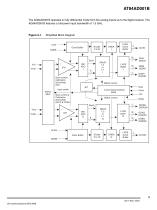
AT84AD001B The AD84AD001B operates in fully differential mode from the analog inputs up to the digital outputs. The AD84AD001B features a full-power input bandwidth of 1.5 GHz. Simplified Block Diagram Clock Buffer DDRB LVDS Clock Buffer Gain control I Calibration Gain/offset ISA I DOAI DOAIN DOBI DOBIN DMUX control Data BIT Input switch INPUT MUX Gain control Q Calibration Gain/offset ISA Q & FiSDA + S/H DMUX control DoirQ Vinq DOIRI DOIRIN DOIRQ DOIRQN DOAQ DOAQN DOBQ DOBQN CLKQ Clock Buffer DDRB LVDS Clock Buffer
Open the catalog to page 3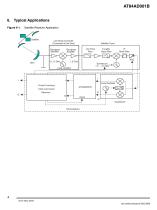
AT84AD001B 6. Typical Applications Figure 6-1. Satellite Receiver Application Low Noise Converter (Connected to the Dish) Bandpass Amplifier Satellite Tuner Low Pass Filter Bandpass Amplifier Tunable Band Filter Local oscillator Local Oscillator Control Functions: Clock Q Quadrature Demodulation
Open the catalog to page 4
Dual Channel Digital Oscilloscope Application Analog switch Channel Mode Selection Clock selection Timing circuit DACs Smart dual ADC DACs Absolute Maximum Ratings Analog positive supply voltage Digital positive supply voltage Output supply voltage Analog input voltage VINI or VINIB VINQ or VINQB Digital input voltage Clock input voltage Maximum difference between VCLK and VCLKB VCLK – VCLKB Maximum junction temperature Storage temperature Maximum difference between VCCA and VCCD Minimum VCCO Lead temperature (soldering 10s) Note: Absolute maximum ratings are limiting values (referenced to GND...
Open the catalog to page 5
Recommended Value Analog supply voltage Digital supply voltage Output supply voltage VINi – VIniB or VINQ – VINQB Differential analog input voltage (full-scale) Differential clock input level Internal Settling Adjustment (ISA) with a 3-wire serial interface for channel I and channel Q Operating temperature range Commercial grade Industrial grade 7. Electrical Operating Characteristics Unless otherwise specified: • VCCA = 3.3V; VCCD = 3.3V; VCCO = 2.25V • VINI – VINB or VINQ – VINQB = 500 mVpp full-scale differential input • LVDS digital outputs (100Ω) • Tamb (typical) = 25° C • Full temperature...
Open the catalog to page 6
Electrical Operating Characteristics in Nominal Conditions (Continued) ICCA ICCD ICCO Supply current (1 channel only, 1:2 DMUX mode) - Analog - Digital - Output ICCA ICCD ICCO Supply current (full standby mode) - Analog - Digital - Output ICCA ICCD ICCO Nominal dissipation (1 clock, 1:1 DMUX mode, 2 channels) Nominal dissipation (full standby mode) Supply current (1 channel only, 1:1 DMUX mode) - Analog - Digital - Output Analog Inputs Full-scale differential analog input voltage to obtain full scale with no gain adjust (mode 0) VINi – VIniB or – VINQB VINQ Analog input common mode Analog input...
Open the catalog to page 7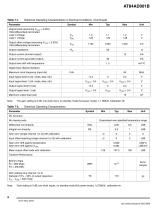
Electrical Operating Characteristics in Nominal Conditions (Continued) Output levels (assuming VCCO = 2.25V) 100Ω differentially terminated Logic 0 voltage Logic 1 voltage Output offset voltage (assuming VCCO = 2.25V) 100Ω differentially terminated Output impedance Output current (shorted output) Output current (grounded output) Output level drift with temperature Digital Input (Serial Interface) Maximum clock frequency (input clk) Input logical level 0 (clk, mode, data, ldn) Input logical level 1 (clk, mode, data, ldn) Output logical level 0 (cal) Output logical level 1 (cal) Maximum output...
Open the catalog to page 8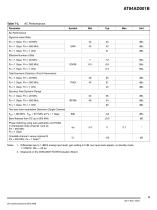
AC Performance Signal-to-noise Ratio Fs = 1 Gsps Fin = 20 MHz Fs = 1 Gsps Fin = 500 MHz Fs = 1 Gsps Fin = 1 GHz Effective Number of Bits Fs = 1 Gsps Fin = 20 MHz Fs = 1 Gsps Fin = 500 MHz Fs = 1 Gsps Fin = 1 GHz Total Harmonic Distortion (First 9 Harmonics) Fs = 1 Gsps Fin = 20 MHz Fs = 1 Gsps Fin = 500 MHz Fs = 1 Gsps Fin = 1 GHz Spurious Free Dynamic Range Fs = 1 Gsps Fin = 20 MHz Fs = 1 Gsps Fin = 500 MHz Fs = 1 Gsps Fin = 1 GHz Two-tone Inter-modulation Distortion (Single Channel) FIN1 = 499 MHz , FIN2 = 501 MHz at Fs = 1 Gsps Band flatness from DC up to 600 MHz Phase matching using auto-calibration...
Open the catalog to page 9All E2v scientific instruments catalogs and technical brochures
 Emerald 8M/12M/16M
2 Pages
 Snappy 2M
2 Pages
 EV12AS350A
90 Pages
 EV12AD550B
49 Pages
 EV12AD550
49 Pages
 EV12AD500A
48 Pages
 EV12AQ600
57 Pages
 VEGA™ - CIS113
28 Pages
 DiViiNA® LM1
8 Pages
 ELiiXA+ 16k mono and colour
2 Pages
 CCTWTs N10503
4 Pages
 ELiiXA® 4S
2 Pages
 ELiiXA+ 8k/4k pixels
2 Pages
 Compact modulator
2 Pages
 MP-7217 & VQ548MP
4 Pages
 High-power pulsed thyratrons
2 Pages
 Imaging brochure
11 Pages
 AViiVA® UM8
2 Pages
 AViiVA® UM4
2 Pages
 AViiVA® UM2
2 Pages
 AViiVA® UC2
2 Pages
 AViiVA® SM2
2 Pages
 AViiVA® SC2
2 Pages
 AViiVA® EM4
2 Pages
 AViiVA® EM2
2 Pages
 AViiVA® EM1
2 Pages
 StellarMini?
4 Pages
 ELiiXA® UC4/UC8
2 Pages
 ELiiXA® 3V
2 Pages
 DiViiNA® LM2
2 Pages
 EV76C454
2 Pages
 Inductive output tubes
2 Pages


- Visible imager
- CMOS camera module
- Full-color camera system
- Monochrome camera module
- Image processing camera module
- GigE Vision camera
- Compact imager
- HD camera module
- Signal amplifying integrated circuit
- Generator
- Transceiver module
- High-speed camera module
- CCD video camera
- High-performance imager
- Smart camera
- Spark optical emission camera module
- Machine vision video camera
- High-sensitivity video camera
- Processor
- Camera Link video camera