
- Catalogs
- DYNABRADE Europe
- Performance Assurance


Performance Assurance

Performance Assurance
- Check if the motor has been oiled and if the air inlet is clean.
- Ensure the tool's spindle can be turned by hand; if not, it may indicate broken vanes due to lack of regular oiling.
- Inspect the tool's exhaust (muffler/silencer) for cleanliness and signs of oil.
- Use a tachometer to measure RPM by affixing reflective tape to the tool's spindle and aiming a laser pointer at it.
- Connect a PSI gauge to adjust air supply pressure to 90 PSIG (6.2 Bar).
- Inspect the condition of couplers, plugs, and air hoses for wear, damage, and proper air supply capacity.
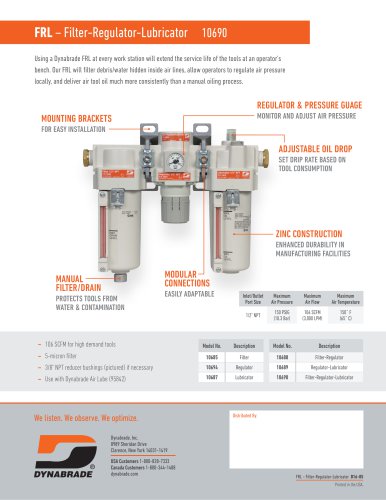
- Check the presence and functionality of the Filter-Regulator-Lubricator (FRL) system, ensuring it is filled with the correct type of oil.
- Recommendations for hose and fitting sizes based on air motor SCFM requirements are provided, ranging from 1/4" to 1/2" I.D. and lengths from 1' to 25'.
- Ensure the sander operates at 90 PSIG and confirm it runs at the rated "Free Speed" RPM.
- Inspect the balancer bearing and back-up pad for defects and compatibility to prevent excessive vibration.
- Follow proper sanding techniques, starting and stopping the sander on and off the surface, respectively, and maintaining a flat position during operation.
- Use a "North, South, East, West" pattern for uniform sanding and inspect abrasives frequently for defects.
- A 1/16" hole in a hose can lead to significant air loss and cost, with calculations provided for potential annual expenses.
- Comparison of common plug connectors versus Dynabrade plug connectors, highlighting differences in SCFM capacity.
Catalog excerpts
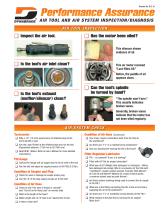
Reorder No. D13.10 Performance Assurance AIR TOOL AND AIR SYSTEM INSPECTION/DIAGNOSISAIR TOOL INSPECTION □ Is the tool's air inlet clean? □ Is the tool's exhaust (muffler/silencer) clean? □ Has the motor been oiled? This silencer shows evidence of oil. This air motor received “Last-Rites Oil.” Notice, the puddle of oil appears clean. □ Can the tool's spindle be turned by hand? “The spindle won’t turn.” This usually indicates broken vanes. Generally, broken vanes indicate that the motor has not been oiled regularly. Tachometer □ Affix a 1/2" (12 mm) square piece of reflective tape to the tool's spindle or pad. □ Aim the Laser Pointer at the reflective tape and run the tool. (Operational distance: 2"/50 mm to 20"/500 mm) □ Read RPM. (Notice: Refer to User's Manual for more detailed instructions.) PSI Gauge □ Connect Air Gauge and air supply hose to the air inlet of the tool. □ Run the tool and adjust air supply pressure to 90 PSIG (6.2 Bar). Condition of Coupler and Plug □ Check for wear or damage to coupler and/or plug. □ Can the I.D. of the plug supply enough air to the tool? Condition of Air Hose □ Check to see if the hose is frayed or cracked? (see “Cost of an Air Hose Leak” on reverse side) □ What is the length of the hose? □ Match length and I.D. of hose to air requirement of tool. □ Is there a hose reel? Condition of Air Hose (Continued) □ How many coupler connections exist from the drop to the workbench? □ Are there any “T’s” or a manifold at the workbench? □ How can Dynaswivel® prolong the life of the hose? Filter-Regulator-Lubricator □ FRL - is it present? If yes, is it working? □ Filled with oil? Set for proper lubrication? □ What type of oil? (Weight, Non-detergent vs. Detergent - Notice: Non-detergent oils contain little to no solvents. Air Tool Oils with “conditioner” usually contain solvents. Example: Both Marvel® Air Tool Oil and Marvel® Mystery Oil contain mineral spirits, a common solvent used as paint thinner.) □ Are there reducer bushings being used to connect the air supply to the FRL? □ What size is the fitting connecting the FRL to the air line that is supplying the air to the workbench? □ Are there any “T's” or manifolds coming directly off the FRL? □ What material is the
Open the catalog to page 1
Equipment Check: Random Orbital Sander □ 90 PSIG (6.2 Bar) is the required operating air supply pressure. Check the air pressure at the sander while it is running. Note: Promote the use of Dynabrade maximum flow plugs and couplers to ensure proper airflow. □ Confirm that the tool is running at the rated “Free Speed” RPM. On an average a 10,000 RPM non-vacuum sander will run at 9,500 RPM; a 12,000 RPM non-vacuum sander will run at 11,500 RPM. A vacuum sander normally runs slightly slower. □ Inspect the balancer bearing (pad bearing). Remove the back-up pad and rotate the balancer bearing shaft...
Open the catalog to page 2All DYNABRADE Europe catalogs and technical brochures
 Dynabrade Abrasive System Products
100 Pages
 TOOLS FOR THE AEROSPACE
16 Pages
 Dynabrade Clean Air Solution
116 Pages
 Dynabrade Backing Pads
8 Pages
 Dynabrade Metalworking D20-10
32 Pages
 MINI-RAPTOR VAC PACKS
6 Pages
 SANDING SOLUTIONS
6 Pages
 Steel Housing Die Grinders
4 Pages
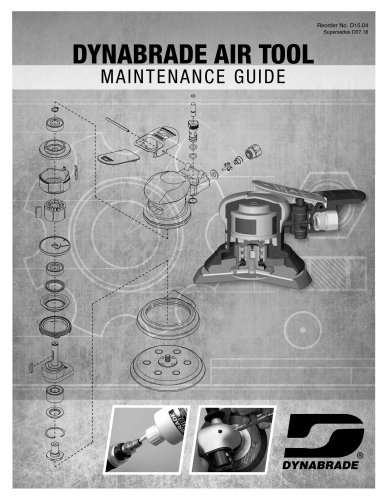 dybabrade air tool
20 Pages
 Mini Raptor Vac Packs
6 Pages
 Tools for Aerospace Industries
20 Pages
 DYNABRADE AIR TOOL
20 Pages
 51520
515202 Pages
 COST SAVINGS PROGRAM
4 Pages
 RAPTOR VAC CART
4 Pages
 600 SERIES
2 Pages
 300 SERIES
2 Pages
 DYNACUT EXTREME ORANGE
2 Pages
 DYNORBITAL EXTREME
6 Pages
 DYNISHER
4 Pages
 DYNAPOINT II
2 Pages
 Downdraft Sanding Tables
2 Pages
 Dynabrade Abrasive Power Tools
96 Pages
 Steel Housing Die Grinders
4 Pages
 Wrenchless Pencil Grinder
2 Pages
 Quick-Change Pencil Grinder
2 Pages
 DynaPen Series
4 Pages
 Pencil Filer from Dynabrade
2 Pages
 Industrial Quality Drills
12 Pages
 Tools for the Wind Energy
16 Pages
 Tools for the Marine Industry
32 Pages
 Vacuum Tools & Accessories
64 Pages







- Industrial press
- Milling tool
- Forming press
- Metal sawing line
- Grinding machine
- Milling tool with replaceable insert
- Surface treatment brush
- Portable grinder
- Drill
- Corner radius milling cutter
- Manual press
- Surface grinding machine
- Cylindrical grinding machine
- Plastic saw
- Sanding disc
- Electric sander
- Metal brush
- Air-operated portable grinder
- Circular brush