
- Catalogs
- DUNLOP INDUSTRIAL BELTS
- Steelcord®


Steelcord®
Steelcord®
Catalog excerpts

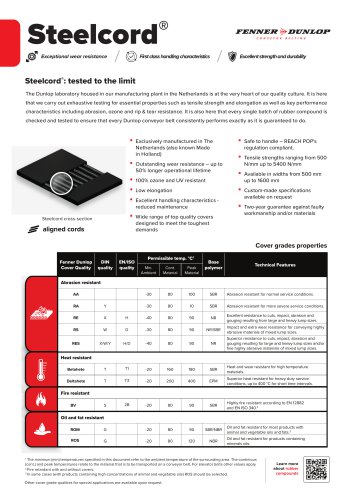
Steelcord® CONVEYOR BELTING Steelcord®: tested to the limit The Dunlop laboratory housed in our manufacturing plant in the Netherlands is at the very heart of our quality culture. It is here that we carry out exhaustive testing for essential properties such as tensile strength and elongation as well as key performance characteristics including abrasion, ozone and rip & tear resistance. It is also here that every single batch of rubber compound is checked and tested to ensure that every Dunlop conveyor belt consistently performs exactly as it is guaranteed to do. Exclusively manufactured in The Netherlands (also known Made in Holland) Outstanding wear resistance - up to 50% longer operational lifetime Excellent handling characteristics -reduced maintenance Wide range of top quality covers designed to meet the toughest demands Safe to handle - REACH POP's regulation compliant. Tensile strengths ranging from 500 N/mm up to 5400 N/mm Available in widths from 500 mm up to 1600 mm Custom-made specifications available on request Two-year guarantee against faulty workmanship and/or materials 1 The minimum (min) temperatures specified in this document refer to the ambient temperature of the surrounding area. The continious (cont.) and peak temperatures relate to the material that is to be transported on a conveyor belt. For elevator belts other values apply. 2 Fire retardant with and without covers. 3 In some cases (with products containing high concentrations of animal and vegetable oils) ROS should be selected. Other cover grade qualities for special applications are available upon request.
Open the catalog to page 1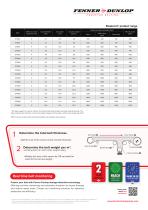
CONVEYOR BELTING Steelcord® product range * The load support of a belt is a factor of the belt width, belt strength and bulk material density. The table indicates the limits for correct load support based on three idlers of the same length set at 30°. Other carcass constructions and belt strengths are available upon request. Determine the total belt thickness. Add the sum of the covers to the carcass thickness. Determine the belt weight per m2. excluding belts for which other weights apply Multiply the sum of the covers by 1.15 and add the result to the carcass weight. Real time belt monitoring...
Open the catalog to page 2All DUNLOP INDUSTRIAL BELTS catalogs and technical brochures
 Trioflex
2 Pages
 Chevron
2 Pages
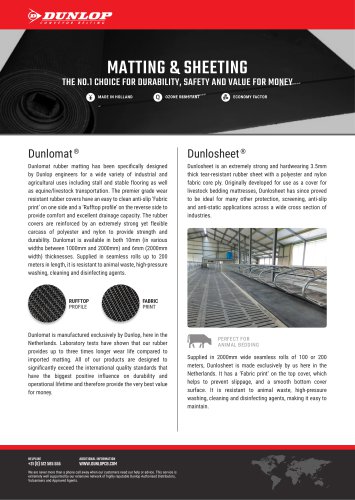 MATTING & SHEETING
2 Pages
 DUNLOP FERROFLEX
2 Pages
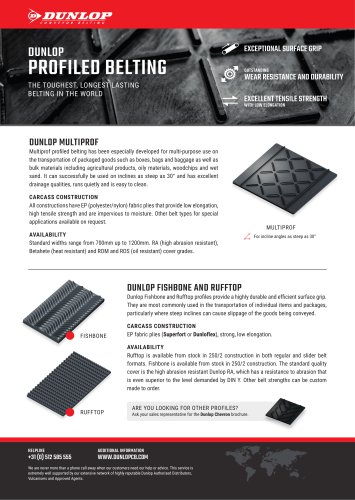 PROFILED BELTING
2 Pages
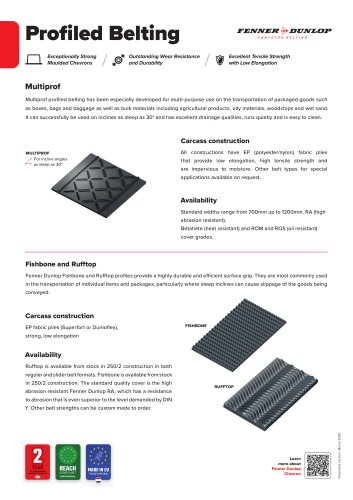 Profiled Belting
2 Pages
 X SERIES
12 Pages
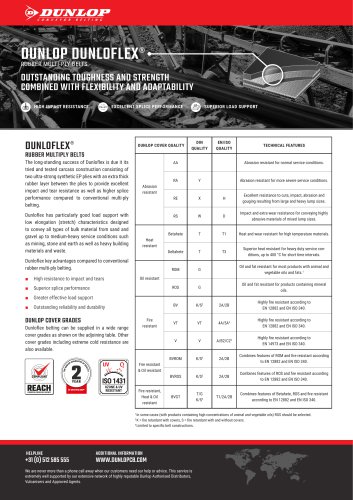 DUNLOP DUNLOFLEX®
2 Pages
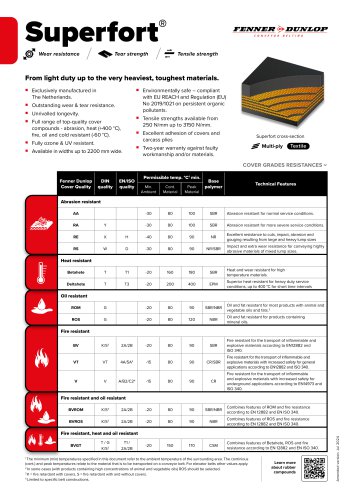 Superfort®
2 Pages
 Dunlop Ultra X
2 Pages
 PRODUCT RANGE
32 Pages
- Plastic conveyor belt
- Industrial conveyor belt
- Conveyor belt for the food industry
- Food conveyor belt
- Process conveyor belt
- Metal belt for conveyor
- Flexible conveyor belt
- High-resistance conveyor belt
- Rubber conveyor belt
- Abrasion-resistant conveyor belt
- Conveyor belt for the chemical industry
- Smooth conveyor belt
- Polyester conveyor belt
- Heavy load conveyor belt
- Heat-resistant conveyor belt
- Heavy-duty conveyor belt
- Oil-resistant conveyor belt
- Conveyor belt for the mining industry
- Anti-static conveyor belt