
- Catalogs
- Dukane Intelligent Assembly Solutions
- Thermal Probe

- Company
- Products
- Catalogs
- News & Trends
- Exhibitions
Thermal Probe

Thermal Probe
- Standard 12mm heating coil accommodation.
- Height locking adjustment accessible even when hot.
- Locking swivel adjustment for position-sensitive tips.
- Quick configuration and alignment to reduce production downtime.
- Reliable permanent inserts and multiple level inserting/staking.
- Quick installation and adjustment with no whitening when degating.
- Better cosmetic appearance and high tolerance to mold release and additives.
- Low initial equipment cost and easier maintenance.
- Nominal probe length without tip: 5 inches.
- Height-locking adjustment: 3/4 inch nut.
- Swivel-locking adjustment: 3/4 inch nut.
- Socket flats: 7/8 inch.
- Fork accepts standard 3/8 inch cap screws.
Catalog excerpts
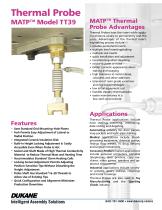
Thermal Probe MATP™ Model TT39 MATP™ Thermal Probe Advantages Thermal Probes heat the insert while applying pressure axially to permanently seat the parts. Advantages of the thermal inserting/staking process include — • reliable permanent inserts • multiple level inserting/staking • multiple size inserts • quick installation and adjustment • no whitening when degating • no particulates or noise • better cosmetic appearance when staking and swaging • high tolerance to mold release, colorants and other additives. • tolerant of resin grade variations and regrind percentages • low initial equipment cost • handles slippery thermoplastics • easier maintenance in a low–tech environment Applications Features • Uses Standard Grid Mounting–Hole Platen • Fork Permits Easy Adjustment of Lateral or Radial Position • Integrated Ceramic Insulation Disk • Built–in Height Locking Adjustment Is Easily • • • • • Accessible Even When Probe Is Hot Socket and Shaft Made of High Thermal Conductivity Material to Reduce Thermal Mass and Heating Time Accommodates Standard 12mm Heating Coils Locking Swivel Adjustment Permits Adjusting Position–Sensitive Tips Without Disturbing the Height Adjustment Probe Shaft Has Standard 1/4–28 Threads to Allow Use of Existing Tips Quick Configuration and Alignment Minimizes Production Downtime Intelligent Assembly Solutions Thermal Probe applications include heat staking, inserting, embossing, date coding and degating. Automotive industry for door panels, map pockets and light–pipe staking. Medical applications include bloodprocessing equipment, chemical pumps, fittings flow meters, IV drug delivery and surgical instruments. Consumer Product market applications include personal computers, portable telephones, laser printers, copy machines, video games, speakers and appliance components. Industrial applications include conveyor systems, gears, pulleys, couplings and motor housings. Thermal Probes are also used in Toy Manufacturing and the Sporting Goods industry.
Open the catalog to page 1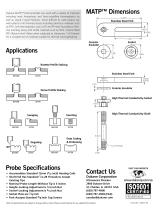
Dukane MATP™ thermal probes can work with a variety of materials including most Amorphous and Semi-crystalline thermoplastics as well as Liquid Crystal Polymers. Some difficult to weld plastics are well suited to the thermal process including lubricious materials such as PTFE. Soft thermoplastics such as PE and PP react favorably to thermal inserting along with brittle materials such as 50% mineral–filled PPO (Ryton) which flakes when subjected to ultrasonics. Call Dukane for a complete list of materials suitable for thermal inserting/staking. Stainless Steel Fork 0.400 1.385 2.812 Ceramic Insulator...
Open the catalog to page 2All Dukane Intelligent Assembly Solutions catalogs and technical brochures
 VWB4900
2 Pages
 ServoWeld Plus Spin Welder
2 Pages
 VWB4500 - Vibration Welder
2 Pages
 VWB4300 - Vibration Welder
2 Pages
 VW5960LPT - Vibration Welder
4 Pages
 VW5900 - Vibration Welder
2 Pages
 VW5700LPT - Vibration Welder
2 Pages
 VW5700 - Vibration Welder
2 Pages
 VW5500 - Vibration Welder
2 Pages
 VW5300 - Vibration Welder
2 Pages
 Corrugated Plastic Welders
2 Pages
 Medical Solutions
4 Pages
 Vibration Welding
4 Pages
 Laser Welder Handout
2 Pages
 Ultrasonic Food Processing
2 Pages
 Ultrasonic Welders Brochure
4 Pages
 Vibration Welding Brochure
4 Pages
 VWB4900 - Vibration Welder
2 Pages
 EZ-Welder
2 Pages
 VWB3500 - Vibration Welder
2 Pages
 VWB3700 - Vibration Welder
2 Pages
 20 kHz Sealed Transducer
2 Pages
 Thermal Press
2 Pages
 Spin Welder - SVB031-SVB051
2 Pages
 UFF-2 40 kHz mini-slitter
2 Pages
 UFF-1 Sonic Slitter
2 Pages
 VW 5500 Vibration welder
2 Pages
 VW 5700 Vibration Welder
2 Pages
 VW5900 Vibration Welder
2 Pages
 VWB4500 Vibration Welder
2 Pages
 VWB4700 Vibration Welder
2 Pages
 VWB4700LPT Vibration Welder
2 Pages
 VWB4900 Vibration Welder
2 Pages
 Standard Sound Enclosure
2 Pages
 ultrasonic press system
4 Pages
 Dukane Vibration Welding
4 Pages


Archived catalogs
 Model 3700 Vibration Welder
2 Pages
 Model 3500 Vibration Welder
2 Pages
 Medical Device Assembly
4 Pages
 Ultrasonic Welders
4 Pages


- Cutting system
- CNC cutting center
- Welding system
- Automatic cut-off machine
- Automation software solution
- Knife cutting system
- Automatic welding machine
- Process software
- Real-time software
- Control software
- Plastic cutting machine
- Industrial software
- Interface software
- Fixed sewing machine
- Quality software
- Metal welding machine
- Automated software
- Manual welding machine
- Touch screen HMI
- Laser sealer