

- Company
- Products
- Catalogs
- News & Trends
- Exhibitions
Flextensional Piezoelectric Actuation

1 / 2 PagesView full catalog
Flextensional Piezoelectric Actuation
Product catalog summary
Introduction
The document discusses the operation and design of Dynamic Structures and Materials (DSM) flextensional piezoelectric actuators (FPA), focusing on the PZT stack as the active element. The PZT stack expands with increased voltage, and this expansion is mechanically amplified by the solid-state kinematic elements in the metal frame.
Specifications and Design
The FPA design includes thicker metal sections connected by thin metal webs called flexures, which act as frictionless hinges. These are designed to flex within material fatigue stress limits. The FPA-80E actuator, for example, achieves an amplified motion of 80 microns from a piezo stack output motion of approximately 20 microns.
Contraction vs. Expansion
The FPA-80E is an expansion actuator, achieving a nominal displacement range of 80-90 microns. The piezo material can also contract under negative voltage. The actuator's spring wire preload keeps the piezo ceramic in compression, allowing for both contraction and expansion.
Kinematic Configurations
The document compares the FPA-80E and FPA-1100C configurations, illustrating how piezo material expansion can create either expansion/pushing or contracting/pulling actions. The spring preload enables bi-directional motion.
Summary
DSM's piezo-actuators utilize the piezoelectric effect to produce a range of actuator solutions. The FPA design offers compact, high-stiffness, highly-amplified motion. DSM also offers Leveraged Piezoelectric Actuators with higher dynamic bandwidth. These actuators are valuable in precision positioning, vibration control, and scanning applications, providing smooth, precise motion from sub-nanometer to multiple-millimeter levels.
The document discusses the operation and design of Dynamic Structures and Materials (DSM) flextensional piezoelectric actuators (FPA), focusing on the PZT stack as the active element. The PZT stack expands with increased voltage, and this expansion is mechanically amplified by the solid-state kinematic elements in the metal frame.
Specifications and Design
The FPA design includes thicker metal sections connected by thin metal webs called flexures, which act as frictionless hinges. These are designed to flex within material fatigue stress limits. The FPA-80E actuator, for example, achieves an amplified motion of 80 microns from a piezo stack output motion of approximately 20 microns.
Contraction vs. Expansion
The FPA-80E is an expansion actuator, achieving a nominal displacement range of 80-90 microns. The piezo material can also contract under negative voltage. The actuator's spring wire preload keeps the piezo ceramic in compression, allowing for both contraction and expansion.
Kinematic Configurations
The document compares the FPA-80E and FPA-1100C configurations, illustrating how piezo material expansion can create either expansion/pushing or contracting/pulling actions. The spring preload enables bi-directional motion.
Summary
DSM's piezo-actuators utilize the piezoelectric effect to produce a range of actuator solutions. The FPA design offers compact, high-stiffness, highly-amplified motion. DSM also offers Leveraged Piezoelectric Actuators with higher dynamic bandwidth. These actuators are valuable in precision positioning, vibration control, and scanning applications, providing smooth, precise motion from sub-nanometer to multiple-millimeter levels.
See more
Catalog excerpts
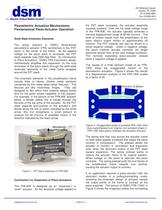
Direction ofam Figure 2 - Exaggerated shape of actuated FPA-100E (darkblue) superimposed over original, non-actuated shape ofFPA-100E (light green) indicates the actuation direction. p lified motion > Direction ofpiezo materialexpansion Figure 1 - PZT stack expansion in FPA-80E >
Open the catalog to page 1All DSM catalogs and technical brochures
 MD-90 Motor Driver
1 Page
 SA-500
1 Page
 VF-500 Voltage Follower
1 Page
 VF-90 Voltage Follower
1 Page
 Model ZSA-1000C
1 Page
 Model XSA-0200C
1 Page
 DSM Model I-20
1 Page
 SUM-40
1 Page
 XRS1-800/1600
3 Pages
 PKA-ZPR-200
1 Page
 PKA-XYZ-400
1 Page
 TTA-1200
1 Page


Archived catalogs


Related Searches
- Positioning table
- Translation stage
- Motorized positioning table
- Precision positioning table
- Single-axis positioning stage
- Manually-operated positioning stage
- 2-axis positioning table
- Rotary positioning table
- Piezoelectric stage
- 3-axis positioning table
- Actuator controller
- Linear piezoelectric actuator
- Long-travel positioning stage
- Linear actuator controller
- Amplified piezoelectric actuator
- Nanopositioning stage
- Linear nanopositioning stage
- Piezoelectric motor
- Linear piezoelectric motor
*Prices are pre-tax. They exclude delivery charges and customs duties and do not include additional charges for installation or activation options. Prices are indicative only and may vary by country, with changes to the cost of raw materials and exchange rates.
About DirectIndustry
DirectIndustry is a marketplace that offers B2B players a complete experience, from product sourcing to purchase. DirectIndustry is an entity of VirtualExpo Group.
Are you a buyer?
Are you a supplier?