
- Catalogs
- ds automation gmbh
- Press release glass breakage dsound® USS5-LS

Press release glass breakage dsound® USS5-LS

Press release glass breakage dsound® USS5-LS
In the food and beverage industry, glass containers can sometimes burst, leading to contamination and potential recalls. To address this issue, ds automation gmbh has developed acoustic sensors that detect glass breakage, preventing affected products from reaching consumers.
Specifications
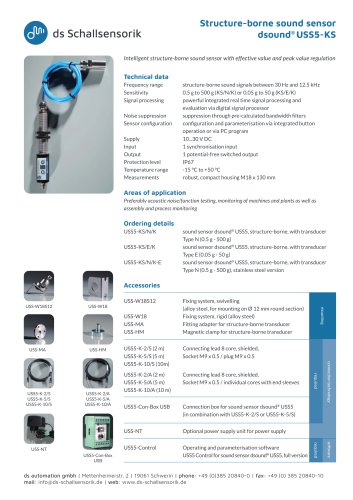
The acoustic sensors are designed to integrate easily into existing production lines. They detect glass breakage by analyzing signal levels and frequency characteristics. The sensors are dustproof and waterproof, meeting IP67 protection standards, and are made of stainless steel to comply with hygiene requirements.
Detection Mechanism
The sensors function as special microphones that monitor environmental noise. They identify deviations from normal noise levels, such as the broadband, high-amplitude sound of glass breaking. Challenges include sound attenuation and interference noise, which are mitigated by placing sensors close to the sound source and using band-pass filtering to focus on frequencies between 16 kHz and 32 kHz.
Customization and Implementation
To minimize false alarms and undetected incidents, sensors are configured individually for each application. This customization ensures reliable detection and appropriate response actions.
Conclusion
By implementing these acoustic sensors, manufacturers can prevent costly recalls and maintain their reputation by ensuring product safety and quality.
Catalog excerpts

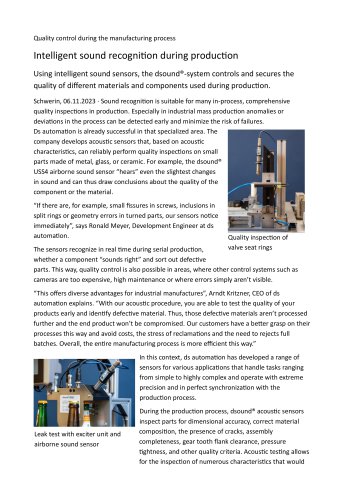
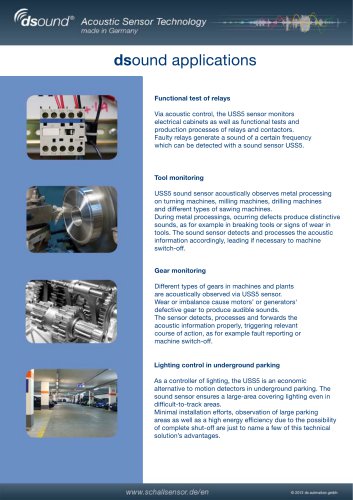
Preventing recalls Acoustic sensors detect glass breakage here food or beverages are filled into containers made of glass, it can happen that they burst. The resulting shards sometimes contaminate other units in the immediate vicinity. If the glass breakage is not detected immediately, the affected products can end up on the market and, in the worst case, all the way to the end customer. At the latest then, elaborate and cost-intensive recalls of entire batches are necessary, which not only annoy the customer base, but also cause lasting damage to the manufacturer's reputation. To prevent this problem from arising in the first place, Schwerin-based ds automation gmbh has developed special acoustic sensors. These can be easily integrated into existing lines and reliably detect glass breakage incidents by signal level and frequency characteristics. Depending on the degree of automation, the line is then either stopped for manual inspection or the affected units are automatically ejected from the filling line. The sound sensors used here are dustproof and watertight in accordance with protection class IP67 and made entirely of stainless steel, so that they also meet the high hygiene requirements in food and beverage production. If the glass breakage is not detected immediately, the affected products can end up in the shops and, in the worst case, all the way to the end customer (photo: Laboko/Shutterstock.com)
Open the catalog to page 1
Technology/IT ¦ IDM The sound sensors are dustproof and waterproof according to protection class IP67 and are made entirely of stainless steel (photo: ds automation gmbh) QA via airborne sound "The sensors for glass breakage detection are special microphones that continuously monitor their environment," explains Christian Schröder, developer at ds automation gmbh. "They detect any deviation from a noise situation defined as normal." For this purpose, specific trigger thresholds are defined in advance, within which the usual background noise of the production line moves. The noise generated by...
Open the catalog to page 2All Ds automation gmbh catalogs and technical brochures
 dsound® Cap Check Sauces
1 Page
 Data sheet dsound® USE01k
2 Pages
 Sound sensors dsound® series
2 Pages
 Data sheet dsound® ALC1
2 Pages




- Inspection system
- Industrial detector
- Leak tester
- Monitoring detector
- Automatic inspection system
- Real-time monitoring module
- Measurement monitoring module
- Detector with alarm
- Quality inspection system
- Compact detector
- Continuous monitoring module
- Environmental monitoring system
- Pressure leak testing machine
- Industrial control system
- Detector with digital display
- Condition monitoring module
- Analog detector
- Process detector
- Defect detection inspection system
- Real-time detector