

DXC120

DXC120
- CO2 Detection Range: 400 to 10,000 ppm
- Accuracy: ±(30 ppm + 3%)
- ADC Resolution: 24 bits
- Sensor Lifetime: 15 years
- Temperature Stability: 2.5 ppm/°C
- Response Time: 25 seconds to reach 63% of a step change
- Power Supply: 5V via USB, with a current consumption of approximately 30 mA
- Operating Temperature: 0 to 50°C
- Operating Humidity: 10 to 90% RH (non-condensing)
- Material: ABS plastic with an IP rating of 51
- The sensor is not waterproof and should be protected from water exposure.
- It should not be used in human applications.
- Electromagnetic interference can affect sensor precision.
- For optimal performance, install the sensor vertically on a wall with the USB cable facing downward.
Catalog excerpts

SMALL USB CARBON DIOXIDE (CO2) SENSOR DXC120 APPLICATIONS ◌ Research & development The DXC120 is a small USB-connected gas sensor for monitoring the indoor level of carbon dioxide (CO2). Built around an advanced NDIR CO2 sensor, it will provides years of precise gas level. The DXC120 has been specifically designed to meet the needs of monitoring CO2 levels in living places such as home, workplace, or other environments with moderate ambient conditions. ◌ Robotics ◌ Home air quality monitoring[1] ◌ OEM integration ◌ Server rooms ◌ Building automation ◌ Workplace ◌ Public spaces ◌ Transport station ◌ Warehouses ◌ Manufacturing facilities ◌ Engineering INSTALLATION TIME Less than 3 minutes UNIQUE SERIAL NUMBER Each unit is assigned a unique serial number allowing for traceability and certification DATA INTEGRATION Command-line tools for direct data access and integration Accuracy drift Sensor lifetime Repeatability[3] Temperature stability[4] Samples rate Response time[5] Factory calibrated[6] Number of IR channel Power supply Calibration baseline OPTIONS Carbon dioxide ADC resolution FREE DAQ SOFTWARE Real-time data visualization and logging – Over lifetime, 400 to 10,000 ppm Operating conditions 400 to 10,000 ppm 0 to 50°C – t63% Individually Ambient air, >400 ppm – Virtual COM Port (VCP) communication protocol Voltage Current Consumption Current Consumption Mechanical Dimensions Colour Weight Housing Operating temperature Operating relative humidity Material IP rating Miscellaneous Fully linearized Sensors technology Long-term stability Temperature compensated Powered through a USB port At 5V Peak, 0.5s See schema below Cyan Without cable Deviation to a high-precision reference in the calibrated range (400 10,000 ppm) of the sensor. RMS error of consecutive measurements at constant conditions. [4] Average slope of CO2 accuracy when changing temperature, valid at 400 ppm. [5] Time for achieving 63% of a respective step function. Response time depends on design-in, heat exchange and environment of the sensor in the final application. [6] Each sensor is individually calibrated by Dracal Technologies and ready to use prior to shipping. [7] If water condensation or splashing is possible, protect the sensor and cable converter using extra precautions. Extra housing may be required depending on the application. [8] Exposing the DXC100 at T > 50°C might result in permanent damage. [9] In a fully controlled environment. [2] ALSO AVAILABLE Traceability certificates Dracal Technologies Inc. All Rights Reserved
Open the catalog to page 1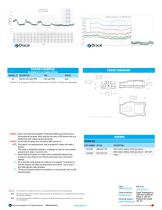
Four days of data Calibrating result on 11 DXC120 units AVAILABLE CHANNEL(S) PRODUCT DIMENSIONS As displayed in our logging software CHANNEL ID* DESCRIPTION * Channel Id as it appears in QTenki. Virtual channel Id differs in QTenki and usbtenkiget. WARNING: Keep in mind that electromagnetic interferences (EMI) may adversely reduce the precision of the sensor. Avoid using this unit close to EMI sources such as or, transformers, high voltage and fluorescent light. WARNING: Do not install the sensor on a flat surface (table, bench, etc.). NOTE: This product is not waterproof and must be protected...
Open the catalog to page 2All Dracal Technologies Inc. catalogs and technical brochures


- Connector
- Electrical cable
- Data connector
- Temperature probe
- Measuring device
- Metal connector
- Resistance temperature sensor
- Analysis software solution
- Circular connector
- Polymer connector
- Windows software
- Screw-in connector
- Socket electrical connector
- IP67 connector
- Electrical data cable
- Pressure probe
- Measurement software
- Interface software
- Thermocouple temperature transducer
- Pt100 temperature transducer