

Peptide and Collagen Processing
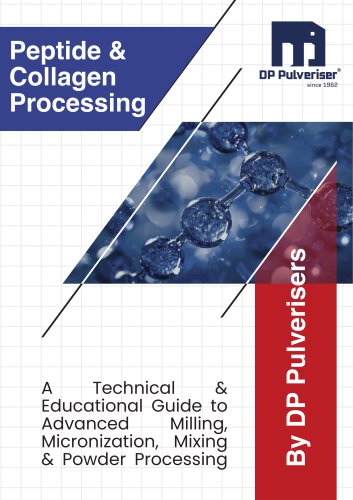
Peptide and Collagen Processing
Peptides and collagen are crucial in various industries such as pharmaceuticals, nutraceuticals, cosmetics, biotechnology, and performance nutrition. Their processing involves advanced milling and powder handling technologies to ensure optimal product performance.
Understanding Peptides
Peptides are short chains of amino acids that act as biological messengers. They are used in pharmaceuticals for targeted activity and in cosmetics for skin benefits. Processing challenges include heat degradation and moisture absorption.
Understanding Collagen
Collagen is a structural protein used in nutraceuticals and beauty products, often hydrolyzed for better absorption. Maintaining particle size distribution is crucial for product quality during processing.
Industries Driving Demand
Peptides and collagen are utilized across pharmaceuticals, nutraceuticals, cosmetics, and biotechnology, each with specific requirements for particle size, dissolution speed, and sensory characteristics.
Importance of Particle Size
Particle size impacts dissolution, bioavailability, and product quality. Advanced micronization technologies are essential to achieve desired particle sizes without damaging the product.
Advanced Milling Technologies
Technologies such as jet milling, air classifying mills, cryogenic milling, and pin mills are employed to achieve fine particle sizes while minimizing thermal impact.
Mixing & Powder Handling Challenges
Challenges include segregation, agglomeration, and static electricity. Proper system design is crucial for maintaining product quality.
Hygienic Processing & GMP Requirements
Manufacturing requires adherence to hygienic standards and validation capabilities, often involving stainless steel construction and dust-tight systems.
Future Trends
Future trends in peptide and collagen processing include continuous manufacturing, AI-assisted optimization, and advanced automation, with precision in processing driving industry innovation.
Mill & Mixer Selection Guide
Equipment selection depends on understanding product characteristics and processing requirements. Different milling technologies offer varied results based on application needs.
Jet Mills
Jet mills use high-velocity compressed gas streams for particle-to-particle collisions, reducing heat generation. They are ideal for processing sensitive peptide compounds, offering micron range D50 values, narrow PSD control, low contamination risk, and compatibility with sterile processing.
Air Classifying Mills (ACM)
ACM systems combine mechanical impact grinding with air classification for controlled particle size, suitable for collagen and nutraceutical manufacturing with moderate-to-fine grinding and high throughput.
Cryogenic Milling Systems
Cryogenic milling uses ultra-low temperatures to process heat-sensitive materials, preserving product integrity and improving particle uniformity.
Pin Mills
Pin mills are used for controlled deagglomeration and improving powder dispersion, particularly in collagen and protein systems.
Mixing Technologies
Proper mixer selection is critical for blending, homogenization, and ingredient incorporation. Various mixers like ribbon, paddle, conical, and fluidized zone mixers are used based on the specific needs of peptide and collagen manufacturing.
Integrated Process Systems
Modern manufacturing relies on integrated systems that include feeding, milling, air classification, conveying, dust collection, blending, and packaging, ensuring product integrity and manufacturing efficiency.
Catalog excerpts

A Technical & Educational Guide to Advanced Milling, Micronization, Mixing & Powder Processing
Open the catalog to page 1
Peptides and collagen have emerged as two of the most influential ingredient categories in modern pharmaceutical, nutraceutical, cosmetic, biotechnology, and performance nutrition industries. Over the past decade, both have moved from niche scientific applications into large-scale commercial manufacturing, driving innovation across everything from anti-aging products and regenerative medicine to sports nutrition, medical foods, and advanced therapeutic systems. As consumer awareness surrounding longevity, wellness, recovery, and functional nutrition continues to expand, manufacturers are under...
Open the catalog to page 2
Understanding Peptides Peptides are short chains of amino acids connected through peptide bonds. While proteins may contain hundreds or thousands of amino acids, peptides are typically much smaller and act as highly specialized biological messengers within the body. These compounds regulate a vast number of physiological processes including hormone signaling, cellular communication, tissue repair, metabolism, immune response, and muscle recovery. In recent years, peptides have gained extraordinary attention within pharmaceutical and wellness industries due to their targeted biological activity...
Open the catalog to page 3
Understanding Collagen Collagen is the most abundant structural protein found within the human body and serves as a primary component of connective tissues including skin, cartilage, ligaments, tendons, and bones. Due to its importance in structural integrity and tissue support, collagen has become one of the fastest-growing ingredient categories within nutraceuticals, beauty products, medical nutrition, and sports recovery systems. The rapid growth of collagen supplementation has driven demand for highly engineered powder processing systems capable of producing extremely consistent particle...
Open the catalog to page 4
Industries Driving Demand The global demand for peptides and collagen continues to accelerate across numerous high-value industries. Pharmaceutical manufacturers increasingly utilize peptides within targeted therapeutic applications, injectable compounds, hormone therapies, biologics, and regenerative medicine systems. These applications require extremely precise particle size control, contamination prevention, sterile processing environments, and advanced containment solutions. Within the nutraceutical industry, peptides and collagen are now common ingredients in sports nutrition powders, recovery...
Open the catalog to page 5
Why Particle Size Matters Particle size distribution is one of the most critical variables in peptide and collagen processing. It directly influences dissolution behavior, bioavailability, blend consistency, flowability, packaging performance, and overall product quality. As particle size decreases, surface area increases dramatically. This increased surface area improves interaction with liquids, allowing powders to hydrate and dissolve more efficiently. For beverage systems, this can significantly improve suspension stability and reduce clumping behavior. In pharmaceutical and nutraceutical...
Open the catalog to page 6
Advanced Milling Technologies Modern peptide and collagen processing often relies on highly engineered milling technologies designed to balance fine particle size reduction with low thermal impact and precise control. Jet milling has become one of the most widely utilized technologies for ultra-fine peptide micronization. Jet mills use high-velocity compressed gas streams to create particle-to-particle collisions without relying on mechanical grinding surfaces. This minimizes heat generation while achieving extremely fine particle sizes and narrow particle size distributions. Because there are...
Open the catalog to page 7
Mixing & Powder Handling Challenges Once peptides or collagen powders have been milled, they frequently undergo secondary processing involving blending, agglomeration, flavor incorporation, vitamin addition, or functional ingredient integration. These operations introduce additional engineering challenges that must be carefully managed. Fine powders are naturally susceptible to segregation, where particles separate based on size, density, or shape during handling and transport. This becomes particularly problematic when micro-ingredients must be distributed uniformly throughout a formulation....
Open the catalog to page 8
Hygienic Processing & GMP Requirements Peptide and collagen manufacturing increasingly operates within highly regulated environments requiring hygienic processing standards and advanced validation capabilities. Pharmaceutical, nutraceutical, and functional food manufacturers often require systems designed around GMP principles, hygienic finishes, dust containment, and contamination prevention. Stainless steel construction, particularly 304 and 316L stainless steel, is commonly utilized to support hygienic operation and corrosion resistance. Smooth internal finishes help minimize product buildup...
Open the catalog to page 9
Mill & Mixer Selection GSelecting the Proper Processing Technology for Peptides & Collagen One of the most common mistakes in peptide and collagen manufacturing is assuming that all powder processing technologies perform similarly. In reality, selecting the incorrect milling or mixing system can lead to severe production inefficiencies, poor product performance, inconsistent quality, excessive dusting, thermal degradation, agglomeration, segregation, and costly downstream processing problems. Peptides and collagen are not conventional commodity powders. They are often highly sensitive, functional,...
Open the catalog to page 10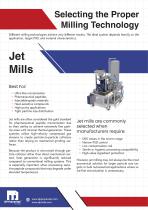
Selecting the Proper Milling Technology Different milling technologies achieve very different results. The ideal system depends heavily on the application, target PSD, and material characteristics. JetMillsBest For: • Ultra-fine micronization • Pharmaceutical peptides • Injectable-grade materials • Heat-sensitive compounds • High-purity applications • Tight particle size distribution Jet mills are often considered the gold standard for pharmaceutical peptide micronization due to their ability to achieve extremely fine particle sizes with minimal thermal generation. These systems utilize high-velocity...
Open the catalog to page 11All DP Mills catalogs and technical brochures
 Algae Processing System
6 Pages
 Carbon Milling
8 Pages
 Protein Milling System
10 Pages
 Cosmetic Manufacturing
8 Pages
 PCB Recycling System
9 Pages
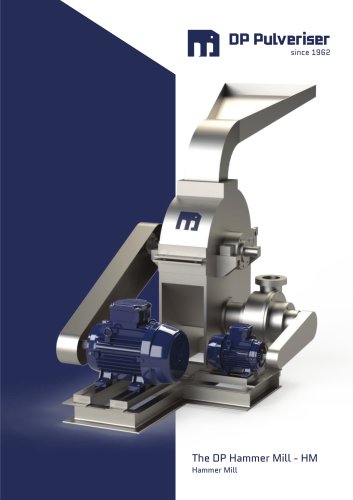 DP Pulverizer Hammer Mills
11 Pages
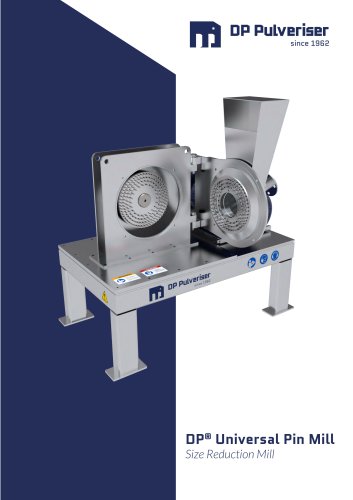 DP Pulverizer Pin MIlls
3 Pages
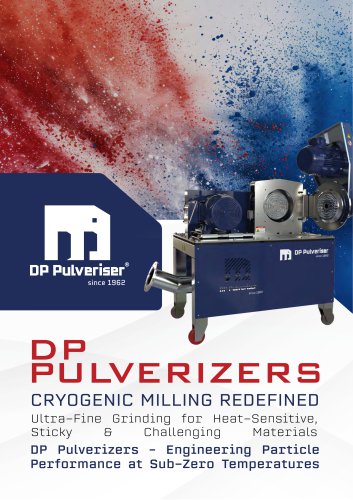 DP Pulverizer Cryogenic Mills
11 Pages
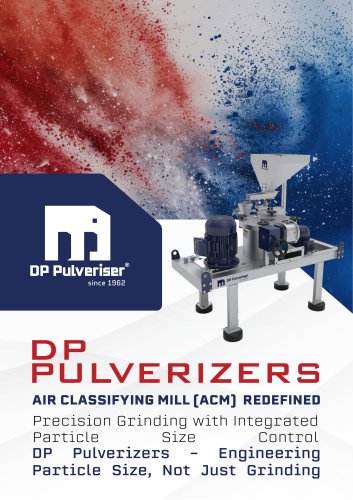 DP Pulverizer Air Classifier Mills
17 Pages
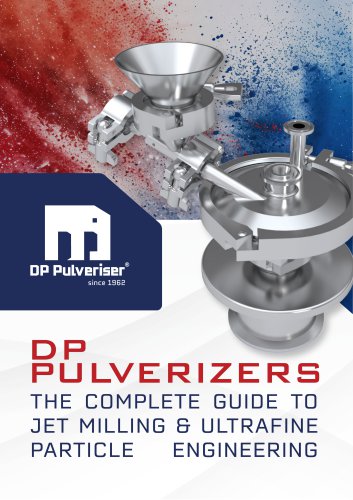 DP Pulverizer Jet Mills
11 Pages
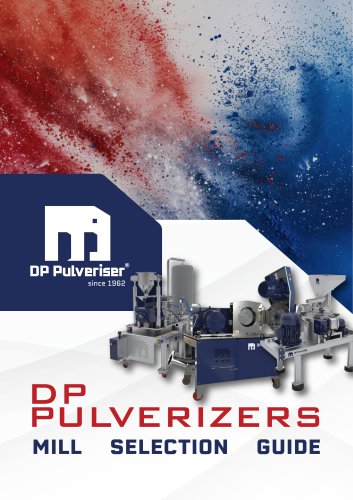
- Food lump breaker
- Waste chopper
- Impact pulverizer
- Recycling grinding mill
- Plastic grinding mill
- Lump breaker for the food industry
- Mill for the pharmaceutical industry
- Hammer grinding mill
- Mineral mill
- Powder lump breaker
- Laboratory pulverizer
- Automatic grinding mill
- High-speed grinding mill
- Grinding mill for the chemical industry
- Disc pulverizer
- Grain grinding mill
- Ultrafine mill
- Wood pulverizer
- Variable speed lump breaker