

PCB Recycling System
PCB Recycling System
DP Pulverizers offers engineered solutions for recovering precious metals from electronic waste, specifically focusing on Printed Circuit Boards (PCBs). PCBs are rich in metals like copper, gold, and palladium, making them valuable yet challenging to process due to their composite nature.
Core Challenge: Composite Material Liberation
The primary challenge in PCB recycling is the liberation of metals from the composite structure of PCBs. This requires reducing the material to a particle size where metals, resins, and fibers are separate entities. DP Pulverizers addresses this with a controlled, multi-stage process that avoids common pitfalls like excessive heat and polymer smearing.
Multi-Stage Recovery Process
The recycling process involves several stages:
- Primary Size Reduction: Breaks down whole PCBs into fragments while preserving structural integrity.
- Secondary Grinding: Weakens bonds between metals and the matrix without deforming metals or generating excessive heat.
- Fine Grinding and Liberation: Achieves a balance between energy input and control to ensure uniform particle size distribution, essential for efficient separation.
Cryogenic Grinding
This technique involves cooling materials with liquid nitrogen to make polymers brittle, enhancing the separation of metals and reducing polymer contamination.
Classification and Separation
Post-liberation, materials are classified and separated using air classification, magnetic separation, electrostatic systems, and gravity-based methods. These processes ensure high purity and recoverability of materials.
System Integration and Control
DP Pulverizers designs integrated systems with advanced control strategies for real-time monitoring and adjustment. Dust management and environmental safety are also prioritized.
Engineering for Performance, Safety, and Profitability
Systems are designed for long-term performance, focusing on throughput, energy efficiency, and maintenance. The goal is to deliver consistent results while minimizing costs.
The DP Pulverizers Difference
DP Pulverizers stands out due to its deep understanding of PCB recycling processes, offering tailored solutions that enhance recovery rates and profitability.
Conclusion
As demand for precious metals grows, efficient recycling becomes crucial. DP Pulverizers provides the technology to transform complex materials into valuable resources, supporting sustainable and economically viable recycling.
Catalog excerpts
DP PULVERIZERS PCB RECYCLING SYSTEM PACKAGE Complete Engineered Solutions for Precious Metal Recovery from Electronic Waste
Open the catalog to page 1
FROM ELECTRONIC WASTE TO ENGINEERED RESOURCE RECOVERY Printed Circuit Boards (PCBs) represent one of the most concentrated and underutilized sources of recoverable metals in modern industry. Unlike traditional mining, where valuable metals are dispersed in low concentrations, PCBs contain a dense combination of copper, precious metals such as gold and palladium, and a complex matrix of polymers and glass fibers. This unique composition makes them both highly valuable and technically challenging to process. The true opportunity in PCB recycling lies not simply in size reduction, but in the ability...
Open the catalog to page 2
UNDERSTANDING THE CORE CHALLENGE: COMPOSITE MATERIAL LIBERATION At the heart of PCB recycling is a single defining concept: liberation. PCBs are not homogeneous materials; they are layered composites where metals are physically bonded to resins and reinforced by fiberglass structures. Simply reducing the size of the material is not enough. In fact, improper grinding can reduce recovery rates by embedding metals deeper into softened polymers or creating coated particles that resist separation. True liberation occurs when the material is reduced to a particle size at which individual components—metal,...
Open the catalog to page 3
A MULTI-STAGE APPROACH TO ENGINEERED RECOVERY Effective PCB recycling is not a single process but a carefully designed sequence of operations, each building upon the previous stage to progressively liberate and refine the material. The process begins with primary size reduction, where whole circuit boards are broken down into manageable fragments. At this stage, the goal is not to create fine particles, but rather to reduce the material in a controlled manner that preserves structural integrity while preparing it for further processing. By focusing on controlled shear rather than excessive impact,...
Open the catalog to page 4
THE ROLE OF CRYOGENIC GRINDING IN ADVANCED PCB PROCESSING One of the most significant challenges in PCB recycling is the behavior of polymer components under mechanical stress. At ambient temperatures, these materials tend to soften and smear when subjected to high-energy grinding. This smearing effect can coat metal particles, making them more difficult to separate and reducing overall recovery efficiency. Cryogenic grinding addresses this issue by fundamentally changing the physical properties of the material prior to size reduction. By introducing liquid nitrogen into the grinding process,...
Open the catalog to page 5
PRECISION THROUGH CLASSIFICATION AND SEPARATION Once the material has been properly liberated, the focus shifts to classification and separation. These stages are where the value of the process is ultimately realized, as they determine the purity and recoverability of the final material streams. Air classification plays a crucial role in ensuring that particles are grouped according to size and density. A consistent and narrow particle size distribution allows downstream separation technologies to operate with greater efficiency and accuracy. Without this level of control, even the most advanced...
Open the catalog to page 6
SYSTEM INTEGRATION: ENGINEERING BEYOND EQUIPMENT A successful PCB recycling operation is not defined by individual machines, but by how well those machines work together as a cohesive system. Material handling, feeding, grinding, classification, and separation must all be synchronized to maintain consistent throughput and product quality. DP Pulverizers designs fully integrated systems that incorporate advanced control strategies, including PLC and HMI platforms that allow operators to monitor and adjust process parameters in real time. This level of control ensures that the system can adapt...
Open the catalog to page 7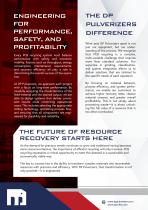
ENGINEERING FOR PERFORMANCE, SAFETY, AND PROFITABILITY Every PCB recycling system must balance performance with safety and economic viability. Factors such as throughput, energy consumption, maintenance requirements, and recovery efficiency all play a role in determining the overall success of the operation. At DP Pulverizers, we approach each project with a focus on long-term performance. By carefully analyzing the characteristics of the feed material and the desired output, we are able to design systems that deliver consistent results while minimizing operational costs. This includes selecting...
Open the catalog to page 8
Bahrain Ghana Malaysia Saudi Arabia Qatar Bangladesh Hongkong Newzealand South Africa U.A.E Canada Indonesia Nigeria Sri Lanka Zambia
Open the catalog to page 9All DP Mills catalogs and technical brochures
 Algae Processing System
6 Pages
 Carbon Milling
8 Pages
 Protein Milling System
10 Pages
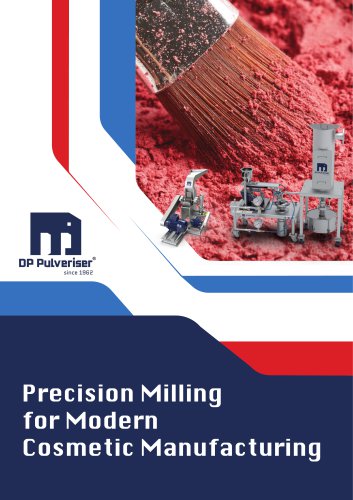 Cosmetic Manufacturing
8 Pages
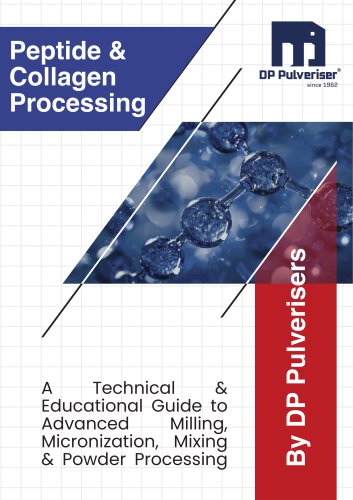 Peptide and Collagen Processing
18 Pages
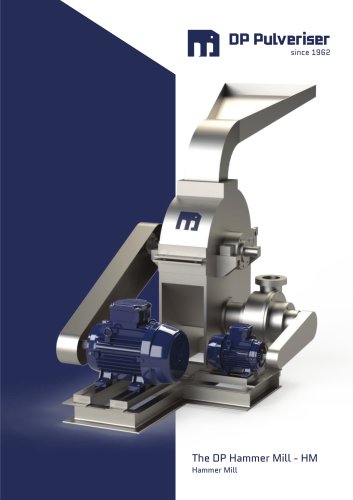 DP Pulverizer Hammer Mills
11 Pages
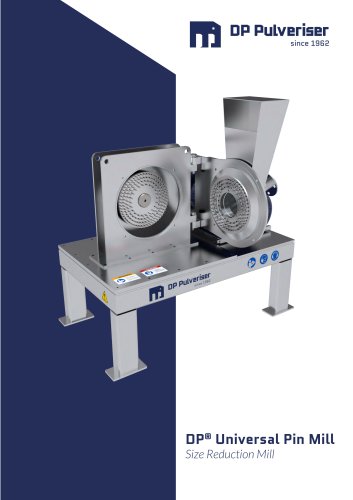 DP Pulverizer Pin MIlls
3 Pages
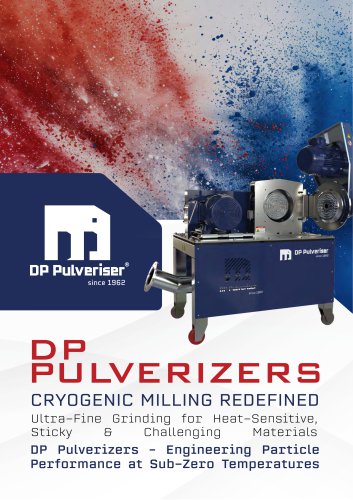 DP Pulverizer Cryogenic Mills
11 Pages
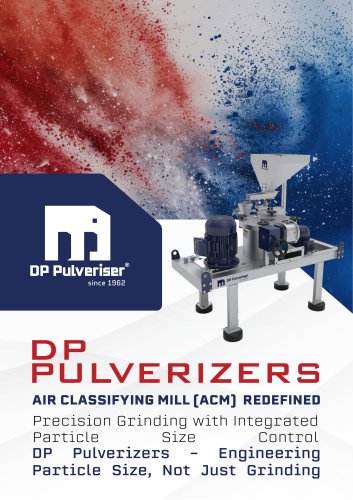 DP Pulverizer Air Classifier Mills
17 Pages
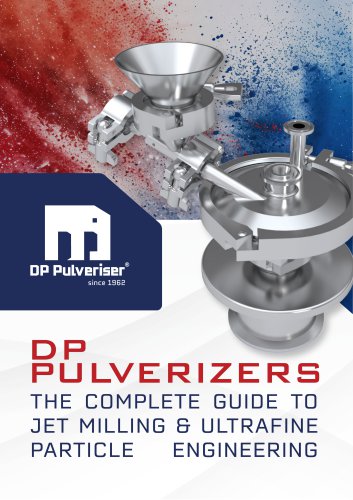 DP Pulverizer Jet Mills
11 Pages
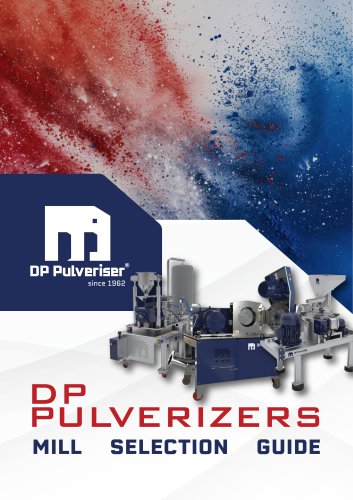
- Grinding mill
- Food lump breaker
- Waste chopper
- Impact pulverizer
- Recycling grinding mill
- Plastic grinding mill
- Lump breaker for the food industry
- Mill for the pharmaceutical industry
- Hammer grinding mill
- Mineral mill
- Powder lump breaker
- Laboratory pulverizer
- Automatic grinding mill
- High-speed grinding mill
- Grinding mill for the chemical industry
- Disc pulverizer
- Grain grinding mill
- Ultrafine mill
- Wood pulverizer
- Variable speed lump breaker