

- Products
- Catalogs
- News & Trends
- Exhibitions
AIR CLASSIFYING MILL SYSTEMS
1 /17Pages
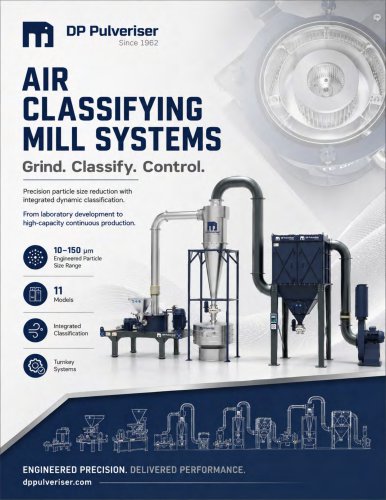
AIR CLASSIFYING MILL SYSTEMS
1 /17Pages
Catalog excerpts
Grind. Classify. Control. Precision particle size reduction with integrated dynamic classification. From laboratory development to high-capacity continuous production Engineered Particle Size Range ENGINEERED PRECISION. DELIVERED PERFORMANCE.
Open the catalog to page 1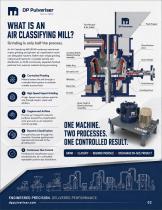
WHAT IS AN AIR CLASSIFYING MILL?Grinding is only half the process. An Air Classifying Mill (ACM) combines mechanical impact grinding and dynamic air classification inside one integrated machine. Rather than simply grinding material and hoping for a suitable particle size distribution, an ACM continuously separates finished particles from oversize material during processing. Baffle Ring Q Controlled Feeding Material enters the mill through a controlled feed system to maintain a stable process load. Q High-Speed Impact Grinding A high-Speed rotor reduces particle size through impact, shear and...
Open the catalog to page 2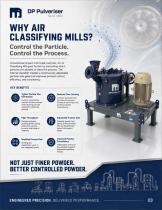
WHY AIRCLASSIFYING MILLS? Control the Particle. Control the Process. Conventional impact mills break particles. An Air Classifying Mill goes further by controlling which particles are allowed to leave the process. The internal classifier creates a continuously adjustable particle-size gate that improves process control, efficiency, and consistency. Tighter Particle Size Distribution Dynamic classification removes finished particles while retaining oversize material for additional grinding. Reduced Over-Grinding Correctly sized particles can leave the process instead of remaining in the grinding...
Open the catalog to page 3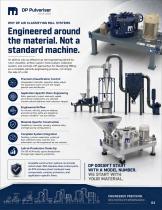
WHY DP AIR CLASSIFYING MILL SYSTEMS An ACM is only as effective as the engineering behind its rotor, classifier, airflow system, feed system, collection system, and controls. DP approaches Air Classifying Milling as a complete particle-engineering process, not simply the sale of a mill. Engineered Airflow Air volume, velocity, pressure balance, and internal flow paths are treated as process variables—not just utilities. The DP-ACM family spans development through high-capacity production. Available construction options can include carbon steel, 304 stainless steel contact parts, all-304 stainless...
Open the catalog to page 4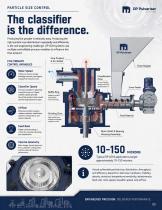
PARTICLE SIZE CONTROL The classifier is the difference. Producing fine powder is relatively easy. Producing the right particle size distribution repeatedly and efficiently is the real engineering challenge. DP ACM systems use multiple controllable process variables to influence the final product. FIVE PRIMARY CONTROL VARIABLES Rotor Speed Influences impact energy, breakage intensity, throughput, and particle reduction rate. Airflow Influences particle transport residence behavior, classification dynamics, temperature, and system capacity. Feed Rate Stable material loading is critical for consistent...
Open the catalog to page 5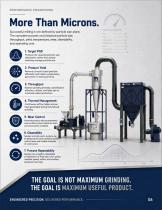
PERFORMANCE ENGINEERING Successful milling is not defined by particle size alone. The complete process must balance particle size, throughput, yield, temperature, wear, cleanability, and operating cost. ENGINEERED PRECISION. DELIVERED PERFORMANCE.
Open the catalog to page 6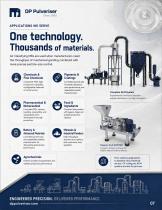
Chemicals & Fine Chemicals Consistent PSD. high production capability, configurable materials of construction. Air Classifying Mills are used when manufacturers need the throughput of mechanical grinding combined with more precise particle-size control. Pigments & Coatings Controlled particle size for better dispersion, color performance, and repeatable powder characteristics. Pharmaceutical & Nutraceutical Controlled PSD. sanitary handling, cleanability, and repeatability from development through production. Battery & Advanced Materials Controlled particle size and repeatable material characteristics...
Open the catalog to page 7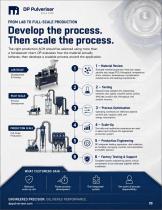
FROM LAB TO FULL-SCALE PRODUCTION The right production ACM should be selected using more than a horsepower chart. DP evaluates how the material actually behaves, then develops a scalable process around the application. 4 - Scale-Up Test data and application experience are used to select and configure the appropriate production system. DP integrates feeding, separation, dust collection, air handling, conveying, controls, instrumentation, and safety systems. 6 - Factory Testing & Support ENGINEERED PRECISION. DELIVERED PERFORMANCE.dppulveriser.com 08
Open the catalog to page 8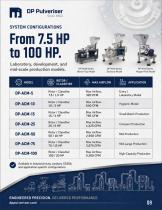
SYSTEM CONFIGURATIONS From 7.5 HP to 100 HP.Laboratory, development, and mid-scale production models. DP-ACM Series Sanitary Model
Open the catalog to page 9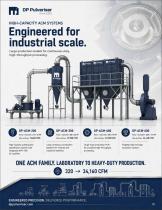
Large production models for continuous-duty, High-capacity grinding and classification system with integrated ARV-760 air classifier. Large continuous-production platform for minerals and industrial materials. Large-scale production ACM for sustained high-throughput processing. Flagship high-tonnage production system. ONE ACM FAMILY. LABORATORY TO HEAVY-DUTY PRODUCTION.© 320 34,160 CFM ENGINEERED PRECISION. DELIVERED PERFORMANCE. dppulveriser.com 10
Open the catalog to page 10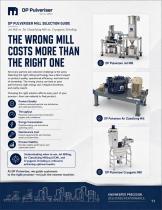
DP PULVERISER MILL SELECTION GUIDE Jet Mill vs. Air Classifying Mill vs. Cryogenic Grinding Not every particle size reduction challenge is the same. Selecting the right milling technology has a direct impact on product quality, operational efficiency, and total cost of ownership. The wrong choice can lead to poor performance, high energy use, frequent downtime, and costly rework. Choosing the right solution affects every part of your process—from raw material to final product. ©Product Quality Achieve consistent particle size distribution and material performance. Maximize output and meet production...
Open the catalog to page 11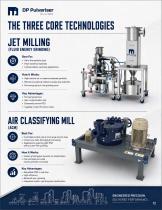
THE THREE CORE TECHNOLOGIES JET MILLING(FLUID ENERGY GRINDING) Best For: • Ultra-fine particle sizes • Heat-sensitive materials • Contamination-sensitive applications How It Works: • High-velocity air or steam accelerates particles • Particle-on-particle collision causes size reduction • No moving parts in the grinding zone Key Advantages: • No heat generation • Zero contamination risk • Capable of sub-10 micron sizes AIR(ACM) CLASSIFYING MILL Best For: • Controlled particle size in mid-range micron sizes • Continuous, high-throughput processing • Applications requiring tight PSD without ultra-fine...
Open the catalog to page 12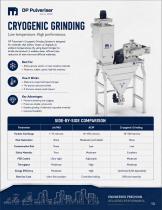
Low temperature. High performance. DP Pulveriser's Cryogenic Grinding System is designed for materials that soften, smear, or degrade at ambient temperatures. By using liquid nitrogen to brittle the product, it enables clean, efficient size reduction of even the most difficult materials. • Prevents smearing and clogging • Preserves volatile compounds • Enables grinding of otherwise impossible materials • Improves flowability SIDE-BY-SIDE COMPARISON Parameter
Open the catalog to page 13All DP Mills catalogs and technical brochures
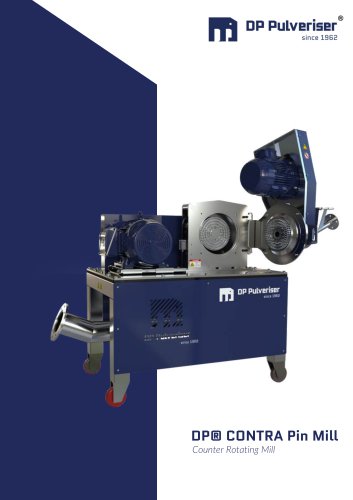 DP® CONTRA Pin Mill
10 Pages
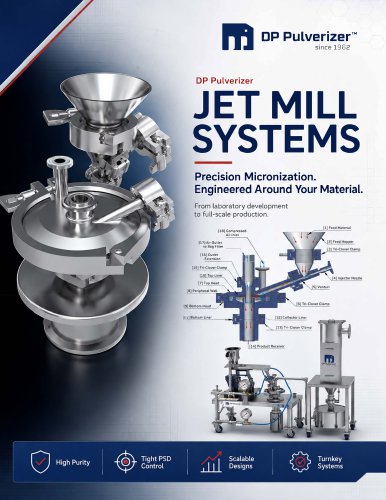 DP Pulverizer
12 Pages
 Algae Processing System
6 Pages
 Carbon Milling
8 Pages
 Protein Milling System
10 Pages
 Cosmetic Manufacturing
8 Pages
 PCB Recycling System
9 Pages
 Peptide and Collagen Processing
18 Pages
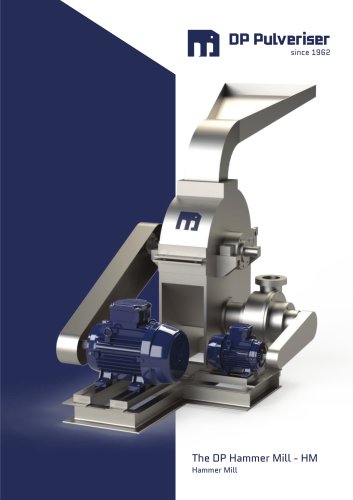 DP Pulverizer Hammer Mills
11 Pages
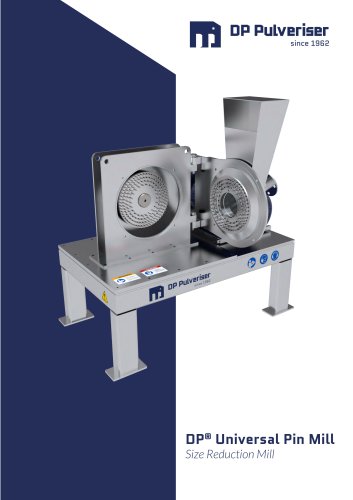 DP Pulverizer Pin MIlls
3 Pages
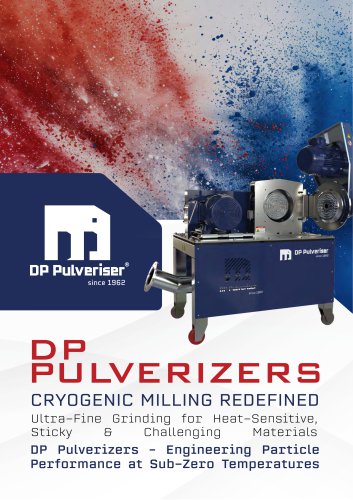 DP Pulverizer Cryogenic Mills
11 Pages
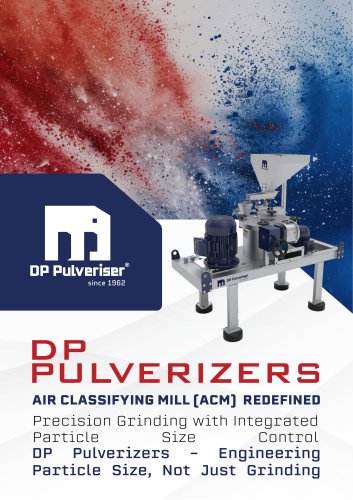 DP Pulverizer Air Classifier Mills
17 Pages
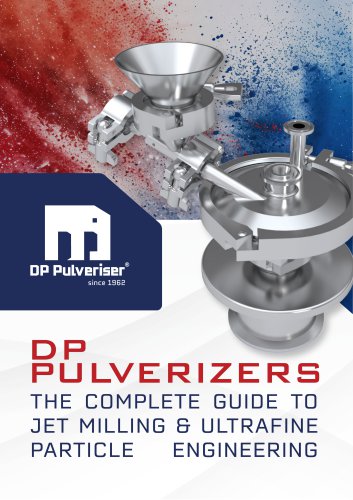 DP Pulverizer Jet Mills
11 Pages
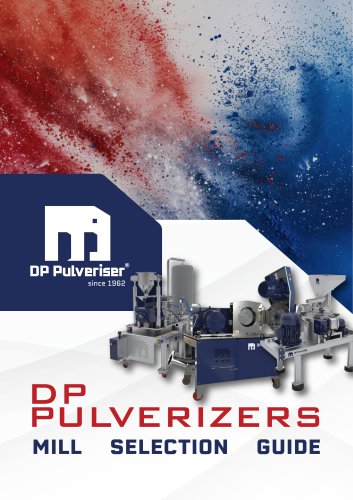
- Food lump breaker
- Waste chopper
- Recycling grinding mill
- Plastic grinding mill
- Lump breaker for the food industry
- Mill for the pharmaceutical industry
- Hammer grinding mill
- Mineral mill
- Powder lump breaker
- Laboratory pulverizer
- Automatic grinding mill
- High-speed grinding mill
- Disc pulverizer
- Grinding mill for the chemical industry
- Grain grinding mill
- Ultrafine mill
- Wood pulverizer
- Variable speed lump breaker