
- Catalogs
- Dow Corning
- Correct Antifoam Concentration Choice


Correct Antifoam Concentration Choice

Correct Antifoam Concentration Choice
Specifications:
The document provides guidelines for determining the appropriate concentration of silicone antifoam, specifically polydimethylsiloxane, in foaming solutions. A starting concentration of 10 parts per million (ppm) is recommended, aligning with FDA and European food additive regulations. Adjustments may be necessary based on local food profiles.
Calculation Formula:
The formula to calculate the required amount of antifoam is:
(ppm polydimethylsiloxane) x (amount of solution to be defoamed) / (% active ingredient in antifoam x 10,000) = antifoam to be added.
Examples are provided for different XIAMETER® products to achieve 10 ppm in 1,000 kg of foaming solution.
Handling Precautions:
Users are advised to consult product and material safety data sheets and container labels for safe handling and hazard information. These resources are available on the Dow Corning website.
Warranty and Liability:
Dow Corning offers a limited warranty that products will meet sales specifications at shipment time. Remedies are limited to refund or replacement. The company disclaims any other warranties and liability for incidental or consequential damages.
Additional Information:
Further details on Dow Corning’s solutions for food and beverage processing can be found on their website.
Catalog excerpts

Choosing the Correct Antifoam Concentration When testing the effectiveness and practicality of a silicone antifoam from Dow Corning, a good starting point is to add the antifoam to the foaming medium at a concentration that represents 10 parts per million (ppm) silicone (polydimethylsiloxane). Typically, 10 ppm is the maximum concentration of silicone allowed according to FDA and European food additive regulations. If appropriate, further reduce the antifoam addition level to obtain the required level of foam control. However, you should always refer to local food profiles to determine the maximum level allowed for the specific type of food. You can use this formula to calculate how much silicone antifoam should be added to achieve the recommended ppm level of polydimethylsiloxane: (ppm polydimethylsiloxane) x (amount of solution to be defoamed1) (% active ingredient in antifoam2) x (10,000) 1 2 Use the same units (liters, gallons, pounds, etc.) to measure the amount of antifoam added and amount of solution to be defoamed. Insert “10” for 10% active, “30” for 30% active, etc. If you want to add 10 parts per million of active polydimethylsiloxane in 1,000 kg of foaming solution, you will have to add: • 0.01 kg of XIAMETER® ACP-1500 Antifoam Compound • 0.1 kg of XIAMETER® AFE-1510 Antifoam Emulsion • 0.05 kg of XIAMETER® AFE-1520 Antifoam Emulsion or XIAMETER® ACP-1920 Powdered Antifoam • 0.033 kg of XIAMETER® AFE-1530
Open the catalog to page 1
Learn more For additional information regarding Dow Corning’s solutions for food and beverage processing, visit dowcorning.com/food. Contact information for a Dow Corning location near you can be found at dowcorning.com/ContactUs. Images: AV22376, AV22609 HANDLING PRECAUTIONS PRODUCT SAFETY INFORMATION REQUIRED FOR SAFE USE IS NOT INCLUDED IN THIS DOCUMENT. BEFORE HANDLING, READ PRODUCT AND MATERIAL SAFETY DATA SHEETS AND CONTAINER LABELS FOR SAFE USE, PHYSICAL AND HEALTH HAZARD INFORMATION. THE MATERIAL SAFETY DATA SHEET IS AVAILABLE ON THE DOW CORNING WEBSITE AT DOWCORNING.COM, OR FROM YOUR...
Open the catalog to page 2All Dow Corning catalogs and technical brochures
 MOLYKOTE® 7325 Grease
2 Pages
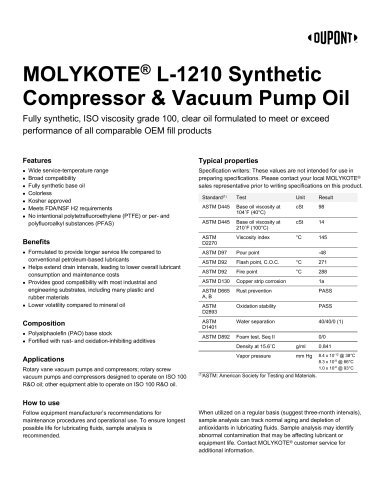 MOLYKOTE® L-1210 Synthetic
2 Pages
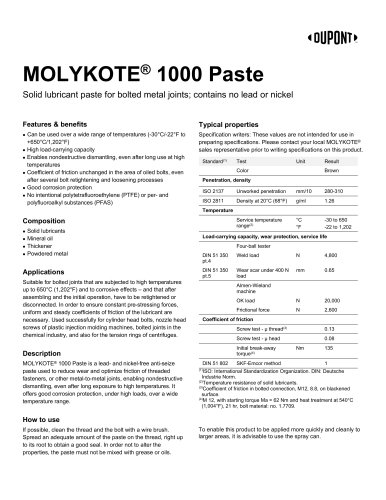 MOLYKOTE® 1000 Paste
2 Pages

Archived catalogs
 Molykote ® Z Powder
2 Pages
 MOLYKOTE® MH-62 GREASE
8 Pages
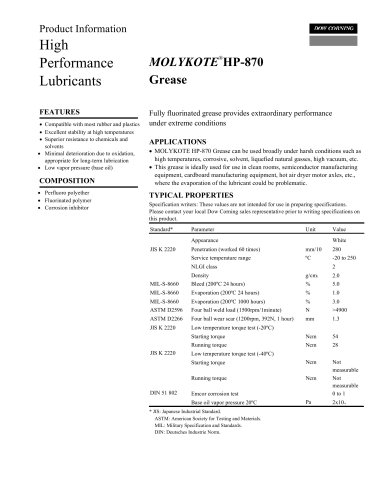 MOLYKOTE® HP-870
2 Pages
 Molykote? G-4501
2 Pages
 MOLYKOTE® 44
2 Pages
 Molykote® 1292
2 Pages
 MOLYKOTE® BR 2
2 Pages
 Dow Corning Plasma Solutions
2 Pages
 Design guide to optimize
8 Pages
 Total Airbag Solutions
8 Pages
 Adhesives advertisement
2 Pages
 Automative
4 Pages
 Chip Scale Review Reprint
5 Pages
 From the Pedal to the Pad
8 Pages
 Dow Corning Code of Conduct
10 Pages
 Automotive Airbag
8 Pages
 Elastomers from Dow Corning
8 Pages
 Dow Corning and You Belgium
6 Pages
 2 part RTV
6 Pages
 Molykote® Industrial Lubricants
52 Pages
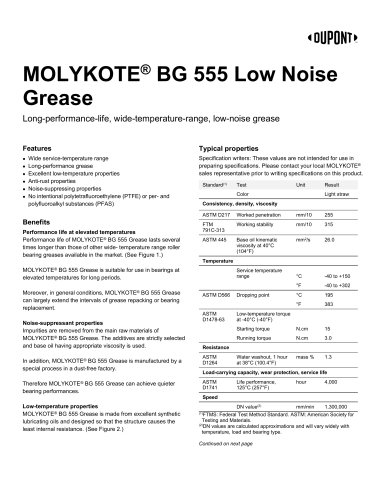


- Synthetic lubricant
- Synthetic oil
- High-performance lubricant
- Mineral lubricant
- Bearing lubricant
- High-temperature lubricant
- Industrial oil
- Gear lubricant
- Mineral oil
- Bearing grease
- Metal lubricant
- Long-life lubricant
- Universal lubricant
- High-temperature oil
- Low-temperature lubricant
- High load capacity lubricant
- High-temperature grease
- Metal spray
- Gear oil
- Synthetic grease