


- Company
- Products
- Catalogs
- News & Trends
- Exhibitions
PCB Relays Safety Relays

PCB Relays Safety Relays
- Product Range: The document lists various types of relays, including safety relays with 4-8 contacts, PCB relays (monostable and bistable), and miniature relays. Each type is detailed with specific models and features.
- Company Philosophy: DOLD emphasizes its philosophy of "Our experience. Your safety," showcasing over 80 years of expertise and a workforce of more than 400 employees. The company prides itself on high-quality products and customer-focused solutions.
- Applications: DOLD relays are used in diverse industries such as machinery, power generation, automation, transport, medical technology, and more. The relays are crucial for safety applications, including emergency stop switches and safety doors.
- Global Presence: The document lists DOLD's agents and contact information across various countries, indicating a strong international presence.
- Certifications and Standards: All safety relays comply with DIN EN 50205 and have TÜV Rheinland and UL approvals. The products are ROHS compliant, adhering to EU guidelines.
- High production depth and modern manufacturing equipment ensure quality and reliability.
- Relays are available in various contact variants and construction forms, offering high switching safety in compact sizes.
- Focus on customer-specific solutions and maintaining close contact with clients for tailored high-tech solutions.
DOLD PCB relays are designed for high power switching with high reliability in compact spaces. They are globally used for switching loads and providing galvanic separation in electrical circuits. Common applications include emergency stop switches, safety doors, light barriers, railway signaling, elevator controllers, and medical equipment. These relays are manufactured with robust quality standards in the Black Forest, ensuring certified safety.
- Galvanic separation between control and load circuits.
- Switching loads up to 16 A with low nominal drive power.
- Up to 8 contacts in one contact set.
- Low contact transfer resistance and increased insulation values.
- Energy efficiency through sensitive or bistable switching behavior.
- Compact dimensions and suitable relay sockets for quick replacement.
These relays, compliant with DIN EN 61810-3, are crucial for protecting people, machines, and goods from injury and damage. They feature at least one NC and one NO contact set, ensuring they cannot be closed simultaneously, which aids in diagnostics and fault detection. Two types exist: Type A (all contacts mechanically linked) and Type B (mechanically and non-mechanically linked contacts).
The document lists various relay types (e.g., OA 5611, OA 5612) with specifications such as contact equipping, contact material, limit continuous current, nominal voltage, voltage range, insulation test voltage, clearance and creepage distances, temperature range, protection type, size, and approvals. These relays are available in monostable types with different contact configurations and materials like AgSnO2 and AgNi.
DOLD relays are used in railway equipment, lift controllers, combustion technology, automation, process technology, and medical equipment. They offer reliability, energy efficiency, and compact design, making them ideal for modern safety applications where space is limited.
Sockets for PCB and DIN rail mounting are available, facilitating quick relay replacement during maintenance. The relays are designed to meet the demands of miniaturization while maintaining necessary clearance and creepage distances.
PCB relays, also known as plug-in/print relays, are utilized for galvanic separation of circuits, signal adaptation, and signal strengthening. They are available in vertical and horizontal designs to suit various applications. Monostable relays return to their original position after power is off, while bistable relays retain their position, making them energy-efficient and suitable for battery-powered systems. DOLD PCB relays support continuous currents up to 16 A and are available with different contact materials and configurations.
Specifications:
Relays are categorized into monostable and bistable types, with contact materials such as AgSnO2 and AgNi. They support nominal voltages ranging from DC 6-110 V and AC 12-230 V, with a test voltage of ≥ 4 kVeff. The temperature range varies from -40°C to +110°C, and they are available in different protection types, including RT II and RT III.
Applications:
Typical applications include building automation, installation technology, energy technology, remote switching, and staircase timers.
Miniature Relays:
Miniature relays are compact, measuring around 20 mm long and 10 mm wide, and are available in SMD and DIL forms. They are suitable for high power switching in small spaces, with features like high switching power, large voltage range, and reliability. They are available in NO design or with changeover contacts.
Safety Relays:
Safety relays, such as OA 5601, OA 5602, and OA 5603, comply with DIN EN 61810-1 and DIN EN 61810-3 standards. They feature forcibly guided contacts, high switching reliability, and high mechanical service life. They are suitable for safety applications in escalators, elevators, railway technology, and medical technology.
Technical Data:
Safety relays have a nominal voltage range of DC 6-110 V, with a nominal consumption of 0.75-1.25 W. They support a continuous thermal current of 10 A and have a high voltage resistance of ≥ 4 kV. The contact arrangement varies, with options for NO and NC configurations.
- Contact Materials: AgSnO2 and AgNi with gold plating options.
- Switching Capacity: Up to 10 A at AC 230 V, with varying cycles based on material.
- Switching Frequency: Maximum of 10 cycles per second.
- Response and Release Time: Typically 27 ms and 5 ms respectively.
- Contact Force: Minimum of 14 cN.
- Contact Gap: Greater than 1 mm in normal operation.
- Mechanical Life: Over 30 million switching cycles.
- Temperature Range: -40°C to +85°C.
- Protection Degree: Options for solder line proof (RT II) and wash proof (RT III).
- Vibration Resistance: Up to 5 g at 10-55 Hz.
- Short Circuit Strength: 1 kA at AC 250 V.
- Insulation Voltage: Rated at 250 V AC with pollution degree 3.
- Test Voltage: Contact-Coil and Contact-Contact at 4 kV for 1 minute.
- Transient Voltage: Contact-Coil at 6 kV.
- Clearance and Creepage Distances: Minimum of 8 mm for Contact-Coil.
- Contact Arrangements: Various configurations including 2 NO/2 NC, 3 NO/1 NC, etc.
- Pin Configuration: Suitable for basic grid dimensions of 2.5 mm and 2.54 mm.
- Weight: Ranges from approximately 78 g to 95 g depending on model.
- Designed for safety applications such as escalators, elevators, and railway technology.
- Relays are available with forcibly guided contacts and high switching reliability.
- Options for wash proof relays are available for enhanced protection.
- Electrical Life: The document specifies the electrical life of various relay contacts under different conditions, such as AC 230 V and DC 24 V, with switching cycles ranging from 0.75 x 10⁵ to 3 x 10⁵ depending on the contact material (AgSnO2 or AgNi).
- Switching Frequency: Maximum switching cycles per second is 10.
- Response and Release Time: Typically 12 ms for response and 8 ms for release.
- Contact Force and Gap: Minimum contact force is 8 cN, and the contact gap is greater than 0.5 mm.
- Mechanical Life: Over 20 million switching cycles.
- Temperature Range: Operates between -40°C and +80°C.
- Protection and Resistance: Wash proof housing (RT III), vibration resistance according to IEC/EN 60068-2-6, and climate resistance as per IEC/EN 60068-1.
- Short Circuit Strength: 1 kA at AC 250 V.
- Contact Arrangements: Various configurations including 3NO/1NC, 2NO/2NC, 4NO/2NC, etc., with different contact materials like AgSnO2 and AgNi with gold plating.
- Insulation: Rated insulation voltage is 250 AC V, with a pollution degree of 2 and overvoltage category III.
- Weight and Packaging: Weight ranges from approximately 35 to 39.5 grams, with packaging options of 15 to 250 pieces depending on the configuration.
- Suitable for use in safety applications, automation, medical devices, railway technology, and more.
- Includes details on soldering methods, pin configurations, and connection diagrams for various relay types.
- Recommendations for ventilation and handling to ensure optimal performance and longevity.
The document outlines the technical specifications for various relay models, including OA 5621, OA 5622, OB 5623, and OA 5642 series. Key specifications include:
- Switching voltage range: AC/DC 2 V to AC 250 V, DC 220 V.
- Limiting continuous current: 3 x 5 A to 5 x 5 A.
- Switching power: 1 mVA to 1250 VA, 1 mW to 120 W.
- Electrical life: Over 2 x 10⁵ cycles at AC 230 V, 5 A.
- Mechanical life: Over 20 x 106 cycles.
- Temperature range: -40°C to +80°C.
- Degree of protection: Wash proof RT III.
The relays comply with standards such as IEC/EN 60947-5-1 and UL 508. They are designed for applications requiring high reliability and safety, including railway and signaling, automation, and medical devices.
The relays are available in various configurations, including 4-pole and 6-pole designs, with different contact arrangements (e.g., 3NO, 1NC; 2NO, 2NC). They feature AgNi and AgSnO2 contact materials with optional gold plating for enhanced performance.
Relays are designed for high switching frequency (up to 10 cycles/s) and have a response time of typically 12 ms. They offer high short circuit strength (1 kA / AC 250 V) and are vibration resistant according to IEC/EN 60068-2-6.
For optimal performance, it is recommended to operate within specified voltage and current limits and to ensure proper ventilation when using maximum switching capacity. The relays are suitable for applications requiring low energy consumption and safe separation between circuits.
Accessories include sockets for mounting, and some models offer manual operation options. The relays are RoHS compliant and designed for easy integration with SMD components.
- Voltage and Current: The document specifies a maximum voltage of 60 V AC/DC and a continuous current limit of 8 A per contact. The switching current ranges from a minimum of 10 mA to a maximum of 8 A.
- Switching Power: The minimum and maximum switching power is detailed as 0.1 VA to 2000 VA and 0.1 W to 200 W, with specific conditions for resistive loads.
- Switching Capacity: Compliance with IEC/EN 60947-5-1 is noted, with specific voltage and current ratings for AC and DC applications.
- Electrical and Mechanical Life: The relay is rated for over 105 switching cycles electrically and over 40 million mechanically.
- Temperature and Protection: Operating temperature ranges from -40°C to +85°C, with a wash-proof protection rating of RT III.
- Contact Materials: Options include AgSnO2 and AgNi with gold plating for enhanced conductivity and durability.
- Insulation and Safety: Rated insulation voltage is 250 V with a pollution degree of 2 and overvoltage category III. Test voltages are specified for contact-coil and contact-contact scenarios.
- Vibration and Climate Resistance: The relay meets IEC/EN 60068-2-6 standards for vibration and IEC/EN 60068-1 for climate resistance.
- The relays are suitable for safety applications and press controls, with approvals according to DIN EN 61810-1 and DIN EN 61810-3.
- Dimensions and Configuration: Detailed dimensions and pin configurations are provided for various relay models.
- Soldering and Packaging: The document specifies soldering methods and packaging details, including quantities per package.
The document outlines the specifications for various PCB relays, including safety relays OA/OW 5669 and OA 5670. These relays comply with standards such as DIN EN 61810-1 and DIN EN 61810-3, featuring forcibly guided contacts, high mechanical service life, and compact size. They offer low power consumption and options for wash-proof models.
Technical Data:
Relays are available with nominal voltages ranging from 6V to 110V DC, with nominal consumption between 0.7W and 1.0W. They support a wide voltage range and have a high dielectric strength. The contact arrangements include configurations like 1 NC/1 NO, 2 changeover contacts, and more. Contact materials include AgSnO2 and AgNi with gold plating options.
Performance:
The relays have a high switching reliability and can operate at temperatures from -40°C to +85°C. They have a mechanical life of over 50 million switching cycles and an electrical life of over 200,000 cycles at specified loads. The switching frequency can reach up to 10 cycles per second.
Safety and Standards:
These relays provide double and reinforced insulation between contact sets, with clearance and creepage distances of ≥8 mm and ≥5.5 mm, respectively. They are designed for applications in safety technology, escalators, elevators, and railway technology.
Accessories:
Various sockets and fixing clips are available for DIN-rail mounting, with options for screw terminals and cage clamp terminals. Function modules with LEDs and free-wheel diodes are also offered.
Applications:
The relays are suitable for use in safety technology, press controls, and other industrial applications requiring high reliability and safety standards.
- Switching Power: Minimum 0.1 VA / 0.13 W, Maximum 1500 VA / 200 W. Refer to the limit curve for arc-free operation.
- Switching Capacity: Compliant with IEC/EN 60947-5-1 and UL 508 standards. AC 15 and DC 13 ratings provided for various configurations.
- Electrical Life: At AC 230 V, 6 A, the life is > 2.6 x 10⁵ cycles for AgNi contacts. At DC 24 V, 6 A, the life is > 4 x 10⁶ cycles.
- Switching Frequency: Maximum of 10 cycles per second.
- Response and Release Time: Typically 11 ms and 6 ms, respectively.
- Contact Force: NO/NC contact force is ≥ 10 cN.
- Mechanical Life: ≥ 50 million cycles.
- Temperature Range: -40°C to +75°C.
- Protection Degree: Options for solder line proof RT II and wash proof RT III.
- Vibration Resistance: 10 to 200 Hz; NC 5 g, NO 10 g as per IEC/EN 60068-2-6.
- Climate Resistance: 40/075/04; A/B/D as per IEC/EN 60068-1.
- Short Circuit Strength: 1 kA at AC 250 V.
- Contact Material: Options include AgNi10, AgSnO2 with Au plating.
- Insulation: Double and reinforced insulation as per IEC 60664-1, EN 50178. Rated insulation voltage is 250 AC V.
- Dimensions and Pin Configuration: Various configurations available for different relay types.
- Weight: Approximately 21 grams.
- Packing: Available in cardboard pieces of 42 or case packages of 210.
- Solder Method: Wave soldering at 260°C for 5 seconds.
- Switching Power: Minimum and maximum values are specified for both VA and W, with different configurations for AC and DC.
- Switching Capacity: Complies with IEC/EN 60947-5-1 and UL 508 standards, with specific ratings for AC and DC voltages.
- Electrical Life: Varies based on voltage and current, with typical values provided for different configurations.
- Switching Frequency: Maximum of 20 switching cycles per second.
- Response and Release Time: Typically 7 ms and 3 ms, respectively.
- Contact Force: Specified for normally open (NO) and normally closed (NC) contacts.
- Mechanical Life: Approximately 30 million switching cycles.
- Temperature Range: Operates between -40°C and +110°C.
- Protection and Resistance: Solder line proof RT II, vibration resistance up to 10 g, and climate resistance according to IEC/EN 60068-1.
- Design Versions: Various models with different contact arrangements and mounting options.
- Insulation: Rated insulation voltage of 250 AC V, with specific test voltages and clearance distances.
- Weight and Packaging: Weight specified for different models, with packaging options in blister and case packages.
- Soldering Method: Wave soldering at 260°C for 5 seconds.
- Relay Types: Includes monostable and bistable relays, with specific models for different applications.
- Applications: Suitable for control techniques and interface applications, with options for wash proof models.
- Accessories: Includes sockets and fixing clips for DIN-rail mounting, with function modules for specific voltage requirements.
- Product Range: Covers a variety of miniature relays, including monostable and SMD models.
- Relay Coil: Nominal voltage options include 4, 5, 6, 12, 20, 24, and 48 V DC. Nominal consumption varies by model and contact type.
- Contacts: Available in 1 NO and 1 changeover contact arrangements. Contact materials include AgSnO2 and AgNi with gold plating options.
- Electrical Ratings: Rated insulation voltage is 250 V AC. Switching voltage ranges from 10 V to 400 V AC/DC. Limiting continuous current (Ith) varies between 5 A and 10 A depending on the model.
- Performance: Electrical life is rated at 1 x 10⁵ switching cycles at AC 230 V, 5 A. Mechanical life exceeds 50 x 106 cycles.
- Environmental Specifications: Operating temperature range is -40°C to +80°C. The relays are wash proof (RT III) and have high vibration and climate resistance.
- Relays are available in very small volume DIL models that can be plugged into standard IC sockets.
- Different connection arrangements and contact materials are offered to suit various applications.
- Pin configurations are compatible with standard grid divisions and have specific tolerances for pin distance.
- High dielectric strength (≥ 4 kV) and low power consumption.
- Safe separation according to IEC/EN standards.
- Large voltage range and low mutual capacitance.
The document provides detailed specifications for various relay types, including OW 5691 and OW 5699. Key parameters include resistance at 20°C, nominal consumption, holding power, response voltage, and nominal voltage. The relays are designed with different contact materials such as AgNi and AgSnO2, and are available in different design versions.
Procedures:
The document outlines soldering methods, including wave soldering at 260°C for 5 seconds and reflow-convection soldering at 260°C for 10 seconds. It also specifies the packing methods, with options for cardboard slipcase or case package.
Standards and Norms:
The relays comply with standards such as DIN EN 61810-1 and DIN EN 60664-1. Insulation is rated according to IEC 60664-1, with a rated insulation voltage of 250 AC V and a test voltage of ≥ 4 kV. Pollution degree is 3, and overvoltage category is III.
Recommendations:
For optimal performance, the relays should be used within specified voltage ranges and under recommended environmental conditions. The document also provides guidelines for handling and installation to ensure reliability and longevity.
Key Data from Tables and Graphs:
The document includes tables detailing resistance, nominal consumption, and response voltage for different relay models. Graphs illustrate operating voltage limit curves, switching power, and contact service life, highlighting the performance characteristics under various conditions.
General Provisions:
The legal relations between supplier and purchaser are governed by specific terms, including retention of title and conditions for partial deliveries. Prices are ex-works, and payment terms are specified.
Time for Supplies and Delay:
Delivery times are binding only if all required documents are furnished by the purchaser. Delays are addressed with specific remedies and conditions for contract rescission.
1. Delivery and Delays:
- Purchaser must ensure timely receipt of necessary permits and fulfill payment obligations. Delays due to force majeure or supplier's own supply issues extend delivery times.
- If the supplier is responsible for delays, the purchaser can claim liquidated damages up to 5% of the affected supply price.
- Purchaser's claims for damages are limited unless due to intent, gross negligence, or personal injury.
2. Passing of Risk:
- Risk transfers to the purchaser upon shipment or assembly completion, depending on the agreement.
- Delays caused by the purchaser result in risk transfer.
3. Assembly and Erection:
- Purchaser provides necessary infrastructure and information for assembly.
- Delays not caused by the supplier result in additional costs for the purchaser.
- Acceptance of supplies is deemed if not contested within two weeks.
4. Receiving Supplies:
- Minor defects do not justify refusal of supplies.
5. Defects as to Quality:
- Supplier liable for defects existing at risk transfer time, with a 12-month limitation for claims.
- Purchaser must notify defects promptly and may withhold payments proportionate to the defect.
- Supplier has the opportunity to repair or replace defective goods.
- Claims are excluded for minor deviations, natural wear, or improper handling.
6. Industrial Property Rights and Copyright:
- Supplier ensures supplies are free from third-party rights in the delivery country.
- Supplier liable for IPR infringements, with options to modify or replace infringing supplies.
7. Impossibility of Performance:
- Purchaser can claim damages for non-performance unless the supplier is not responsible.
- Contract adaptation is possible for unforeseeable events affecting supply.
8. Other Claims for Damages:
- Purchaser's claims are limited unless due to mandatory liability, intent, or gross negligence.
- Statute of limitations applies to damage claims.
- If the Purchaser is a businessman, any disputes related to the contract will be resolved at the Supplier's place of business. However, the Supplier has the option to initiate legal action at the Purchaser's place of business.
- The contract is governed by German substantive law, excluding the United Nations Convention on Contracts for the International Sale of Goods (CISG).
- If any provision of the Agreement is legally invalid, the remaining provisions remain valid unless it is unreasonable for one party to continue the contract.
Catalog excerpts

PCB Relays Safety Relays
Open the catalog to page 1
Europe Austria IPR Industrieprodukte Konrad Rechberger Rosenleiten 84 A-4101 Feldkirchen Phone: +43 7233 662111 Fax: +43 7233 662121 e-mail: [email protected] Belgium Tempolec S.A. Route de Biesme 49 B-6530 Thuin Phone: +32 71 590039 Fax: +32 71 590161 e-mail: [email protected] Czech Republic OS-KOM spol.s.r.o Zdikovska 22 CZ 150 00 Praha 5 - Smichov Phone: +420 2 57210114 Fax: +420 2 57211935 e-mail: [email protected] Denmark ICS A/S Holkebjergvej 79 DK-5260 Odense SV Phone +45 66 17 10 74 Fax +45 66 17 10 65 E-mail [email protected] interner http://www.ics-as.dk England Dold Industries Ltd. 11...
Open the catalog to page 2
Product range Safety relays with 4-6 or 4-8 contacts sensitive with double contacts with 2 contacts 2 contacts, for high ambient temp. up to +85°C with with reinforced insulation with 4 contacts Miniature relays
Open the catalog to page 3
Foreword Our catalogue includes an overview of all available PCB relays from Dold. In the first part you will find the relays with positive guided contacts. All safety relays correspond to DIN EN 50205 and are approved by TÜV Rheinland. Additionally the relays have an UL- approval. In the second part you will find an overview of PCB- and miniature relays. We would like to inform you that all relays mentioned in our catalogue are also available with other voltages, contact variants and combinations of different contact materials. Of course, our products are ROHS compatible (Restriction of Hazardous...
Open the catalog to page 4
Table of contents Function Type Page Miniature relays Safety relays Type Page
Open the catalog to page 5
Machinery and plant Power generation/distribution Oil and gas industry Automation Transport and material handling systems Rail technology Aviation/marine industry Paper and printing industry Food industry Rubber/plastics industry Heating and refrigeration Automotive Mining/metal working Chemical/pharmaceutical applications Medical technology Water/waste water treatment Cable cars/ski lifts ... and wherever safety has high priority. We can cover your industrial applications as well!
Open the catalog to page 6
The DOLD philosophy, “Our experience. Your safety” constitutes our program: Offering solutions based on over 80 years of experience with a workforce of more than 400 employees, we manufacture high quality products using state-of-the-art production plant at our Furtwangen facility in Germany. The comprehensive product range includes relay modules, safety relays with positively-driven contacts and electronic housings with virtually unparalleled production detail. The combination of know-how, innovation and experience makes us one of the leading worldwide manufacturers. Apart from standard solutions,...
Open the catalog to page 7
Printed circuit board relays from DOLD DOLD PCB relays.Your solution provider. DOLD relays are used throughout the world. They have the task of switching loads and galvanically separating electrical circuits. Classical applications, particularly for relays with mechanical forcibly guided contacts, are in the monitoring of emergency stop switches, safety doors or light barriers, for example.They are also essential in railway signalling equipment, in the controllers for passenger and goods elevators as well as in medical equipment.Wherever people and machines must be protected from injury and damage...
Open the catalog to page 8
The right relay - for every application Individual, customer-specific safety relays. Features that distinguish DOLD relays: Partially equipped contact sets for increased insulation values, mixed contact equipping with single and double contacts as well as different contact materials for the loads to be switched require only a few minor adjustments for us to adapt our relays to individual, customer-specific requirements. ▶ Galvanic separation between control and load circuits ▶ Switching of loads up to 16 A with low nominal drive power ▶ Up to 8 contacts in one contact set ▶ Low contact transfer...
Open the catalog to page 9
Safety relays, i.e. relays with mechanically forcibly guided contacts per DIN EN 61810-3, are used wherever people, machines and valuable goods must be protected from injury and damage. One such relay comprises at least one NC contact set and one NO contact set and is constructed such that the NC set and the NO set can never be closed at the same time. For example, if a NO contact fails when trying to open, the associated NC contact cannot close when the power supply is switched off. This behaviour enables simple diagnostics and fault detection when monitoring the forcibly guided feedback contacts....
Open the catalog to page 10
DOLD safety relays are available in vertical and horizontal designs and offer up to 8 mechanically forcibly guided contacts. With different construction forms, contact materials and also with partially equipped contact sets if required, we offer you maximum flexibility. Types OA 5601, OA 5602 and OA 5603 with 4, 6 or 8 contacts are rated for max. continuous currents up to 10 A. It is also possible to choose between single contacts and double contacts for challenging tasks with the OA 5621 and OA 5622 relays. With DOLD you can always switch safe and reliably. You can find more detailed information...
Open the catalog to page 11
Relays with mechanically forcibly guided contacts are used in safety relay modules or controllers amongst other things. The simplicity in the use of safety relays makes them the ideal component for detecting faults due to the forced driving of NC and NO contacts without the need for complex circuitry. In these safety relevant applications, particular attention is paid to the compact form alongside the high degree of switching security. At just 10.3 mm height, the extremely flat relay family OA 5642, OA 5643 and OA 5644 with 2, 3 takes account of the desire for components to be ever smaller and...
Open the catalog to page 12
Sockets for PCB mounting are available for almost all safety relays. These enable the safety relays to be quickly replaced during preventative maintenance. In addition, sockets are also available for DIN rail mounting. Typical areas of application are: ► Railway equipment ► Lift controllers ► Combustion technology ► Automation and process technology ► Medical equipment ► Materials handling With DOLD you can always switch safe and reliably. You can find more detailed information on our PCB relays at www.dold.com.
Open the catalog to page 13All DOLD catalogs and technical brochures
 SAFEMASTER
13 Pages
 SAFEMASTER
5 Pages
 SAFEMASTER PRO
9 Pages
 VARIMETER PRO
5 Pages
 VARIMETER
7 Pages
 SAFEMASTER W group mode
9 Pages
 SAFEMASTER W
9 Pages
 DOLD
DOLD3 Pages
 Speed monitor UH 6932
2 Pages
 Insulation monitor RN 5897
2 Pages
 Safety technique
626 Pages
 Installation technique
114 Pages
 Time control technique
194 Pages
 Control technique
162 Pages
 Power electronics
210 Pages
 Monitoring technique
514 Pages
 News E-Mobility
3 Pages
 News 2018.01
3 Pages
 News 2017.01
5 Pages
 News 2017.02
3 Pages
 News 2016
3 Pages
 Highlights
7 Pages
 Brochure SAFEMASTER STS
20 Pages
 Flyer Option module
4 Pages
 Flyer Safety timer UG 6960
2 Pages
 Flyer Safety module UG 6970
2 Pages
 Flyer SAFEMASTER PRO
2 Pages
 Flyer enclosure KS 4460
3 Pages
 Flyer SAFEMASTER STS
2 Pages
 Catalog relay modules
909 Pages
 Enclosure overview
20 Pages
 Flyer In Rail Bus
4 Pages
 company presentation
7 Pages
 Catalog PCB relays safety relays
135 Pages


- Digital I/O
- DOLD plastic enclosure
- IO module
- Mechanical lock
- DOLD switching relay
- Analog I/O
- Digital IO module
- Technology switch
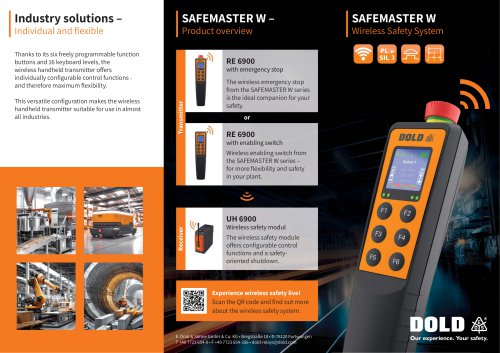
- Wireless remote control
- Industrial remote control
- Remote control with buttons
- Protection relay
- Multipole switch
- DOLD electronic equipment enclosure
- Electromechanical relay
- Compact housing
- Door lock
- Steel lock
- Electromechanical switch
- Analog IO module