
- Catalogs
- DL Chemicals
- PARACHIM POLYESTER

PARACHIM POLYESTER

PARACHIM POLYESTER
- The product may cause staining in certain materials, such as natural stone, due to monomer migration. Preliminary testing is advised.
- Not suitable for anchoring into porous or reconstituted stone.
- Not intended for cosmetic or decorative use.
- Not suitable for anchoring into holes flooded with seawater.
Catalog excerpts
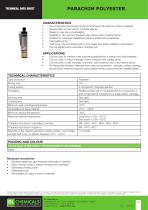
PARACHIM POLYESTER TECHNICAL DATA SHEET Two component anchoring mortar for anchoring into solid and hollow materials Styrene free, can be used in confined spaces Ready to use, pre-cut packaging Suitable for dry, wet and flooded holes without loss of performance Suitable for overhead installations (without additional accessories) Fast loading time Anchoring may be placed close to the edges (see table installation parameters) Can be applied with a standard cartridge gun Can be used for medium load anchoring applications in hollow and solid materials. Can be used in hollow materials: hollow masonry and voided stone. Can be used in solid materials: concrete, solid masonry, rock, hard natural stone. For fixing roller shutters, staircase hand rails, sun protection, canopies, boilers, racking, bicycle racks, masonry supports, signs, safety barriers, balcony fences, satellite dishes... TECHNICAL CHARACTERISTICS Type of product Mixing ratio Curing system Flexible pocket with 2 compartments for component A and component B contained in a single-piston cartridge Working time Loading time Minimum resin cartridge temperature Temperature of base material Minimum service temperature Maximum service temperature Long term (>12h): +50°C Short term (<12h): +80°C Threaded rod sizes in uncracked concrete Threaded rod sizes in masonry Shelf life, in the original packing in upside position, out of direct sunlight and in dry conditions between +5°C - +25°C PACKING AND COLOUR 12 cartridges of 300 ml/box - 95 boxes/pallet (1140 cartridges) Beige Necessary accessories • Standard applicator gun (manual, pneumatic or electric) • Static mixing nozzle (2 pieces included with cartridge) • Cleansing blowing pump • Cleansing brush • Sieve sleeve (in case of hollow materials) This technical data sheet replaces all previous editions. The data on this sheet have been drafted according to the last state of the laboratory data. Technical characteristics can be changed or adapted. We are not responsible in case of incompleteness. Before usage, one needs to ensure that the product is suitable for its application. Therefore, tests are necessary. Our general conditions apply.
Open the catalog to page 1
METHOD OF USE EXTRUDE THE FIRST PART TO WASTE Application in solid or hollow substrate 1. Drill the hole to the correct diameter and depth. 2. Thoroughly clean the hole in the following sequence: For solid materials: blow clean x2, then brush clean x2, then blow clean x2, then brush clean x2 and blow clean x2. For hollow materials: brush clean 1x, then blow clean x1. Note: use a brush with the required extensions and a source of clean compressed air. For holes of 400 mm or less deep, a blow pump may be used. The resin should be injected into a properly cleaned hole. Remove standing water before...
Open the catalog to page 2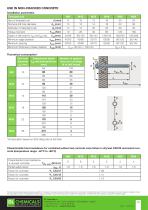
USE IN NON-CRACKED CONCRETE Installation parameters Threaded rod Nominal drill hole diameter Diameter of cleaning brush Minimum edge distance Minimum spacing Minimum thickness of base material Torque moment Depth of drill hole for hef min/hef max Theoretical consumption* Drill hole diameter do (mm) Number of applications per cartridge (# of drill holes) Embedment depth hef min/standard/max (mm) *Consumption based on 60% filling rate of drill hole. Characteristic bond resistance for combined pullout and concrete cone failure in dry/wet C20/25 uncracked concrete (temperature range: -40°C to +80°C)...
Open the catalog to page 3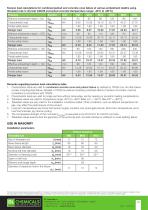
Tension load calculations for combined pullout and concrete cone failure at various embedment depths using threaded rods in dry/wet C20/25 uncracked concrete (temperature range: -40°C to +80°C) Property Effective embedment depth = 8d Characteristic load Partial safety factor Design load Effective embedment depth = STD Characterstic load Partial safety factor Design load Effective embedment depth = 10d Characterstic load Partial safety factor Design load Effective embedment depth = 12d Characterstic load Partial safety factor Design load Remarks regarding tension load calculations table 1. Characteristic...
Open the catalog to page 4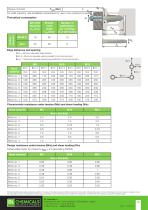
Torque moment Tinst For solid masonry: see installation parameters for use in non-cracked concrete. Theoretical consumption Hollow masonry Anchor size Drill hole diameter do (mm) Number of applications per cartridge (# of drill holes) Edge distances and spacing Cmin = Minimum allowable edge distance Smin II = Minimum allowable spacing parallel to the horizontal joint Smin ⊥ = Minimum allowable spacing perpendicular to the horizontal joint Base material Characteristic resistance under tension (NRk) and shear loading (VRk) Base material Design resistance under tension (NRd) and shear loading (VRd)...
Open the catalog to page 5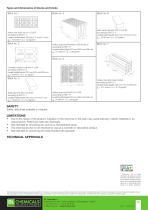
Types and dimensions of blocks and bricks Brick no.1 Solid sand lime brick KS 12-2,0-NF according to EN771-2 Length/width/height 240 mm/115 mm/70 mm fb ≥ 12 N/mm² / p ≥ 2,0 kg/dm³ Hollow clay brick Hlz 12-1,0-2DF according to EN771-1 Length/width/height 235 mm/112 mm/115 mm fb ≥ 12 N/mm² / p ≥ 1,0 kg/dm³ Hollow clay brick Porotherm 25P+W KL15 according to EN771-1 Length/width/height 373 mm/250 mm/238 mm fb ≥ 12 N/mm² / p ≥ 0,9 kg/dm³ Brick no. 5 Concrete masonry unit Hbn 4-12DF according to EN771-3 Length/width/height 370 mm/240 mm/238 mm fb ≥ 4 N/mm² / p ≥ 1,2 kg/dm³ Hollow clay brick Hueco...
Open the catalog to page 6All DL Chemicals catalogs and technical brochures
 PARACOL UNIVERSAL FLOORING
2 Pages
 PARABOND SPRAYABLE
2 Pages
 PRIMER PU TURBO
2 Pages
 DL MAXI EGALINE
2 Pages
 PARABOND CONSTRUCTION
3 Pages
 PARABOND TRANSPARENT
2 Pages
 PARABOND MARINE PARQUET
2 Pages
 PARACHIM VINYLESTER
6 Pages
 PARACOL SUPERGLUE F
1 Page
 PARACOL MIROSEAL MS
2 Pages
 PARACOL PVC PVC
1 Page
 PARACOL TUILE
2 Pages
 PARACOL STRATI/F
1 Page
 PARACOL STRATI/G
2 Pages
 PARACOL MONTAGEKIT NEOPRENE
2 Pages
 PARAFOAM NBS GREY
2 Pages
 PARASILICO CURTAIN WALL
2 Pages
 PRODUCT CATALOGUE
140 Pages
 PARACOL 2C PU CONSTRUCT
2 Pages
 PARAFLEX 40
2 Pages
 00 EXTRA
2 Pages
 PARASILICO E95
2 Pages
- Single-component adhesive
- Protection sleeve
- Adhesive tape
- Metal adhesive
- Plastic adhesive
- Epoxy adhesive
- Protective coating
- Primer
- Manual shear
- Sealing adhesive tape
- Industrial coating
- Wood adhesive
- Lubricant spray
- Corrosion protection aerosol spray
- Diaphragm seal
- Rubber adhesive
- Metal shear
- Plastic tape
- Masking tape
- Adhesive sealant