
- Catalogs
- DJB Instruments UK Ltd
- Piezo-Electric Accelerometers - A/53/F

Piezo-Electric Accelerometers - A/53/F

Piezo-Electric Accelerometers - A/53/F
- Charge Sensitivity: A/53/F: 10/15 pC/g, A/53/F/HT: 1.4/2.0 pC/g
- Capacitance: A/53/F: 1400/1800 pF, A/53/F/HT: 400/900 pF
- Resonant Frequency: 15 kHz
- Cross Axis Error: Max 5%
- Temperature Range: A/53/F: -50/+300°C, A/53/F/HT: -50/+400°C
- Pyro-electric Output: 0.1 g/°C
- Max Continuous Acceleration: 1000 g sine
- Case Material: Stainless steel or Inconel 303 S31
- Weight: 20 gm (excluding cable)
- Close tolerance output
- Temperature calibration up to 400°C for HT version
- Proof pressure testing up to 100 bar
- Various cable/connector options
- Intrinsic safety version available (EEx ia IIC T3)
- Hermetic sealing and welded construction ensure reliability and measurement integrity.
- Isolated signal minimizes ground loop interference.
- High-temperature operation may reduce insulation resistance and increase low-frequency noise.
- Thermal burn-in and proof pressure tests are recommended for optimal performance.
- Choice of cable involves trade-offs between physical properties and cost.
- Frequency Response: Shows deviation percentages across various frequencies.
- Temperature Response: Illustrates deviation percentages and insulation resistance changes across temperature ranges.
Catalog excerpts

Industrial piezo-electric accelerometer A/53/F, A/53/F/HT 12pC/g, 300°C max (/F) • 1.7pC/g, 400°C max (/F/HT) • 20gm wt. (ex cable) • isolated output • hermetic, integral hardline cable • Intrinsic version available on request (EEx ia IIC T3) close tolerance output temperature calibration to 400°C (/HT) proof pressure testing to 100bar cable/connector options are shown in Fig .1 Intrinsic version EEx ia IIC T3 perm. temp. radius radius 9 mm 4.5 mm perm. temp. radius radius 15 mm 7.5 mm 1.5mm M.I. cable/pot seal with flying leads x 15cm long TEMPERATURE RESPONSE TEMPERATURE RESPONSE Charge sensitivity pC/g Capacitance pF (ex cable) Resonant frequency kHz Cross axis error % max Temperature range °C Charge sensitivity deviation re 20°C Pyro-electric output, g/°C Pyro-electric corner freq. Hz Base strain sens. g/µ strain Max continuous accn. g sine Case material Mounting Weight gm Case seal 1000 s/steel inconel 303 S31 2 x 5.2mm ø holes @ 24.4mm ctrs 20 welded, hermetic CONVERSION MODE iniature, rugged, industrial grade accelerometer with integral hardline cable, suitable for long term vibration monitoring in adverse environments. These transducers are hermetic and are proof up to 100bar fluid pressure @ 20°C. Isolated signal minimises ground loop interference, however the 2 core cable termination option, being unguarded viz à viz spurious ground loop induced voltage, may need a differential charge amplifier interface. The alternative triaxial cable guards signal transmission external to the accelerometer. Choice of cable is somewhat subjective and involves physical and cost tradeoffs. High temperature operation (A/53/F/HT) is accompanied by significant reduction in insulation resistance and by increased low frequency pyro-electric noise content. This may impose a minimum frequency constraint. A/53’s have seen extensive long term service in a variety of hostile environments. We recommend thermal burn-in and proof pressure tests where appropriate. KONIC sensing element, all welded construction, and welded cable termination maximises measurement integrity and reliability.
Open the catalog to page 1All DJB Instruments UK Ltd catalogs and technical brochures
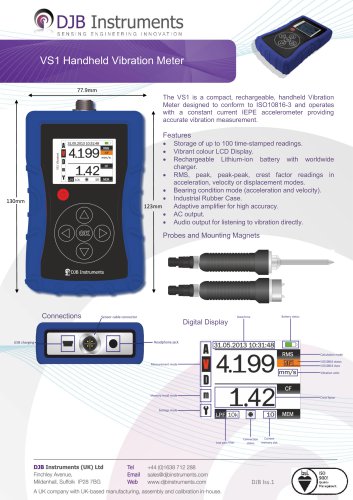 VS1 Handheld Vibration Meter
2 Pages
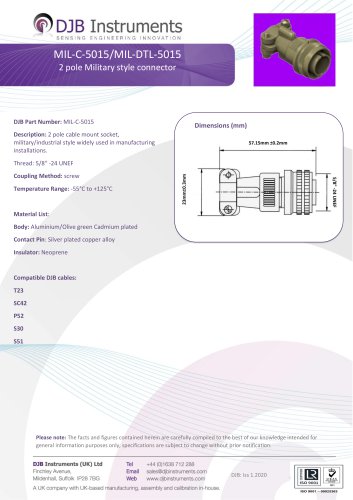 MIL-C-5015/MIL-DTL-5015
1 Page
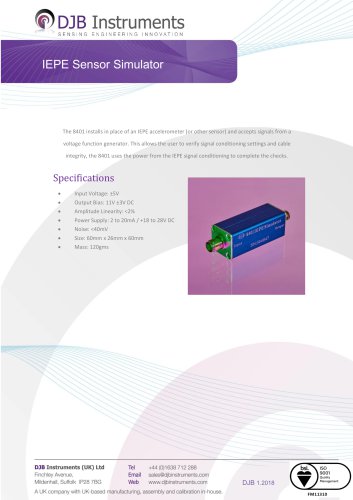 IEPE Sensor Simulator
1 Page
 New Reference Technical Guide
36 Pages
 V3/04
V3/041 Page
 VS1
VS12 Pages
 CA/04/N,
2 Pages
 CV1
CV11 Page
 CA/100/F
1 Page
 CA/04/V
2 Pages
 VB/01
VB/011 Page
 IEPE Impact Hammer Range
1 Page
 AF IEPE Impedance Head
1 Page
 A/161
A/1611 Page
 A/122/V
2 Pages
 A/107/F
1 Page


Archived catalogs
 Technical Reference Guide
24 Pages
 Connectors
3 Pages
 Cables, cables armour
2 Pages
 Joiners
1 Page
 Accelerometer mounting studs
3 Pages


- Piezoelectric accelerometer
- Single-axis accelerometer
- IEPE accelerometer
- Triaxial acceleration sensor
- Compact accelerometer
- Signal conditioner
- General purpose accelerometer
- Industrial accelerometer
- Voltage output accelerometer
- Miniature accelerometer
- Analog signal conditioner
- Accelerometer for automotive applications
- High-temperature accelerometer
- Adhesive accelerometer
- Amplifier signal conditioner
- Multi-channel signal conditioner
- Seismic sensor
- Ultraminiature accelerometer
- Modular signal conditioner