
- Catalogs
- Displaytech
- DT010ATFT

DT010ATFT
DT010ATFT
The Displaytech DT010ATFT is a 1.0” color IPS LCD module with a 4-line SPI interface, featuring a resolution of 80 x 160 pixels. It is suitable for video systems, mobile systems, and wearable devices.
Specifications
- LCD Features: 0.96 inches, IPS, transmissive, normally black, RGB vertical stripe configuration, LED backlight.
- Dimensions: 13.50 mm (W) x 27.95 mm (L) x 1.40 mm (H).
- Active Area: 10.80 mm (W) x 21.70 mm (L).
- Pixel Pitch: 0.135 mm (W) x 0.135 mm (H).
- Viewing Direction: All directions.
Pin Descriptions
The module includes pins for serial interface data, clock, display data/command select, reset, chip select, ground, supply voltage, and LED backlight connections.
Electrical Characteristics
- Supply Voltage: 2.5 to 3.3 V for analog, 1.65 to 3.3 V for logic.
- Supply Current: Typical 2 mA.
- LED Backlight: Forward current of 20 mA, forward voltage of 2.8 V.
Timing Characteristics
The module supports a 4-wire serial interface with specific timing requirements for chip select, serial clock cycle, and data/command select.
Optical Characteristics
- Contrast Ratio: 800:1.
- Response Time: 30 to 40 ms.
- Viewing Angles: 80° in all directions.
- Luminance: 300 Cd/m2.
Environmental/Reliability Testing
The module has been tested for high and low temperature operation, storage, humidity, thermal shock, ESD, vibration, and package drop.
Precautions for Use
- Handle with care to avoid mechanical shock and excessive force.
- Prevent static electricity by grounding tools and personnel.
- Store in a dark, clean environment at 25°C with low humidity.
- Clean with a soft cloth moistened with ethanol.
Mechanical Drawing
Detailed mechanical drawings are provided for installation and assembly guidance.
Catalog excerpts
1.0” IPS LCD Module with SPI Interface DT010ATFT Displaytech, a SEACOMP company Phone: 1.760.918.6722 [email protected] Contents of this document are subject to change without notice. No part of this document may be reproduced or transmitted in any form or by any means, electronic or physical, for any purpose, without the express written permission of Displaytech.
Open the catalog to page 1
dP Display techTable of Contents 1 Overview 1 3.1 Absolute Maximum Ratings 2 7.6 Cautions for installation and assembly 9
Open the catalog to page 3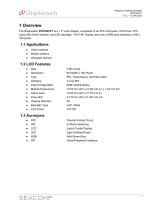
1 Overview The Displaytech DT010ATFT is a 1.0” color display, composed of an IPS LCD panel, LCD driver, FPC cable with serial interface, and LED backlight. The 0.96” display area has a RGB pixel resolution of 80 x 160 pixels. • Video systems • Mobile systems • Wearable devices • Pixel Configuration • Module Dimensions • Active Area • Pixel pitch • Viewing Direction • Backlight Type IPS, Transmissive, Normally black Flexible Printed Circuit In-Plane Switching Liquid Crystal Display Light Emitting Diode Red-Green-Blue Serial-Peripheral Interface
Open the catalog to page 4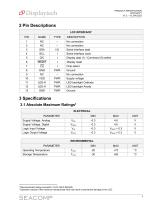
1 Recommended mating connector: FH12-13S-0.5SH(55) 2 Operation outside of the maximum ratings listed here may result in permanent damage to the LCD.
Open the catalog to page 5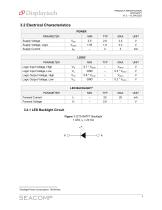
cP Displaytech3.2 Electrical Characteristics POWER Backlight Power Consumption: 70mWMax.
Open the catalog to page 6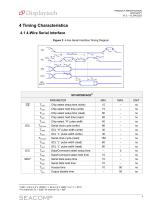
cP Displaytech4 Timing Characteristics4.1 4-Wire Serial Interface SPI INTERFACE4
Open the catalog to page 7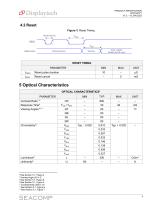
RESX Initial status Figure 3: Reset Timing Initial condition (Default for HW reset) RESET TIMING
Open the catalog to page 8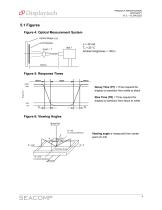
5.1 Figures Figure 4: Optical Measurement System Figure 5: Response Times Decay Time (TF) = Time required for display to transition from white to black Rise Time (TR) = Time required for display to transition from black to white Figure 6: Viewing Angles Viewing angle is measured from center point of LCD
Open the catalog to page 9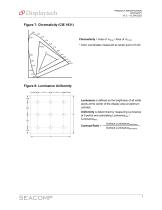
Chromaticity = Area of △RGB / Area of △NTSC * Color coordinates measured at center point of LCD Figure 8: Luminance Uniformity Luminance is defined as the brightness of all white pixels at the center of the display area at optimum contrast. Uniformity is determined by measuring Luminance at 9 points and calculating LuminanceMIN / LuminanceMAX Contrast Ratio = Surface LuminanceWhitePixels Surface LuminanceBlackPixels
Open the catalog to page 10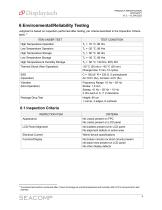
cP Displaytech6 Environmental/Reliability Testing Judgment is based on inspection performed after testing, per criteria described in the Inspection Criteria table.13 13 Functional test shall be conducted after 4 hours of storage at normal temperature and humidity, after LCD is removed from test chamber.
Open the catalog to page 11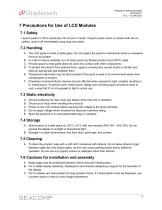
cP Displaytech 7 Precautions for Use of LCD Modules Liquid crystal in LCD is poisonous. Do not put in mouth. If liquid crystal comes in contact with skin or clothes, wash it off immediately using soap and water. A. The LCD panel is made of plate glass. Do not subject the panel to mechanical shock or excessive force on its surface. B. In order to ensure reliability, do not hold product by flexible printed circuit (FPC) cable. C. Provide space so that panel does not come into contact with other components. D. To protect the product from external force, apply a covering lens (acrylic board or similar)...
Open the catalog to page 12All Displaytech catalogs and technical brochures
 DT024ETFT-IPS, DT024ETFT-IPS-SHB
17 Pages
 DT024DTFT
11 Pages
 DT024CTFT & DT024CTFT-TS
13 Pages
 DT018BTFT, DT018BTFT-SHB
17 Pages
 DT018ATFT
12 Pages
 64240C-Series
22 Pages
 64128Q-Series
24 Pages
 64128P-Series
22 Pages
 64128N-Series
19 Pages
 64128M-Series
21 Pages
 64128LX-Series
21 Pages
 64128L-Series
21 Pages
 64128KX-Series
21 Pages
 64128K-FC-BW-RGB
25 Pages
 32128A-Series
19 Pages
 128240D-RGB-Series
21 Pages
 128240D-Series
21 Pages
 128240C-RGB-Series
21 Pages
 128240C-Series
21 Pages
- Power supply unit
- DC power supply
- AC/DC power supply
- LCD display panel
- CE power supply
- Compact power supply
- Lithium battery
- RGB display panel
- RoHS power supply
- IEC battery
- Graphic display panel
- SPI display
- UL power supply
- Adjustable thermostat
- Rectangular battery
- Monochrome display
- Dot-matrix display panel
- Power supply with USB outlet
- Digital thermostat