1. Catalogs
  2. Directedmetal 3D S.L.
  3. Meltio Stainless Steel 17-4PH

Meltio Stainless Steel 17-4PH

Meltio Stainless Steel 17-4PH

Meltio Stainless Steel 17-4PH

Product catalog summary
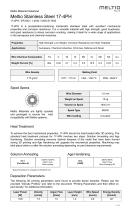
Material Overview: Meltio Stainless Steel 17-4PH is a precipitation-hardening martensitic stainless steel known for its excellent mechanical properties and corrosion resistance. It is widely used in aerospace and chemical industries due to its high strength, good toughness, and resistance to stress corrosion cracking.
Physical Properties: The wire density is 7.75 g/cm³, and the melting point ranges from 1677 to 1713 K (1404 to 1440 ºC or 2559 to 2624°F).
Heat Treatment: To optimize mechanical properties, 17-4PH should undergo heat treatment post-3D printing. The process includes Solution Annealing to relieve internal stresses and Age Hardening to enhance mechanical properties. Machining can occur before or after solution annealing based on part tolerance needs.
3D Printing Parameters: Key parameters for achieving dense samples include a laser power of 1100 W, velocity of 7.5 mm/s, argon flow of 10 l/min, layer height of 1.0 mm, wire speed of 9.6 mm/s, and energy density of 147 J/mm³.
Wire Specifications: The wire diameter is 1.0 mm, with a spool weight of 15 kg and volume of 1935 cm³. The spool type is BS300, and the wire is uncoated.
Chemical Composition: The composition includes Fe, C (0.02%), Ni (4.7%), Si (0.4%), Mn (0.5%), Cr (16.5%), Mo (0.2%), Nb (0.23%), and Cu (3.4%).
Mechanical Properties: The material exhibits high strength and low weight, with corrosion resistance and heat treatability. Applications span aerospace, chemical industries, oil & gas, defense, and naval sectors.
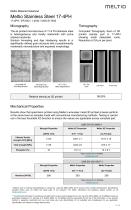
Microstructure: The as-printed microstructure is heterogeneous and mostly martensitic with some retained austenite. Post heat treatment, the structure becomes predominantly martensitic with equiaxed morphology.
Performance: Meltio's wire-laser metal 3D printed process yields specimens with performance comparable to conventional manufacturing methods. Relative density as 3D printed is 99.90%.
Testing and Standards: Mechanical testing shows ultimate tensile strength (UTS) of 1391 ± 7 MPa (HT.1 + HT.2) and 1017 ± 15 MPa (as printed). Yield strength is 1243 ± 8 MPa (HT.1 + HT.2) and 815 ± 17 MPa (as printed). Elongation is 10 ± 3% (HT.1 + HT.2) and 14 ± 0.1% (as printed). Hardness is 393 HV-30 (HT.1 + HT.2) and 258 HV-30 (as printed).
Disclaimer: Specifications are subject to change, and users must determine the suitability and completeness for their application. For further information, contact [email protected].
See more

Catalog excerpts

Meltio Stainless Steel 17-4PH-1

Meltio Material Datasheet Rev 2.0 17-4PH / ER 630 /1.4542 / UNS SI 7400 17-4PH is a precipitation-hardening martensitic stainless steel with excellent mechanical properties and corrosion resistance. It is a versatile material with high strength, good toughness, and good resistance to stress corrosion cracking, making it ideal for a wide range of applications in the aerospace and chemical industries.

 Open the catalog to page 1
Meltio Stainless Steel 17-4PH-2

Meltio Material Datasheet Tomography Computed Tomography Scan of 3D printed sample part in 17-4PH showing small detectable voids. Resolution of 24 pm per pixel. The as printed microstructure of 17-4 PH stainless steel is heterogeneous and mostly martensitic with some retained austenite. Solution Annealing and Age Hardening results in a significantly refined grain structure with a predominantly martensitic microstructure and equiaxed morphology. lOOx Magnification lOOOx Magnification lOOOx Magnification Relative density as 3D printed Results show that specimens printed using Meltio’s wire-laser...

 Open the catalog to page 2

All Directedmetal 3D S.L. catalogs and technical brochures

  1. Meltio M450

    2  Pages

Archived catalogs

*Prices are pre-tax. They exclude delivery charges and customs duties and do not include additional charges for installation or activation options. Prices are indicative only and may vary by country, with changes to the cost of raw materials and exchange rates.