
- Catalogs
- Directedmetal 3D S.L.
- Meltio Engine Robot Integration

Meltio Engine Robot Integration

Meltio Engine Robot Integration
The Meltio Engine Robot Integration transforms a robot arm into a versatile metal 3D printing system without size constraints. It is ideal for large-scale and complex 3D printing, repair, cladding, and feature addition. The system is compatible with any robot arm manufacturer and interface available in the market.
- Dimensions: 390 x 700 x 1025 mm
- Power Consumption: 2 - 5 kW peak
- Print Envelope: Varies with integration
- Process Control: Closed-loop, laser and wire modulation
- System Weight: 142 kg
- Enclosure: Laser-safe, sealed, controlled atmosphere
- Laser Type: 6 x 200 W direct diode lasers
- Cooling: Active water-cooled chiller included
- Laser Wavelength: 976 nm
- Wire Feedstock Diameter: 0.8 - 1.2 mm
- Total Laser Power: 1200 W
- Wire Feedstock Spool: BS300 or Wire drums
- Power Input: 208/230 V single phase or 400 V three phase
- Hot Wire: Preheats material to increase deposition rate.
- Dual Wire: Allows sequential 3D printing of two wire materials with quick switches.
- Laser Alignment System: Facilitates accurate alignment of the multi-laser deposition head.
- Wire Materials: Stainless Steels, Mild Steels, Carbon Steels, Titanium Alloys, Nickel Alloys
- Printhead Size: 202 x 297 x 784 mm
- Printhead Weight: 15.5 kg
- Robot payload of at least 45 - 60 kg for precise toolpath following.
- Position repeatability of ± 0.06 mm as per ISO 9283.
- Minimum of 8 Digital I/O, with 16 recommended for certain protocols.
- Pre-installation, configuration, and calibration of the robot and positioner.
- Laser-safe robot cell with a security circuit between the robot controller, Meltio Engine, and cell door interlock.
- Integrator responsible for security system installation and operation.
Catalog excerpts
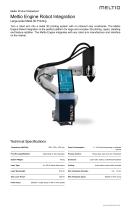
Meltio Product Datasheet Meltio Engine Robot Integration Large-scale Metal 3D Printing Turn a robot arm into a metal 3D printing system with no inherent size constraints. The Meltio Engine Robot Integration is the perfect platform for large and complex 3D printing, repair, cladding and feature addition. The Meltio Engine integrates with any robot arm manufacturer and interface on the market. Technical Specifications Dimensions (WxDxH): Print Envelope(WxDxH): System Weight: Laser Type: Depending on the integration 142 kg 6 x 200 W direct diode lasers Power Consumption: Process Control: Enclosure: Cooling: Laser Wavelength: Wire Feedstock Diameter: Total Laser Power: Wire Feedstock Spool: Power Input: 2 - 5 kW peak depending on selected options Closed-loop, laser and wire modulation Laser-safe, sealed, controlled atmosphere Active water-cooled chiller included 0.8 - 1.2 mm BS300 or Wire drums 208/230 V single phase or 400 V three phase
Open the catalog to page 1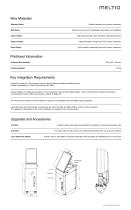
Wire Materials Stainless Steels: Excellent strength and corrosion resistance. Mild Steels: Cheap and ductile, with unparalleled machinability and weldability. Carbon Steels: High impact strength, retain hardness at high temperatures. Titanium Alloys: Highest strength to weight ratio and corrosion resistance. Nickel Alloys: High versatility, outstanding heat and corrosion resistance. Printhead Information Printhead Size (WxDxH): Printhead Weight: Key Integration Requirements Payload of at least 45 - 60 kg ensures that the robot can follow the additive toolpath precisely. Position repeatability...
Open the catalog to page 2All Directedmetal 3D S.L. catalogs and technical brochures
 Meltio Nickel 625
2 Pages
 Meltio Nickel 718
2 Pages
 Meltio Titanium 64
3 Pages
 Meltio Invar 36
2 Pages
 Meltio Tool Steel H11
3 Pages
 Meltio Mild Steel ER70-S
2 Pages
 Meltio Robot Cell
4 Pages
 Meltio M450
2 Pages


Archived catalogs
 Meltio Stainless Steel 316L
18 Pages