


- Company
- Products
- Catalogs
- News & Trends
- Exhibitions
Parylene

Parylene
Parylene coatings are derived from the polymer group poly(para-xylylene) and are known for their waterproof, insulating, chemically inert, and biocompatible properties. These coatings are used across various industries including electronics, medical devices, aerospace, automotive, and lighting due to their ability to conform to complex surfaces and provide a pinhole-free, chemically resistant barrier.
- Electronics: Used in PCBs, sensors, semiconductor devices, and magnets.
- Medical Devices: Applied to cannulas, catheters, biopsy needles, and implants.
- Aerospace: Utilized in navigation electronics, cockpit instrumentation, and satellite electronics.
- Automotive: Employed in sensors, engine electronics, and battery systems.
- LEDs: Used in electronic billboards and various lighting applications.
- Industry: Applied to seals, O-rings, pipes, and containers.
- Conformal coating that adapts to complex contours.
- Chemically insoluble and resistant to a wide range of chemicals.
- High dielectric strength and low friction coefficient.
- Hydrophobic with a contact angle of H2O between 92° and 98°.
- Transparent in the visible wavelength range and biocompatible.
- Parylene N: Halogen-free, good dielectric properties, FDA approved, temperature resistance up to 60°C.
- Parylene C: Contains one chlorine atom, excellent barrier properties, FDA approved, temperature resistance up to 80°C.
- Parylene D: Contains two chlorine atoms, good mechanical properties, temperature resistance up to 100°C.
- Parylene F-VT4: Contains four fluorine atoms, high temperature resistance up to 200°C.
- Parylene F-AF4: Contains four fluorine atoms on aliphatic groups, highest temperature resistance up to 350°C, FDA approved.
The deposition of parylene coatings is achieved through a vacuum-assisted chemical vapor deposition (CVD) process. The dimer is sublimated and pyrolyzed to form reactive monomers, which polymerize on cold surfaces to form a thin layer of parylene. A cold trap is used to prevent damage to the vacuum pump by capturing unreacted monomers.
Various types of parylene differ in density, refractive index, tensile modulus, yield strength, and other mechanical and thermal properties. Parylene F-AF4 offers the highest temperature resistance and lowest friction coefficient, making it suitable for specialized applications.
Catalog excerpts

Monomer units of the most common parylene types Raw material - Dimer powder What are parylene coatings: Parylene is the abbreviation for the polymer group named poly (para-xylylene). These polymers consist of differently substituted para-xylylenes. The initial state for the coating is given by the so-called dimers. A dimer is a molecule composite which consists of two identical subunits, namely the monomers. Advantages and properties: Parylene coatings offer a wide range of benefits. Parylene coatings … • are perfectly conformal: that means that the coating is adapting also on complex substrate...
Open the catalog to page 2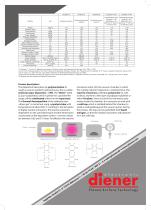
[1] W.Beach, C. Lee, and D. Bassett, Encyclopedia of Polymer Science and Engineering (Wiley, New York, 1985), 17, 990 [2] J.B. Fortin, Poly-para-xylylene Thin Films: A Study of the Deposition Chemistry, Kinetics, Film Properties, and Film Stability, Ph.D. Thesis, rensselaer Polytechnic Institute, 2001 [3] F.E. Cariou, D.J. Vally, and W.E. Loeb, IEEE Transactions on Biomedical Engineering 33(2), 202 (1992). [4] Structural and dielectric properties of parylene-VT4 thin films Article (PDF Available) in Materials Chemistry and Physics 143(3):908-914 ■ February 2014 with 71 Reads [5] Angaben aus www.matweb.com...
Open the catalog to page 3All Diener electronic GmbH & Co. KG catalogs and technical brochures
 DLC
DLC3 Pages
 RF 300
2 Pages
 RF 100
2 Pages
 Tetra 150
6 Pages
 Tetra 100
6 Pages
 Parylene P300
2 Pages
 Parylene P260
2 Pages
 Parylene P120D
2 Pages
 Parylene P30
2 Pages
 Parylene P6
2 Pages
 Surface treatment Service
6 Pages
 Atto/Zepto
2 Pages
 APC 500
4 Pages
 MWG1200
2 Pages
 LFG5000
2 Pages
 LFG3000
2 Pages
 LFG1000
2 Pages
 LFG500
5 Pages
 Plasma Surface Technology
15 Pages
 PlasmaBeamMini
2 Pages
 PlasmaBeamDuo
6 Pages
 PlasmaBeam PC
6 Pages
 Special systems
36 Pages
 TETRA 30
6 Pages
 PlasmaBeam
6 Pages
 TETRA
TETRA9 Pages
 NANO
NANO2 Pages
 PICO
PICO2 Pages
 FEMTO
FEMTO2 Pages
 Tetra 8
1 Page
 PLASMA APC 500
1 Page


- Ink
- Vacuum chamber
- Surface treatment machine
- Coating application system
- Plasma surface treatment machine
- Plasma generator
- Automatic surface treatment machine
- Laboratory surface treatment machine
- Surface treatment machine for the printing industry
- PC-controllable surface treatment machine
- Medical device surface treatment machine
- Portable surface treatment machine
- 3D part surface treatment machine
- Fabric surface treatment machine
- Plate surface treatment machine
- Label printing surface treatment machine
- Surface treatment machine for the eyewear sector
- Desmear surface treatment machine
- Vacuum surface treatment machine
- Atmospheric plasma generator