

- Products
- Catalogs
- News & Trends
- Exhibitions
CATALOG 2017/18

CATALOG 2017/18
Di-soric is a company with over 35 years of experience in producing sensors for industrial automation, used in industries like automotive, electronics, pharmaceuticals, and packaging. They offer vision sensors, LED lighting, and safety products. Di-soric Solutions GmbH & Co. KG focuses on image processing and identification solutions.
Company Facts:
- 100% owner-managed
- Headquarters in Urbach, Germany
- Technology and production center in Lüdenscheid, Germany
- Presence in over 40 countries
- Certifications: IQNet, DQS - ISO 9001:2015, UL, RoHS, GS1
Product Offerings:
Includes a wide range of sensors and lighting solutions for automation tasks, such as laser fork light barriers, angled light barriers, frame and ring light barriers, fiber-optic sensors, light grids, and color sensors.
Technical Specifications:
Details on service voltage, protection type, housing design, and switching frequency. For example, through-beam sensors offer high resolution and operating distances up to 20 meters.
Product Selection and Support:
Di-soric provides a product finder tool and emphasizes solution-oriented consultation and technical expertise.
Conclusion:
Di-soric is committed to providing practical solutions for industrial automation, ensuring precision and cost-effectiveness.
- LAT 51 Series: Red-light laser, 50 to 500 mm distance, laser triangulation, switching and analog outputs, remote teach option, metal housing.
- LAT 61 Series: High resolution, laser triangulation, integrated display, multiple outputs, plastic housing.
- LHT 9-45 Series: Red-light laser, up to 10 m distance, laser time-of-flight, parameterizable outputs, metal housing.
All models operate at +20 °C, 24 V DC, with varying emitted light types and protection classes.
High-Performance Light Barriers:
Designed for high switching accuracy and dirt resistance, operating over distances up to 50 m, available with stainless steel housing and switchable heating elements.
Fork Light Barriers:
Adjustable sensitivity, high switching frequency, robust housing, available with IO-Link for configuration, suitable for dynamic tasks requiring high precision.
- Standard Version: Resolution of 0.5 mm, voltage drop of 2.5 V, switching frequency of 1,000 Hz, made from aluminum.
- Teach Function: Sensitivity adjustment via teach button, switching frequency of 3,000 Hz.
- Adjustable on the Front Side: Front-side sensitivity adjustment, resolution of 0.5 mm, switching frequency of 4,000 Hz.
- Standard Version: High resolution (50 µm) and high switching frequency.
- High-Resolution Version: Higher resolution (50 µm) and reproducibility (10 µm).
- Standard Version: High switching frequency and adjustable sensitivity.
- With IO-Link: Enhanced functionality with IO-Link interface.
- With Power Electronics: Increased transmitting power and contamination indicator.
- Frame Light Barriers: Detecting and counting small parts, adjustable pulse stretching.
- Ring Light Barriers: Resolution of 1.5 mm, suitable for monitoring ejection/removal of workpieces.
- Service voltage of 10 to 35 V DC, IP 67 rating.
- Switching outputs typically pnp, with NO/NC switchable options.
- Ambient temperature range of -10 to 60 °C.
- High ambient light immunity, robust metal housing, optional air nozzles.
- 5-year warranty, emphasizing reliability and durability.
- Ambient temperature: 0 to +40 °C
- Service voltage: 20 to 26 V DC
- Protection type: IP 00, IP 65 with optional housing
- Switching capacity: 250 mA
- Protection class: III, operation on protective low voltage
- EMC directives: EN 61000-6-1: 2001, EN 61000-6-3: 2001
- Housing material: Plastic
- Configurable parameters for beam evaluation
- Cycle time per light beam: 0.05 ms
- RS232 interface for configurable functions
- Expansion modules available for various interfaces
- Evaluation electronics mounted on a standard top-hat rail
- Perceptive method based on colorimetric spaces L*a*b and L*u*v
- Differentiation of small color shades (∆E <1)
- Up to 350 channels with adjustable color tolerance
- High ambient light immunity and reflection compensation
- Exportable measured values for computer applications
- Lighting with aging-compensated white-light LED
- High temperature resistance and robust design
- Focus optics for small measuring spot diameters
- Operating range: 10 to 300 mm
- Available with static or dynamic evaluation
- High detection sensitivity for metal parts
- Various fastening options and accessories
- Static sensors: Quick commissioning, no setting elements
- Dynamic sensors: High resolution, insensitive to dirt
Designed for various applications, offering different housing designs, sizes, and switching distances.
Specifications:
- Housing Design and Material: Brass nickel-plated and V2A materials.
- Switching Distance: 2.0 mm to 40.0 mm, flush and non-flush installations.
- Switching Output: PNP and NPN configurations, NO and NC states.
- Current Rating: 200 mA or 400 mA.
- Cable Length: Standard 2.0 meters, optional plug connectors.
Product Variants:
- Helical Design: Increased switching distances, robust construction.
- Cylindrical Design: Compact and versatile.
- Rectangular Design: Larger sensing area.
Key Features:
- Increased Switching Distance: Up to three times the standard.
- Protection Ratings: IP67, IP68, and IP69K.
- Pressure Resistance: Up to 100 bar.
Applications:
Used in automation, manufacturing, and process control.
For more detailed information, visit www.di-soric.com.
- Helical Design: Models like M12, M18, and M30.
- Rectangular Design: Models like 8x8x50.
- High-Temperature Resistant: Withstand temperatures up to 230°C.
- Low-Temperature Resistant: Operate in environments as low as -55°C.
- High-Pressure Resistant: Withstand pressures up to 500 bar.
Various safety systems and components, including static PNP safety outputs, master/slave models, and models with IP 69K and heated protective housing.
Safety Light Curtains/Grids:
Solutions for machine safety with a variety of functions and sizes.
Safety and Interface Relay:
Includes integrated muting functions and additional safety features.
Safety-Related Accessories:
Connection cables, installation systems, deflection mirrors, vibration dampers, and laser alignment devices.
Risk Assessment:
Risk graph for performance level requirements.
Standards and Directives:
Comply with various international standards and directives.
Technical Data:
Profile cross-section of 28 x 30 mm, PNP safety outputs, LED displays, and self-diagnostics.
- Type 4 safety devices, suitable for high-risk applications.
- Operating distances up to 20 meters.
- Protection types include hand and body protection.
- Response times range from 2.5 ms to 15.5 ms.
- Integrated safety functions available in certain models.
- Master/slave configurations for series connections.
- Safety outputs are PNP type.
- Self-diagnostic LED displays.
- Connection cables up to 100 meters for master connections.
- All electrical connections utilize M12 connectors.
- Mounting options include rear-side T-shaped slots.
- Comply with IEC/TS 61496-2, IEC 61508, IEC 62061, and ISO 13849-1 standards.
- Protection types include IP 65 and IP 67.
- Master/slave models support up to three light curtains/grids in series.
- Feedback input for external relay monitoring (EDM).
- Safety Relay Outputs: NO (2x) + NC (1x), 2 A, 250 V AC
- Reaction Time: < 20 ms
- Service Voltage: 19.2 to 28.8 V DC
- Ambient Temperature: 0 to +55 °C
- Protection Type: IP 20 for housing, IP 2X for terminal strip
- Mounting: Top-hat rail in accordance with EN 50022-35 standard
- Dimensions: 101 x 35 x 120 mm
1. Optical power reduction factor of 15% for each mirror.
2. Built-in spherical spirit level for correct vertical positioning.
3. Steel anchor bolts included for base installation.
4. Adjustable steel bases ensure optimal mounting of columns.
5. Deflection mirrors available with heights from 250 to 1900 mm.
6. Laser alignment device for quick and reliable optical alignment.
7. Test rods available for light curtains with resolutions from 14 mm to 50 mm.
8. Safety screens made of polycarbonate protect light curtains/grids from damage.
Mounting Columns:
1. Various models available for light curtains/grids and deflection mirrors.
2. Dimensions and product descriptions provided for each model.
3. Steel bases can be adjusted precisely with steel springs for fine adjustment.
Accessories:
1. Sensor tester for pnp, npn, and push-pull sensors with visual and audible signals.
2. Connection cables and adapter plugs for M8 and M12 connectors.
3. Counter modules with reset function and LCD display for easy mounting.
4. Logic distributors available in double and quadruple configurations.
Recommendations and Best Practices:
1. Ensure mirrors are positioned to maintain safety distance to hazard zones.
2. Use laser alignment device for aligning light curtains/grids over long distances.
3. Regularly test light curtains with test rods to ensure no beam diversion.
4. Replace safety screens promptly if damaged to maintain protection.
Additional Information:
1. For more models and detailed specifications, visit the di-soric website.
2. Various accessories available to optimize sensor and lighting products for different applications.
The document provides detailed specifications and descriptions of various logic distributors, function adapters, and accessories for sensors and light barriers.
- Service voltage: 10 to 35 V DC
- Current-carrying capacity: 200 mA, short-circuit proof
- No-load current: 20 mA
- Ambient temperature: -20 to +70 °C
- Protection type: IP 67
- Protection class: III
Catalog excerpts

2018/19 SENSORS | LIGHTING VISION | SAFETY
Open the catalog to page 1
ABOUT THE INVENTOR OF THE FORK LIGHT BARRIER: DI-SORIC. For over 35 years, we have been producing and selling sensors used in industrial automation, primarily in assembly and handling technology, the automotive, electronics and pharmaceutical industries and packaging technology. Other cornerstones of our product range are vision sensors, high-quality LED lighting and products for safety at work. Our sister company, di-soric Solutions GmbH & Co. KG, specializes in the business areas of image processing and identification and prioritizes complete solutions, developed for you, which we call "Engineered...
Open the catalog to page 2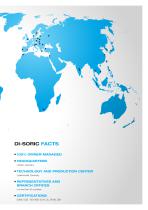
DI-SORIC FACTS ■ 100% OWNER-MANAGED ■ HEADQUARTERS Urbach, Germany ■ TECHNOLOGY AND PRODUCTION CENTER Ludenscheid, Germany REPRESENTATIVES AND BRANCH OFFICES in more than 40 countries CERTIFICATIONS IQNet, DQS - ISO 9001:2015, UL, RoHS, GS1
Open the catalog to page 3
SOLUTIONS. To us, finding solutions means providing you with exactly the right solution for the job. ■ Solution-oriented consultation and implementation ■ Product portfolio for numerous application areas ■ Engineered solutions for industria
Open the catalog to page 4
CLEVER. To us, being clever means finding new, smart, unconventional and therefore more effective solutions. ¡¡ dded value for product and application A ¡¡ Efficient in function and application ¡¡ penness and flexibility for the best solutions O PRACTICAL. To us, being practical means being available, taking a straightforward approach and communicating as partners. ¡¡ olution-oriented consultation and technical expertise S ¡¡ traightforward, cooperative and dynamic approach S ¡¡ Address what is important, and forget about unnecessary
Open the catalog to page 5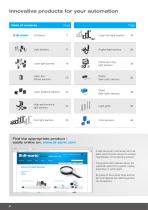
Innovative products for your automation Table of contents Laser fork light barriers Light barriers Angled light barriers Laser light barriers Frame and ring light barriers Laser line diffuse sensors Plastic fiber-optic sensors Laser distance sensors Glass fiber-optic sensors High-performance light barriers Light grids Fork light barriers Color sensors Find the appropriate product – easily online on: www.di-soric.com A clear structure in connection with intelligent search function allows for a simple indentification of the matching product. The product direct selection allows the systematic search...
Open the catalog to page 6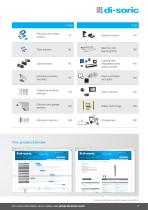
Ring and wire-break sensors Special sensors Tube sensors Machine and signal lighting Label sensors Lighting with integrated power output control Inductive proximity switches Flash controllers and lights Capacitive proximity switches Vision sensors Cylinder and gripper sensors Safety technology Ultrasonic sensors © di-soric | All information is subject to change | Version 08/2018 For more information and models visit www.di-soric.com
Open the catalog to page 7
Light barriers di-soric light barriers are the optimum solution for nearly all automation tasks. A wide variety of designs and functional principles enable flawless application versatility. Through-beam sensors ¡¡ High resolution ¡¡ Operating distances of up to 20 m ¡¡ Alignment aid ¡¡ High protection type Retroreflective sensors ¡¡ High resolution ¡¡ Operating distances of up to 5.7 m ¡¡ Potentiometer or teach function ¡¡ High protection type ¡¡ Diffuse sensors ¡¡ High resolution ¡¡ Scan widths of up to 1.2 m ¡¡ Background suppression ¡¡ Potentiometer or teach function ¡¡ Function reserve /...
Open the catalog to page 8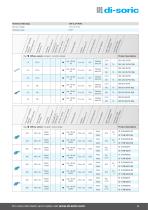
Technical data (typ.) Service voltage Protection type [}><=t| Diffuse sensor energetic, helical design Product description
Open the catalog to page 9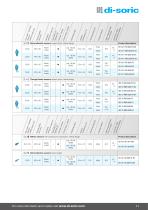
Plastic Metal Plastic Metal Plastic Metal Plastic Metal Qd—»-c0 Through-beam sensors angled optics, helical design Plastic Metal Plastic Metal Plastic Metal Plastic Metal For more information and models visit www.di-soric.com 11
Open the catalog to page 11
Cab le Plug materia conn l/len ecto gth, r Co n nect io (opt iona n cable lly a vaila ble) tput g ou chin Swit Se n sit sett ivity ing by m ean s of Tran sm Rec itter (T eive r (R) ) / Red light , clo cked Infra red light , clo cked Sca nw dista idth / o pe n ratin sett ce, g ing rang e (m m) Ho u sin Size g desig (mm n ) Light barriers Diffuse sensor energetic, rectangular design Retroreflective sensors rectangular design Through-beam sensors rectangular design Product description Diffuse sensor energetic, rectangular design M8 10 to 100 Cab le Plug materia conn l/len ecto gth, r Con nect io...
Open the catalog to page 12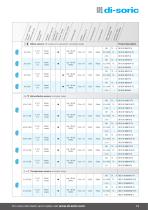
For more information and models visit www.di-soric.com 13
Open the catalog to page 13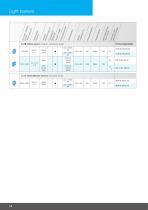
Cab le Plug materia conn l/len ecto gth, r Co n nect io (opt iona n cable lly a vaila ble) tput g ou chin Swit Se n sit sett ivity ing by m ean s of Tran sm Rec itter (T eive r (R) ) / Red light , clo cked Infra red light , clo cked Sca nw dista idth / o pe n ratin sett ce, g ing rang e (m m) Ho u sin Size g desig (mm n ) Light barriers Diffuse sensor energetic, rectangular design Teach Remote teach Product description pnp, 100 mA NO pnp, 100 mA NC Push-pull, 200 mA NO/NC Push-pull, 200 mA NO/NC Retroreflective sensors rectangular design
Open the catalog to page 14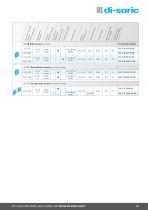
For more information and models visit www.di-soric.com
Open the catalog to page 15
Laser light barriers and diffuse sensors are used for the precise detection of small parts in all areas of automation. These devices are lightning-fast, non-contact, wear-free and extremely precise, counting small parts, determining their position and completeness exactly, and providing trigger signals for camera systems and system controls. Laser light barriers ■ Collimated red-light laser ■ Various designs ■ Resolution down to 0.2 mm ■ High switching frequency Laser line retroreflective sensors ■ Red-light laser, clocked ■ Fan-shaped laser beam with auto-collimation principle ■ Detection of...
Open the catalog to page 16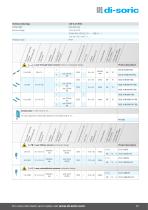
For more information and models visit www.di-soric.com 17
Open the catalog to page 17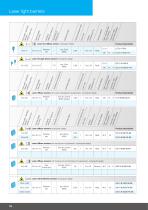
ial Cab le m Plug ateria conn l/len ecto gth, r Co n nect ion (opt iona cable lly a vaila ble) chin Swit Se n sit sett ivity ing by m ean s of Tran smit te Rec eive r (T) / r (R) Sca nw dista idth / o pe n ratin sett ce, g ing rang e (m m) Laser light barriers Laser line diffuse sensor rectangular design 20 to 70 Product description Laser through-beam sensors rectangular design chin Swit Laser diffuse sensors rectangular design 75 to 200 100 to 600 chin Swit tput g ou chin Swit ean s of Tran smit ter ( T) / R eceiv er Sca nw dista idth / ope n ratin sett ce, g ing rang e (m m) Product description...
Open the catalog to page 18All Di-soric catalogs and technical brochures
 Product family series 30
12 Pages
 Laser Distance sensors
12 Pages
 ULTRASONIC SENSORS US
8 Pages
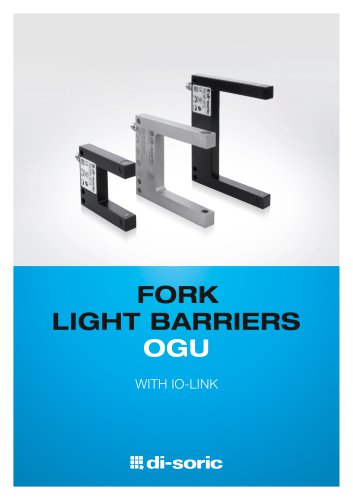 FORK LIGHT BARRIERS WITH IO-LINK
16 Pages
 LABELING TECHNOLOGY
20 Pages



- Proximity switch
- Cylindrical proximity sensor
- Inductive proximity sensor
- Photoelectric sensor
- IP67 proximity sensor
- Light fixture
- Rectangular photoelectric sensor
- Signal tower light
- LED stack light
- Camera objective
- Aluminum lighting
- Multibeam light curtain
- M12 proximity sensor
- Through-beam light curtain
- Rectangular proximity sensor
- Magnetic sensor
- Waterproof light curtain