


- Products
- Catalogs
- News & Trends
- Exhibitions
TCD 2013

TCD 2013
- Water-cooled 4 or 6-cylinder inline engines with turbocharging and charge air cooling.
- Equipped with DEUTZ Common Rail (DCR®) injection system and electronic engine control (EMR 4) for optimal performance and low fuel consumption.
- Features include wet cylinder liners, long oil change intervals, and easy fluid changes to reduce running costs and increase machinery availability.
- Low noise emissions due to acoustically optimized components.
- Compact design for easy and cost-effective installation.
- Pre-assembled air filter and cooling system.
- Excellent cold starting performance under extreme conditions.
- Engine types: TCD 2013 L4 2V, TCD 2013 L6 2V, TCD 2013 L6 4V.
- Number of cylinders: 4 or 6.
- Bore/stroke: 108/130 mm (4.3/5.1 in).
- Displacement: 4.8 to 7.2 liters (293 to 439 cu in).
- Weight with cooling system and air filter: 660 to 955 kg (1455 to 2105 lb).
- Limited Time Running Power (LTP) and Continuous Power (COP) ratings provided for different engine models.
- Power output varies with engine type and load conditions.
- Fuel consumption data provided for 25%, 50%, 75%, and 100% load conditions.
- Consumption rates vary by engine model and load percentage.
- Heat dissipation data for engine radiator, charge air cooler (CAC), and convection.
- Cooling air flow and fan power requirements specified.
- Maximum intake depression, combustion air volume, exhaust gas temperature, and exhaust gas flow rates provided.
- Dimensions vary by engine model, affecting installation space requirements.
Catalog excerpts
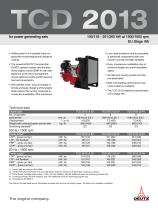
for power generating sets Low noise emissions due to acoustical- The powerful DEUTZ Common Rail Easy, inexpensive installation due to gines with turbocharging and charge air cooling. ly optimized components with very smooth running and high durability. (DCR®) injection system and the electronic engine control (EMR 4) with intelligent link to the drive management ensure optimum engine performance at low fuel consumption. minimum weight and small installation space. Air filter and cooling system are fully pre-assembled. Best cold starting performance even Wet cylinder liners, long oil change in- under extreme conditions. tervals and easy changing of the engine fluids reduce the running costs and increase the availability of the machinery. The TCD 2013 meets the requirements of EU Stage IIIA. Technical data Engine type No. of cylinders Bore/stroke Displacement Weight with cooling system and air filter Governing standard5) 50 Hz / 1500 rpm Power output1) LTP2) - gross (no fan) LTP - net flywheel PRP3) - gross (no fan) COP4) - gross (no fan) 60 Hz / 1800 rpm Power output1) LTP2) - gross (no fan) LTP - net flywheel PRP3) - gross (no fan) COP4) - gross (no fan) 1) 2) 3) 4) 5) Power (kW) according to ISO 14396. Limited Time Running Power: For up to 500 h/year, thereof a maximum of 300 h/year continuous running. Prime Power: Average power output ≤ 80%, no time limitation, plus 5% additional power for governing purpose only. Continuous Power: No time limitation, plus 10% additional power for governing purpose only. According to ISO 8528-5. The data on this data sheet are for information purposes only and are not binding values. The data in the quotation is definitive.
Open the catalog to page 1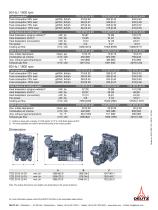
50 Hz / 1500 rpm Fuel comsuption1) Fuel comsuption 25% load Fuel comsuption 50% load Fuel comsuption 75% load Fuel comsuption 100% load g/kWh | lb/hph g/kWh | lb/hph g/kWh | lb/hph g/kWh | lb/hph Heat balance & cooling system Heat dissipation (engine radiator)2) Heat dissipation (CAC)2) Heat dissipation (convection) Fan power Cooling air flow Inlet & exhaust data max. intake depression Combustion air volume max. exhaust gas temperature Exhaust gas flow g/kWh | lb/hph g/kWh | lb/hph g/kWh | lb/hph g/kWh | lb/hph Heat balance & cooling system Heat dissipation (engine radiator)2) Heat dissipation...
Open the catalog to page 2All DEUTZ catalogs and technical brochures
 DEUTZ TCD 12.0/16.0 2022
2 Pages
 BFM 1013
2 Pages
 DEUTZ TCD 18.0
2 Pages
 DEUTZ TCD 9.0/12.0/13.5
2 Pages
 DEUTZ TCD 3.6
2 Pages
 TCD 2012
2 Pages
 DEUTZ TCD 12.0/16.0 2020
2 Pages
 TTCD 7.8 L6
2 Pages
 DEUTZ TCD 7.8
2 Pages
 DEUTZ TCD 4.1/6.1
2 Pages
 TCD 2011
4 Pages
 DEUTZ TCD 2.9
2 Pages


Archived catalogs
 2012 The Genset Engine
2 Pages
 DEUTZ Hybrid Drive
2 Pages
 TCD 914M
2 Pages
 TCG 2015
2 Pages
 2015M
2015M2 Pages
 D 2011Li
2 Pages
 D 2011L
2 Pages
 TCD 2015M
2 Pages
 FL 912
2 Pages
 DEUTZ TCD 2.2
2 Pages
 DEUTZ G 2.2 - 2.9
2 Pages
 BFM 2011
2 Pages
 2015M The marine engine
8 Pages
 912 The marine engine
4 Pages
 BFL 914
4 Pages
 BFM 1015
2 Pages
 914 The genset engine
2 Pages
 912 The genset engine
2 Pages
 1015 The genset engine
2 Pages
 1013 The genset engine
2 Pages
 M 2011 The genset engine
2 Pages
 1013M The marine engine
8 Pages
 1015M The marine engine
8 Pages
 Flyer Oil Filter
2 Pages
 Genuine DEUTZ pistons
2 Pages
 Xchange engines and parts
9 Pages
 TCD 2013 The genset engine
4 Pages
 L 2011 The genset engine
2 Pages


- Diesel engine
- Multi-cylinder engine
- Turbocharged engine
- Cylinder engine
- In-line engine
- 4-stroke engine
- Compact engine
- 6-cylinder engine
- 4-cylinder engine
- Water cooling engine
- Liquid-cooled engine
- Common-rail engine
- Engine with direct fuel injection
- Generator set engine
- Engine for marine applications
- Air cooling engine
- Tier 2 engine
- Stage III engine
- Tier 4 engine
- Soundproof engine