
- Catalogs
- Detroit demand performance
- DETROIT ® POWERTRAIN THE INTEGRATED DETROIT® POWERTRAIN IN THE


DETROIT ® POWERTRAIN THE INTEGRATED DETROIT® POWERTRAIN IN THE

DETROIT ® POWERTRAIN THE INTEGRATED DETROIT® POWERTRAIN IN THE
Detroit® offers an integrated powertrain system that enhances fuel efficiency by combining engines, transmissions, and axles. This system is designed to work with the aerodynamic features of Freightliner® Cascadia® and Western Star® 57X trucks to achieve superior fuel economy.
The DD15 Gen 5 and DD13 Gen 5 engines provide power outputs of up to 455 HP and 450 HP respectively, with torque reaching 1750 LB-FT. These engines are compliant with 2021 Greenhouse Gas requirements and are optimized for lower RPMs to improve fuel economy and reduce friction.
The DT12® transmission offers both Direct Drive and Over Drive options with various gear ratios. It features Intelligent Powertrain Management, which uses terrain maps to optimize transmission and engine functions, enhancing fuel efficiency and performance.
Detroit® drive axles are available in 6x4, 6x2, and 4x2 configurations with different rear axle ratios. The Axle Lubrication Management system improves fuel efficiency by optimizing oil flow and reducing friction.
Detroit® steer axles are available in 12,000 lbs, 12,500 lbs, and 13,300 lbs ratings. They are designed for durability and optimal performance with other powertrain components.
The integrated powertrain system includes features like superfinished gears for reduced parasitic losses, electronically enhanced eCoast for additional fuel savings, and an integrated communication network for damage prevention.
Catalog excerpts
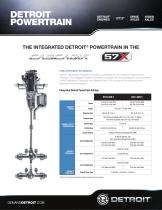
DETROIT® ENGINES DRIVE AXLES STEER AXLES THE INTEGRATED DETROIT® POWERTRAIN IN THE FUEL EFFICIENT BY DESIGN Detroit® seamlessly integrates its engines, transmissions, and axles for improved fuel efficiency. The Integrated Detroit Powertrain combines with the aerodynamic improvements of the Freightliner® Cascadia® and Western Star® 57X to produce the industry’s next generation of fuel economy. Integrated Detroit Powertrain Ratings DD15 GEN 5 Power DETROIT® ENGINE Torque Displacement Transmission DETROIT® DT12® TRANSMISSION Direct Drive (available with 2.16, 2.28, and 2.41 Ratios) Over Drive (available with 2.64 and 2.85 Ratios) Torque Input Cruise Control Intelligent Powertrain Management (IPM) 40,000 lb Tandem with Axle Lubrication Management (ALM2) 2.28 Rear Axle Ratio* 2.16 Rear Axle Ratio* 2.85 Rear Axle Ratio 2.64 Rear Axle Ratio 20,000 lbs Single DETROIT® DRIVE AXLE 20,000 lbs Tag 2.28 Rear Axle Ratio 2.85 Rear Axle Ratio 23,000 lbs Single 4x2 Configuration 2.28 Rear Axle Ratio DETROIT STEER AXLE Detroit Steer Axle *2.28 or 2.16 rear axle ratio requires driveline changes and trans oil cooler 2.85 Rear Axle Ratio
Open the catalog to page 1
DD15® GEN 5 AND DD13® GEN 5 ENGINE We all know slowing down is the best way to save fuel, so we’ve designed an engine that can cruise at the same road speed at lower RPMs, reducing fuel consumption and friction. This is made possible by integrating our fastest-ever tandem axle and made easy with our smooth-shifting DT12, making the Cascadia and 57X even more fuel efficient. • Dropping engine speed reduces the number of fuel injections, dramatically improving fuel economy • Integrated with DT12® automated manual transmission and fast axle ratio, this engine torque curve keeps you in top gear longer...
Open the catalog to page 2All Detroit demand performance catalogs and technical brochures
 DD13 VOCATIONAL
2 Pages
 DD13 ON-HIGHWAY
1 Page
 eFill All-in-one 240
1 Page
 eFill All-in-one 120
1 Page
 eFill Power Center 180
1 Page
 DT12
DT122 Pages
 DETROIT™ POWERTRAIN
8 Pages
 DETROIT™ DD16
2 Pages
 DETROIT™ DD8™
2 Pages
 DETROIT™ DD5™
2 Pages


- Diesel engine
- Multi-cylinder engine
- Cylinder engine
- In-line engine
- 4-cylinder engine
- Water cooling engine
- Common-rail engine
- Charging post
- Electric vehicle charging station
- Software suite
- Floor-mounted charging station
- Vehicle engine
- DC charging station
- High-efficiency engine
- Outdoor charging station
- Management software suite
- Analysis software suite
- Stage II engine
- Real-time software suite
- Drivetrain system