
- Catalogs
- Detector Electronics Corp. (Det-Tronics)
- Protecting Aircraft in Hangars


- Products
- Catalogs
- News & Trends
- Exhibitions
Protecting Aircraft in Hangars
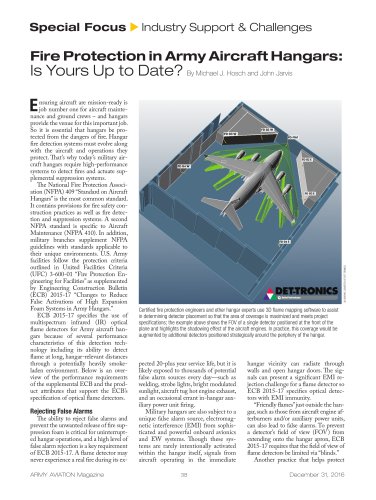
Protecting Aircraft in Hangars
Ensuring aircraft are mission-ready is crucial for maintenance and ground crews, with hangars playing a vital role. Protecting hangars from fire is essential, requiring advanced fire detection and suppression systems.
Standards and Guidelines
The National Fire Protection Association (NFPA) 409 and 410 standards guide fire safety in aircraft hangars. The U.S. Army follows additional criteria outlined in United Facilities Criteria (UFC) 3-600-01 and Engineering Construction Bulletin (ECB) 2015-17, which emphasize the use of multispectrum infrared (IR) optical flame detectors.
False Alarm Rejection
Preventing false alarms is critical to avoid unnecessary foam release. ECB 2015-17 requires detectors with high false alarm rejection capabilities and immunity to electromagnetic interference (EMI).
Detection Coverage
Complete flame detection coverage is necessary for all assets and hazards. ECB 2015-17 mandates that any hangar floor position be viewed by at least three detectors, posing a design challenge due to potential obstructions.
Planning and Implementation
Rigorous planning using 3D CAD mapping tools is essential for optimal detector placement. Systems must act within 30 seconds to prevent significant damage, with detectors like the Det-Tronics X3301 meeting these requirements.
Commissioning and Testing
Proof-testing systems for compliance traditionally involved jet fuel pan fires, posing safety risks. Det-Tronics developed a safer alternative using a jet fuel fire simulator that replicates fire characteristics without the associated dangers.
Conclusion
Military hangars require carefully engineered fire protection systems. Collaborating with experts like Det-Tronics ensures effective planning and implementation of the latest technologies to safeguard military aircraft.
Catalog excerpts
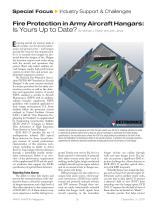
Special Focus u Industry Support & Challenges Fire Protection in Army Aircraft Hangars: Is Yours Up to Date? By Michael J. Hosch and John Jarvis nsuring aircraft are mission-ready is job number one for aircraft maintenance and ground crews – and hangars provide the venue for this important job. So it is essential that hangars be protected from the dangers of fire. Hangar fire detection systems must evolve along with the aircraft and operations they protect. That’s why today’s military aircraft hangars require high-performance systems to detect fires and actuate supplemental suppression systems. The National Fire Protection Association (NFPA) 409 “Standard on Aircraft Hangars” is the most common standard. It contains provisions for fire safety construction practices as well as fire detection and suppression systems. A second NFPA standard is specific to Aircraft Maintenance (NFPA 410). In addition, military branches supplement NFPA guidelines with standards applicable to their unique environments. U.S. Army facilities follow the protection criteria outlined in United Facilities Criteria (UFC) 3-600-01 “Fire Protection Engineering for Facilities” as supplemented by Engineering Construction Bulletin (ECB) 2015-17 “Changes to Reduce False Activations of High Expansion Foam Systems in Army Hangars.” ECB 2015-17 specifies the use of multispectrum infrared (IR) optical flame detectors for Army aircraft hangars because of several performance characteristics of this detection technology including its ability to detect flame at long, hangar-relevant distances through a potentially heavily smokeladen environment. Below is an overview of the performance requirements of the supplemental ECB and the product attributes that support the ECB’s specification of optical flame detectors. Rejecting False Alarms The ability to reject false alarms and prevent the unwanted release of fire suppression foam is critical for uninterrupted hangar operations, and a high level of false alarm rejection is a key requirement of ECB 2015-17. A flame detector may never experience a real fire during its exARMY AVIATION Magazine 3D GRAPHIC COURTESY OF DET-TRONICS Certified fire protection engineers and other hangar experts use 3D flame mapping software to assist in determining detector placement so that the area of coverage is maximized and meets project specifications; the example above shows the FOV of a single detector positioned at the front of the plane and highlights the shadowing effect of the aircraft engines. In practice, this coverage would be augmented by additional detectors positioned strategically around the periphery of the hangar. pected 20-plus year service life, but it is likely exposed to thousands of potential false alarm sources every day—such as welding, strobe lights, bright modulated sunlight, aircraft tug hot engine exhaust, and an occasional errant in-hangar auxiliary power unit firing. Military hangars are also subject to a unique false alarm source, electromagnetic interference (EMI) from sophisticated and powerful onboard avionics and EW systems. Though these systems are rarely intentionally activated within the hangar itself, signals from aircraft operating in the immediate 38 hangar vicinity can radiate through walls and open hangar doors. The signals can present a significant EMI rejection challenge for a flame detector so ECB 2015-17 specifies optical detectors with EMI immunity. “Friendly flames” just outside the hangar, such as those from aircraft engine afterburners and/or auxiliary power units, can also lead to false alarms. To prevent a detector’s field of view (FOV) from extending onto the hangar apron, ECB 2015-17 requires that the field of view of flame detectors be limited via “blinds.” Another practice that he
Open the catalog to page 1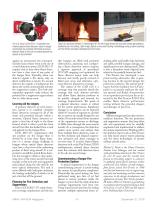
PHOTO COURTESY OF DET-TRONICS PHOTO COURTESY OF DET-TRONICS The U.S. Army’s ECB 2015-17 specifies that infrared optical flame detectors used in hangar construction be provided with blinds to ensure detector fields of view do not extend beyond the spaces to be protected. Taken at Ladd Army Airfield, Ft. Wainwright, AK, the left image shows the soot and smoke generated by traditional pan fire testing; right image depicts a new proof-testing methodology using a patent-pending Jet Fuel Flame Simulator developed by Det-Tronics. against an unnecessary but consequential false foam release event is the...
Open the catalog to page 2
Originally published in the December 31,2016 issue of ARMY AVIATION Magazine. AR-1116 | December 2016 Originally published in the December 31,2016 issue of ARMY AVIATION Magazine. AR-1116 | December 2016 Corporate Office 6901 West 110th Street Minneapolis, MN 55438 USA Phone: 952.946.6491 Toll-free: 800.765.3473 Fax: 952.829.8750 [email protected] © 2016 Detector Electronics Corporation. All rights reserved.
Open the catalog to page 3All Detector Electronics Corp. (Det-Tronics) catalogs and technical brochures

Archived catalogs
 Digital Communication Unit
8 Pages
 PM-5MPX Dual Spectrum IR
2 Pages
 FlexVu Universal Display
2 Pages
 Det-Tronics Product Catalog
247 Pages
 Det-Tronics Product Catalogue
241 Pages


- Digital I/O
- IO module
- Digital IO module
- Gas detector
- Gas sensor
- Industrial detector
- Leak monitor
- Remote I/O
- Infrared detector
- DIN rail mounted I O module
- Remote IO module
- Gas leak detector
- Electrochemical gas sensor
- Explosion-proof detector
- Safety I/O
- Smoke detector
- Methane detector
- Fixed detector
- Monitoring gas sensor
- Gas transmitter