
- Catalogs
- Detector Electronics Corp. (Det-Tronics)
- Faster Fire Protection for FRT Applications


- Products
- Catalogs
- News & Trends
- Exhibitions
Faster Fire Protection for FRT Applications
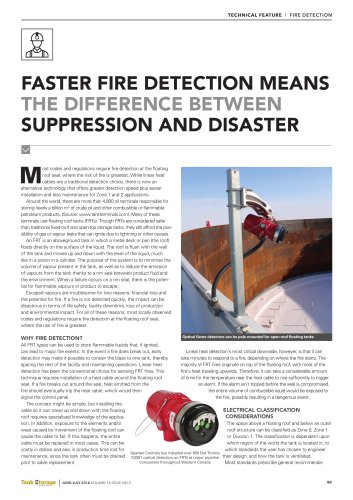
Faster Fire Protection for FRT Applications
Fire detection at floating roof seals is critical due to the high risk of fire. Traditional linear heat cables are being replaced by faster, easier-to-install optical flame detectors, especially in Zone 1 and 2 applications.
Floating Roof Tanks (FRTs)
FRTs are used globally to store flammable liquids. They minimize vapor emissions but can still leak, posing fire risks. Quick fire detection is crucial to prevent catastrophic events.
Fire Detection Technologies
Linear heat detection, though traditional, is slow and requires complex installation. Optical flame detectors offer faster response times (3-8 seconds) and cover larger areas, making them more effective for FRTs.
Electrical Classification
The space above FRTs can be classified as Zone 0, 1, or 2, depending on the likelihood of explosive atmospheres. This classification affects the choice of detection technology.
Optical Flame Detection
Optical detectors detect electromagnetic radiation from flames and provide rapid response, reducing the risk of fire escalation. They are strategically placed to ensure comprehensive coverage.
Gas Detection
Gas detection adds another layer of safety, identifying leaks that could lead to fires. Technologies include fixed-point, infrared, and acoustic detection, each with specific advantages.
Integrated Safety Systems
Effective fire and gas safety systems integrate detectors with controllers that manage alarms and suppression actions, ensuring rapid response to fire threats.
Conclusion
Optical flame detection is a superior alternative to linear heat detection for FRTs, offering faster and more reliable fire detection, thus preventing potential disasters.
Contact Information
For more details, contact Det-Tronics at their Minneapolis office or visit their website.
Catalog excerpts
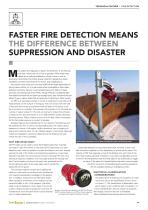
TECHNICAL FEATURE l FIRE DETECTION FASTER FIRE DETECTION MEANS THE DIFFERENCE BETWEEN SUPPRESSION AND DISASTER ost codes and regulations require fire detection at the floating roof seal, where the risk of fire is greatest. While linear heat cables are a traditional detection choice, there is now an alternative technology that offers greater detection speed plus easier installation and less maintenance for Zone 1 and 2 applications. Around the world, there are more than 4,800 oil terminals responsible for storing nearly a billion m3 of crude oil and other combustible or flammable petroleum products. (Source: www.tankterminals.com). Many of these terminals use floating roof tanks (FRTs). Though FRTs are considered safer than traditional fixed-roof and open-top storage tanks, they still afford the possibility of gas or vapour leaks that can ignite due to lightning or other causes. An FRT is an aboveground tank in which a metal deck or pan (the roof) floats directly on the surface of the liquid. The roof is flush with the wall of the tank and moves up and down with the level of the liquid, much like in a piston in a cylinder. The purpose of the system is to minimise the volume of vapour present in the tank, as well as to reduce the emission of vapours from the tank thanks to a rim seal between product fluid and the environment. When a failure occurs on a rim seal, there is the potential for flammable vapours or product to escape. Escaped vapours are troublesome for two reasons: financial loss and the potential for fire. If a fire is not detected quickly, the impact can be disastrous in terms of life safety, facility downtime, loss of production and environmental impact. For all of these reasons, most locally observed codes and regulations require fire detection at the floating roof seal, where the risk of fire is greatest. Optical flame detectors can be pole mounted for open roof floating tanks All FRT types can be used to store flammable liquids that, if ignited, can lead to major fire events. In the event a fire does break out, early Linear heat detection’s most critical downside, however, is that it can detection may make it possible to contain the blaze to one tank, thereby take minutes to respond to a fire, depending on where the fire starts. The sparing the rest of the facility and maintaining operations. Linear heat majority of FRT fires originate on top of the floating roof, with most of the detection has been the conventional choice for sensing FRT fires. This fire’s heat traveling upwards. Therefore, it can take a considerable amount technique requires installation of a heat cable around the floating roof of time for the temperature near the heat cable to rise sufficiently to trigger seal. If a fire breaks out around the seal, heat emitted from the an alarm. If the alarm isn’t tripped before the seal is compromised, fire should eventually trip the heat cable, which would then the entire volume of combustible liquid would be exposed to signal the control panel. the fire, possibly resulting in a dangerous event. The concept might be simple, but installing the ELECTRICAL CLASSIFICATION cable so it can travel up and down with the floating CONSIDERATIONS roof requires specialised knowledge of the application. In addition, exposure to the elements and/or The space above a floating roof and below an outer wear caused by movement of the floating roof can roof structure can be classified as Zone 0, Zone 1 cause the cable to fail. If this happens, the entire or Division 1. The classification is dependent upon cable must be replaced in most cases. This can be which region of the world the tank is located in, to costly in dollars and also in production time lost for which standards the user has chosen to engineer Spartan Controls has installed over 650 Det-Tronics maintenance, since the tank often must be drained X3301 optical detectors on FRTs at major pipeline their design, and how the tank is ventilated. companies throughout Western Canada prior to cable replacement. Most standards prescribe general recommenda- JUNE/JULY 2018 VOLUME 14 ISSUE NO.3
Open the catalog to page 1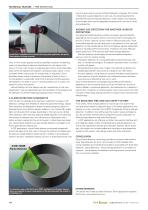
TECHNICAL FEATURE l FIRE DETECTION ping of a given area to ensure sufficient detection coverage. The number of detectors required depends on tank size, the stored liquid and the specified fire size that requires detection. Under certain circumstances, some smaller tanks can be adequately protected with only two or three optical detectors. ADDING GAS DETECTION FOR ANOTHER LAYER OF PROTECTION In this Zone 1 classified fixed-roof internal floating tank application, the optical flame detector is flange mounted tions on how certain spaces should be classified; however, the defining means of prescribing...
Open the catalog to page 2
This article was originally published in the June/July 2018 edition of Tank Storage Magazine. www.tankstoragemag.com AR-1124 This article was originally published in the June/July 2018 edition of Tank Storage Magazine. www.tankstoragemag.com AR-1124 Corporate Office 6901 West 110th Street Minneapolis, MN 55438 USA Phone: 952.946.6491 Toll-free: 800.765.3473 Fax: 952.829.8750 [email protected] © 2018 Detector Electronics Corporation. All rights reserved
Open the catalog to page 3All Detector Electronics Corp. (Det-Tronics) catalogs and technical brochures

Archived catalogs
 Digital Communication Unit
8 Pages
 PM-5MPX Dual Spectrum IR
2 Pages
 FlexVu Universal Display
2 Pages
 Det-Tronics Product Catalog
247 Pages
 Det-Tronics Product Catalogue
241 Pages


- Digital I/O
- IO module
- Digital IO module
- Gas detector
- Gas sensor
- Leak monitor
- Industrial detector
- Remote I/O
- Infrared detector
- DIN rail mounted I O module
- Remote IO module
- Gas leak detector
- Electrochemical gas sensor
- Explosion-proof detector
- Safety I/O
- Smoke detector
- Methane detector
- Fixed detector
- Monitoring gas sensor
- Gas transmitter