
- Catalogs
- Detector Electronics Corp. (Det-Tronics)
- Digital Communication Unit


- Products
- Catalogs
- News & Trends
- Exhibitions
Digital Communication Unit

Digital Communication Unit
- Field addressable with patented fault isolation.
- Advanced communication technology with pass-through capability during power loss.
- Ten-bit signal resolution and two alarm setpoints.
- Non-volatile memory for event logging and non-intrusive calibration.
- LED indicators for calibration, fault, and alarm status.
- EMI hardened and compatible with Eagle Quantum systems.
- Input Voltage: 24 VDC (18 to 32 VDC operating range).
- Inputs: 4 to 20 mA analog signal with 200 ohms impedance.
- Outputs: Digital communication, transformer isolated.
- Power Consumption: 95 mA max for toxic gas sensors; 180 mA normal, 500 mA startup for combustible gas sensors.
- Temperature Range: Operating from -40°F to +167°F; Storage from -67°F to +185°F.
- Certification: FM/CSA, CENELEC/CE, ATEX/EMC compliant.
- Shipping Weight: Aluminum 6 lb, Stainless Steel 10 lb.
- The DCU is installed in a digital communication loop with shielded twisted pair wire.
- Calibration and event logging are facilitated by non-intrusive methods and stored in non-volatile memory.
- Fault-tolerant network design allows for continued operation despite wiring faults.
- Addressability is set via DIP switches, with a range from 5 to 250.
- Ensure the area is free of combustible gases before applying power with the cover removed.
- Use appropriate grease for sensor threads to prevent damage.
- Follow specific guidelines for sensor separation and wiring to maintain system integrity.
Catalog excerpts
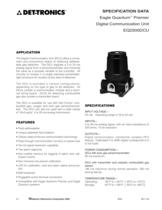
The Digital Communication Unit (DCU) offers a conve-nient and economical means of obtaining address- able gas detection. The DCU digitizes a 4 to 20 ma analog signal from a sensor/transmitter and transmits the value as a process variable to the controller. All circuitry is housed in a single explosion-proof/water- tight enclosure for location at the area of detection.The DCU is provided in various configurations,depending on the type of gas to be detected. All DCUs contain a communication module and a termi- nal wiring board. DCUs for detecting combustible gas also contain a transmitter board. The DCU is available for use with Det-Tronics com-bustible gas, oxygen and toxic gas sensor/transmit- ters. The DCU can also be used with a wide variety of ғthird party 4 to 20 ma analog instruments. > 24 vdc. Operating range is 18 to 32 vdc. INPUT VOLTAGEԗ INPUTS 4 to 20 ma analog signal, with an input impedance of 200 ohms, 10 bit resolution. > OUTPUTSח Digital communication, transformer isolated (78.5 kbaud). Calibrated 0 to 4095 digital corresponds to 0 to full scale. POWER CONSUMPTIONDCU with toxic gas sensor/transmitter: 95 ma maximum. וField addressableUnique patented fault isolation ՕUtilizes state-of-the-art communication technology Pass through communication circuitry on power loss ՕTen bit signal resolution capability Two alarm setpoints ՕNon-volatile memory for logging of alarm and cali-bration eventsNon-intrusive one person calibration ՕLED for calibration, fault and alarm status annuncia-tionEMI hardened ՕPluggable screw terminal connectors Compatible with Eagle Quantum Premier and EagleQuantum systems. DCU with transmitter and catalytic combustible gassensor: 180 ma maximum during normal operation, 500 ma during startup. TEMPERATURE RANGE Operating:40ְF to +167F (Ж40C to +75аC). Storage:67ְF to +185F (Ж55C to +85аC). > 2.1 Detector Electronics Corporation 2003 8/0390-1118 size="-1">
Open the catalog to page 1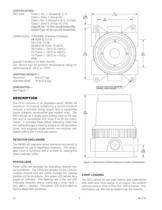
SHIPPING WEIGHT Aluminum:6 lb (2.7 kg) Stainless Steel:10 lb (4.5 kg). DIMENSIONSח CERTIFICATION See Figure 1. FM / CSA:Class I, Div. 1, Groups B, C, D.Class I, Zone 1, Group IIC. Class I, Div. 2, Groups A, B, C, D (T4A). Class I, Zone 2, Group IIC (T4). Class II/III, Div. 1 & 2 (for use with Model STB). NEMA/Type 4X (for use with Model STB).CENELEC/CE:ATEX/EMC Directive Compliant.0539 II 2 GEEx d IIC T4-T6 DEMKO 02 ATEX 131321X T6 (Tamb = ז55C to +50аC). T5 (Tamb = 55ְC to +65C). T4 (Tamb = Ж55C to +75аC). IP66.Special Conditions for Safe Use (X): The device has an ambient temperature rating...
Open the catalog to page 2
IMPORTANT EQ2200DCU DIGITAL COMMUNICATION UNIT USED WITH POINTWATCH Insulate the shields to prevent shorting to the device housing or to any other conductor. Attach the communication module to the standoffs asshown in Figure 4. Connect the ribbon cable from the terminal wiring board to the communication module.Set the address for the device (see AddressabilityӔ onpage 3).Check the wiring to ensure proper connections, thenpour the conduit seals and allow them to dry (if conduit is being used). Determine the best mounting locations for the detectors. Whenever practical, detectors should be placed...
Open the catalog to page 5
COMMUNICATION MODULESWITCHES ON SAME SIDE(RIGHT)TRANSMITTER BOARDTERMINAL WIRING BOARD > COMMUNICATION MODULESWITCHES ON OPPOSITE SIDES(WRONG)TRANSMITTER BOARDTERMINAL WIRING BOARD > SENSOR POWERCOM 2COM SHIELDCOM 1 AB AB TERMINAL WIRING BOARD >
Open the catalog to page 6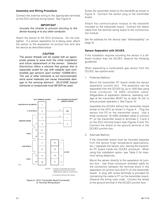
Screw the transmitter board to the standoffs as shown inFigure 8. Connect the sensor plug to the transmitter board.Attach the communication module to the standoffsmounted on the transmitter board. Connect the ribbon cable from the terminal wiring board to the communica- tion module.Set the address for the device (see AddressabilityӔ onpage 3). Assembly and Wiring Procedure Connect the external wiring to the appropriate terminalson the DCU terminal wiring board. See Figure 9. IMPORTANT Insulate the shields to prevent shorting to the device housing or to any other conductor. Attach the sensor to...
Open the catalog to page 7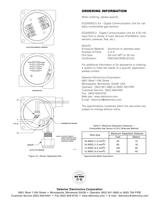
SENSORCATALYTIC SENSOR ELECTROCHEMICAL SENSOR > B1878
Open the catalog to page 8All Detector Electronics Corp. (Det-Tronics) catalogs and technical brochures

Archived catalogs
 PM-5MPX Dual Spectrum IR
2 Pages
 FlexVu Universal Display
2 Pages
 Det-Tronics Product Catalog
247 Pages
 Det-Tronics Product Catalogue
241 Pages


- Digital I/O
- IO module
- Digital IO module
- Gas detector
- Industrial detector
- Leak monitor
- Remote I/O
- Infrared detector
- DIN rail mounted I O module
- Remote IO module
- Gas leak detector
- Electrochemical gas sensor
- Explosion-proof detector
- Safety I/O
- Smoke detector
- Methane detector
- Fixed detector
- Monitoring gas sensor
- Gas transmitter