
- Catalogs
- Detector Electronics Corp. (Det-Tronics)
- Detecting Combustible Gases and Smoke


- Products
- Catalogs
- News & Trends
- Exhibitions
Detecting Combustible Gases and Smoke
Detecting Combustible Gases and Smoke
Water and wastewater treatment plant operators need to understand fire safety equipment basics to make informed decisions about replacing or upgrading smoke and gas detectors. This document provides practical advice for maintaining detection devices effectively.
Understanding Ratings
Detectors in treatment plants are often located in hazardous areas as defined by OSHA. NFPA 820 provides detailed guidelines on installation and performance requirements for these detectors. Hazardous locations are classified into Class I, Division 1, and Division 2, each with specific requirements for equipment safety.
First Line of Defense
Combustible gas detection systems are crucial for early leak detection, preventing ignition. These systems measure methane levels and can trigger alarms, activate ventilation, and suppress ignition. Options include line-of-sight and fixed-point gas detection technologies, each with unique benefits and limitations.
Placing Smoke Detectors
Smoke detectors are recommended for specific areas like sludge-processing and incinerator buildings. They must be approved for hazardous locations and strategically placed to avoid false alarms. Some detectors are designed for ductwork installation to comply with NFPA 820 requirements.
Conclusion
Effective fire and gas safety systems are essential in treatment plants to protect personnel and infrastructure. While specialists often handle initial installations, operators should be knowledgeable about detection equipment to ensure ongoing safety and ease of maintenance.
About the Author
Aaron Paterson is an applications engineer with Det-Tronics, specializing in flame and gas detection systems for high-risk industrial operations.
Catalog excerpts
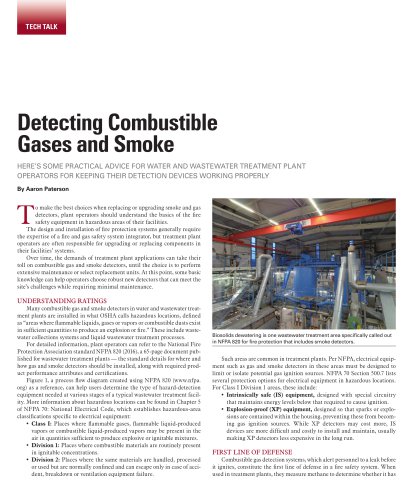
TECH TALK Detecting Combustible Gases and Smoke HERE’S SOME PRACTICAL ADVICE FOR WATER AND WASTEWATER TREATMENT PLANT OPERATORS FOR KEEPING THEIR DETECTION DEVICES WORKING PROPERLY By Aaron Paterson o make the best choices when replacing or upgrading smoke and gas detectors, plant operators should understand the basics of the fire safety equipment in hazardous areas of their facilities. The design and installation of fire protection systems generally require the expertise of a fire and gas safety system integrator, but treatment plant operators are often responsible for upgrading or replacing components in their facilities’ systems. Over time, the demands of treatment plant applications can take their toll on combustible gas and smoke detectors, until the choice is to perform extensive maintenance or select replacement units. At this point, some basic knowledge can help operators choose robust new detectors that can meet the site’s challenges while requiring minimal maintenance. UNDERSTANDING RATINGS Many combustible gas and smoke detectors in water and wastewater treatment plants are installed in what OSHA calls hazardous locations, defined as “areas where flammable liquids, gases or vapors or combustible dusts exist in sufficient quantities to produce an explosion or fire.” These include wastewater collections systems and liquid wastewater treatment processes. For detailed information, plant operators can refer to the National Fire Protection Association standard NFPA 820 (2016), a 65-page document published for wastewater treatment plants — the standard details for where and how gas and smoke detectors should be installed, along with required product performance attributes and certifications. Figure 1, a process flow diagram created using NFPA 820 (www.nfpa. org) as a reference, can help users determine the type of hazard-detection equipment needed at various stages of a typical wastewater treatment facility. More information about hazardous locations can be found in Chapter 5 of NFPA 70: National Electrical Code, which establishes hazardous-area classifications specific to electrical equipment: • Class I: Places where flammable gases, flammable liquid-produced vapors or combustible liquid-produced vapors may be present in the air in quantities sufficient to produce explosive or ignitable mixtures. • Division 1: Places where combustible materials are routinely present in ignitable concentrations. • Division 2: Places where the same materials are handled, processed or used but are normally confined and can escape only in case of accident, breakdown or ventilation equipment failure. Biosolids dewatering is one wastewater treatment area specifically called out in NFPA 820 for fire protection that includes smoke detectors. Such areas are common in treatment plants. Per NFPA, electrical equipment such as gas and smoke detectors in these areas must be designed to limit or isolate potential gas ignition sources. NFPA 70 Section 500.7 lists several protection options for electrical equipment in hazardous locations. For Class I Division 1 areas, these include: • Intrinsically safe (IS) equipment, designed with special circuitry that maintains energy levels below that required to cause ignition. • Explosion-proof (XP) equipment, designed so that sparks or explosions are contained within the housing, preventing these from becoming gas ignition sources. While XP detectors may cost more, IS devices are more difficult and costly to install and maintain, usually making XP detectors less expensive in the long run. FIRST LINE OF DEFENSE Combustible gas detection systems, which alert personnel to a leak before it ignites, constitute the first line of defense in a fire safety system. When used in treatment plants, they measure methane to deter
Open the catalog to page 1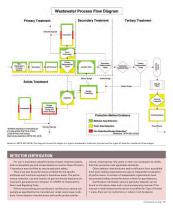
Wastewater Process Flow DiagramSecondary Treatment Tertiary Treatment Wastewater Ultimate Disposal Grit Removal Aeration Tank Tertiary Sedimentation x Tanks Solids Treatment Waste Sludge Waste Sludge Sludge Dewatering. Drying and Indoor Storage Protection Method Guidance Final Effluent Fire Detection/Smoke Detection* •Systems supplying or exhausting air at a rate greater than 56.6 mVmin (2.000 ftVmin) shall include listed smoke detection (NFPA 820, 2016) Based on NFPA 820 (2016), this diagram shows the stages in a typical wastewater treatment process and the types of detection needed at those...
Open the catalog to page 2
(Continued from page 43) reached a combustible level. These systems can also trigger alarms, record events, provide time for intervention or evacuation, activate ventilation, and release water mist or carbon dioxide to suppress ignition if a gas cloud is forming. Gas detector options suited to wastewater applications include: • Line-of-sight (or open-path) gas detection, using laser, infrared or UV technology. These detectors, which monitor combustible gas levels between two points, are most often used to monitor open spaces above valves, tanks and pipelines. • Fixed-point gas detection by electrochemical,...
Open the catalog to page 3All Detector Electronics Corp. (Det-Tronics) catalogs and technical brochures
Archived catalogs
 Digital Communication Unit
8 Pages
 PM-5MPX Dual Spectrum IR
2 Pages
 FlexVu Universal Display
2 Pages
 Det-Tronics Product Catalog
247 Pages
 Det-Tronics Product Catalogue
241 Pages


