
- Catalogs
- Detector Electronics Corp. (Det-Tronics)
- Det-Tronics Best Practices for Fire Gas Detection


- Products
- Catalogs
- News & Trends
- Exhibitions
Det-Tronics Best Practices for Fire Gas Detection
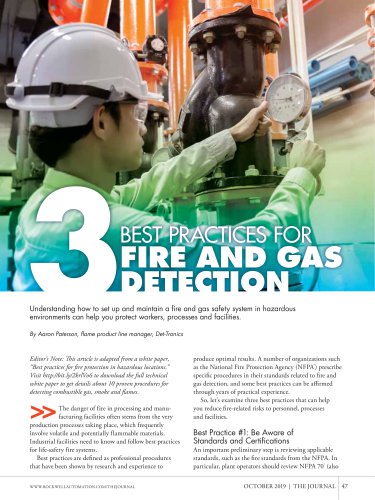
Det-Tronics Best Practices for Fire Gas Detection
The document discusses best practices for fire protection in hazardous locations, particularly in processing and manufacturing facilities where volatile materials are present. It emphasizes the importance of adhering to professional procedures and standards to ensure optimal safety.
Best Practice #1: Awareness of Standards and Certifications
Understanding and reviewing applicable standards, such as those from the National Fire Protection Agency (NFPA), is crucial. Key standards include NFPA 70 (National Electrical Code) and NFPA 72 (National Fire Alarm and Signaling Code). These standards help classify hazardous areas and ensure that equipment meets safety requirements through third-party certifications.
Best Practice #2: Careful Placement of Gas Detectors
Proper placement of gas detectors is essential for effective detection. Point detectors should be placed near the equipment being protected, considering factors like ventilation and gas density. Line-of-sight detectors require unobstructed views and stable mounting to maintain alignment. Accessibility for maintenance is also important.
Best Practice #3: Combining Gas Detection Technologies
Using a combination of gas detection technologies can enhance safety. Point detectors provide localized gas-level information, while line-of-sight detectors monitor broader areas and track gas movement. This combination maximizes coverage and effectiveness.
Conclusion
The document highlights the importance of integrating various detection technologies and adhering to established standards to mitigate fire risks in industrial settings. For more detailed procedures, the full white paper is available for download.
Catalog excerpts
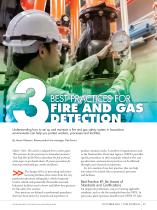
Understanding how to set up and maintain a fire and gas safety system in hazardous environments can help you protect workers, processes and facilities. By Aaron Paterson, flame product line manager, Det-Tronics Editor’s Note: This article is adapted from a white paper, “Best practices for fire protection in hazardous locations.” Visit http://bit.ly/2krlVo6 to download the full technical white paper to get details about 10 proven procedures for detecting combustible gas, smoke and flames. The danger of fire in processing and manufacturing facilities often stems from the very production processes taking place, which frequently involve volatile and potentially flammable materials. Industrial facilities need to know and follow best practices for life-safety fire systems. Best practices are defined as professional procedures that have been shown by research and experience to W W W.ROCKWELLAUTOMATION.COM/THEJOURNAL produce optimal results. A number of organizations such as the National Fire Protection Agency (NFPA®) prescribe specific procedures in their standards related to fire and gas detection, and some best practices can be affirmed through years of practical experience. So, let’s examine three best practices that can help you reduce fire-related risks to personnel, processes and facilities. Best Practice #1: Be Aware of Standards and Certifications An important preliminary step is reviewing applicable standards, such as the fire standards from the NFPA. In particular, plant operators should review NFPA 70® (also O
Open the catalog to page 1
Research from the NFPA reported that almost 65% of combined industrial or manufacturing facility structure fires occurred specifically in manufacturing properties. known as the NFPA 70® National Electrical Code®, or NEC ®) and NFPA 72®: National Fire Alarm and Signaling Code®. Chapter 5 of the NEC addresses “special occupancies.” Within that chapter, Article 500 stipulates that locations be classified based on flammables that could be present, as well as their concentration or quantity. Hazardous-area classifications specific to electrical equipment are considered in this section. Class I areas are...
Open the catalog to page 2All Detector Electronics Corp. (Det-Tronics) catalogs and technical brochures
Archived catalogs
 Digital Communication Unit
8 Pages
 PM-5MPX Dual Spectrum IR
2 Pages
 FlexVu Universal Display
2 Pages
 Det-Tronics Product Catalog
247 Pages
 Det-Tronics Product Catalogue
241 Pages


- Digital I/O
- IO module
- Digital IO module
- Gas sensor
- Industrial detector
- Leak monitor
- Remote I/O
- Infrared detector
- DIN rail mounted I O module
- Remote IO module
- Gas leak detector
- Electrochemical gas sensor
- Explosion-proof detector
- Safety I/O
- Smoke detector
- Methane detector
- Fixed detector
- Monitoring gas sensor
- Gas transmitter