
- Catalogs
- Detector Electronics Corp. (Det-Tronics)
- Best practices for fire protection in hazardous locations


- Products
- Catalogs
- News & Trends
- Exhibitions
Best practices for fire protection in hazardous locations
Best practices for fire protection in hazardous locations
Catalog excerpts
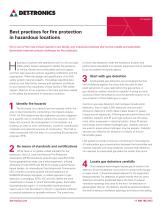
Best practices for fire protection in hazardous locations Fire is one of the most critical hazards in any facility, and industrial processes that involve volatile and potentially flammable materials present challenges for fire protection. azardous locations and operations call for a fire and gas (F&G) safety system designed to detect the presence of smoke, flames and combustible and toxic gases, and then take executive actions regarding notification and fire suppression. While the design and specification of an F&G safety system requires experts, knowledge regarding best practices can help facility owners and operators contribute to and maintain the robustness of their facility’s F&G safety system. Read on for an overview of ten best practices related to life safety fire protection in hazardous locations. Identify fire hazards The first step is to identify any fire hazards within the area to be protected by conducting a fire hazard analysis (FHA). An FHA determines the expected outcome triggered by a specific set of conditions called a fire scenario, which takes into account the arrangement of rooms/areas in a building, as well as room dimensions, contents, construction materials and potential sources of combustion. The FHA is often conducted with the help of a consulting fire protection engineer (FPE). Be aware of standards and certifications While there is no global unified standard for fire protection, the U.S. uses the National Fire Protection Association (NFPA) standards while Europe uses BS EN 54. Some geographical areas use a hybrid approach, utilizing attributes of both NFPA and EN 54 to create a performancebased design. As International Electrotechnical Commission (IEC) member countries publish national adoptions of IEC60079-29 series standards, a unified approach to gas detection is emerging. ATEX, IEC and AEx define the zone classification of areas in which flammable gases, flammable liquid-produced vapors, or combustible liquid-produced vapors are or may be present in the air in quantities sufficient to produce explosive or ignitable mixtures. The surest way to know that detectors meet the hazardous location and performance standards is to specify equipment that is certified by an accredited third-party agency. Start with gas detection Combustible gas detectors are considered the first line of defense against fire since they are able to alert plant personnel of a gas leak before the gas ignites. A gas detection system should be capable of giving an early warning of both the presence and the general location of an accumulation of flammable gas or vapor. Common gas leak detection technologies include point detectors, line of sight (LOS) detectors and acoustic/ ultrasonic detectors which detect leaks based on gases’ unique sound signatures. Offering proven performance and reliability, catalytic and IR point gas sensors are the types most often employed in industrial plants. Since IR sensor technology cannot detect hydrogen gas, catalytic sensors are used in areas where hydrogen may be present. Catalytic sensors are effective for detection of nearly all known flammable gases. LOS systems provide continuous monitoring for the presence of hydrocarbon gas concentrations between the transmitter and receiver, typically over long distances. Acoustic leak detectors can respond to pressurized gas leaks the instant they occur. Locate gas detectors carefully Point detector technologies require gas to travel to the detector. Since the detector must come in contact with the gas or vapor cloud, it should be placed adjacent to the equipment being protected. For detection of gases heavier than air, point detectors should be positioned below the level of exhaust ventilation openings and close to the floor. For detection of gases lighter than air, the detector should be positioned above the level of exhaust ventilation openings and close to the ceiling.
Open the catalog to page 1
Tip Sheet | Best practices for fire protection in hazardous locations LOS detectors should be mounted to a rigid and stable surface so the optical alignment of the transmitter and receiver is maintained consistently. In addition, component placement must be performed carefully as the system requires an unobstructed line of sight between the transmitter and receiver. Combine gas detection technologies Since each of the gas detection technologies has benefits and limitations, a common strategy is combining the technologies and placing them in locations that maximize their effectiveness. In many...
Open the catalog to page 2
Tip Sheet | Best practices for fire protection in hazardous locations Final thoughts Understanding the best practices above can help plant owners and operators make informed decisions regarding the purchase, installation and maintenance of a fire and gas safety system. The content of this white paper is provided for informational purposes only and is not intended to provide professional services or substitute for the review and advice, in any given circumstances, of an appropriate professional. Det-Tronics makes every effort to provide timely and accurate information but makes no claims, promises,...
Open the catalog to page 3All Detector Electronics Corp. (Det-Tronics) catalogs and technical brochures
Archived catalogs
 Digital Communication Unit
8 Pages
 PM-5MPX Dual Spectrum IR
2 Pages
 FlexVu Universal Display
2 Pages
 Det-Tronics Product Catalog
247 Pages
 Det-Tronics Product Catalogue
241 Pages


