

Digital Earmould Production with DETAX Premium Plastic Materials

Digital Earmould Production with DETAX Premium Plastic Materials
The document discusses the integration of digital manufacturing in the audiological sector, specifically focusing on the production of earmoulds using 3D printing technology. It highlights the shift towards digital methods in earmould production, emphasizing the use of DETAX premium plastic materials.
Specifications and Materials
DETAX provides premium materials such as luxaprint® 3D shell/mould and luxaprint® shellac varnishes, optimized for digital manufacturing processes like Digital Light Processing (DLP). These materials are designed for both hard and soft earmoulds, offering benefits like high transparency, mechanical strength, biocompatibility, and a variety of colors.
Manufacturing Process
The document details the use of rapidshape 3D printers, specifically the HA90 system, which allows for efficient production of earmoulds. The combination of rapidshape printers and DETAX materials enables the production of 40-45 earmoulds in 80-90 minutes, significantly reducing production time compared to traditional methods.
Advantages
Key advantages include the ability to produce colored eartips directly, improved surface finish, and reduced material consumption due to lower viscosity. The digital process allows for precise modeling and the integration of features like filter systems and multichannel bores.
Finishing and Quality
After printing, earmoulds can be finished with DETAX luxaprint® shellac, enhancing durability and quality perception. The varnish provides a scratch-resistant, easy-to-clean surface that reduces earwax adhesion and yellowing.
Conclusion
The use of DETAX premium plastics in earmould production represents a significant advancement, offering faster, cost-effective, and reproducible manufacturing. The technology supports continuous innovation and high-quality development in the audiological field.
Author Information
Dominic Schmidt, a Bachelor of Science, has been involved in audiological development at Hörluchs hearing protection systems since 2015, focusing on innovative developments in audiology and hearing protection.
Catalog excerpts
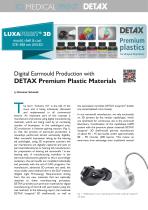
3D MEDICAL PRINT LUXA mould, shell & cast 378–388 nm UV/LED plastics for all open 3D printers Digital Earmould Production with DETAX Premium Plastic Materials by Dominic Schmidt he term “Industry 4.0” is the talk of the town and is being intensively discussed and implemented in all commercial sectors. An important part of this concept is manufacture of products using digital manufacturing methods, which are being used by an increasing number of businesses. In the audiological area, 3D production is likewise gaining traction (Fig.1), so that the process of earmould production is nowadays performed almost exclusively digitally. After successful impression taking by the hearing aid audiologist, using 3D impression scanners the ear impressions are digitally captured and sent to earmould laboratories or hearing aid manufacturers for preparation of hearing aid earmoulds / in-ear hearing aids. A manufacturing workflow in the earmould laboratories geared to this is accordingly necessary; the earmoulds are modelled individually and precisely with the aid of CAD programs. For manufacture, advanced 3D printers are used; the most widely used method here is the DLP method (Digital Light Processing). Requirements arising from this are new materials that are optimally matched to these manufacturing processes. DETAX provides such premium materials for digital manufacturing of hard & soft earmoulds (using the cast method). In the following report, the materials DETAX luxaprint® 3D shell/mould, as well as the associated varnishes DETAX luxaprint® shellac are contemplated more closely. In our earmould manufacture, we rely exclusively on 3D printers by the vendor rapidshape, which are optimised for continuous use in the earmould laboratory. Combination of the rapidshape HA90 system with the premium plastic materials DETAX luxaprint® 3D shell/mould permits manufacture of about 40 – 45 earmoulds within approximately 80 – 90 minutes (400 layers). This means an enormous time advantage over traditional manual Fig. 1: Professional in-ear monitoring with shells made luxapri
Open the catalog to page 1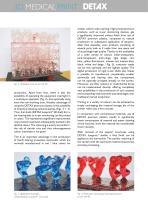
production. Apart from that, there is also the possibility of operating the equipment overnight in a multi-layer operation (Fig. 2), thus optimally using even the non-working time. Another advantage of using the DETAX premium plastics is the possibility of directly producing coloured eartips (Figs. 3 + 4). Thus, thin shells (DETAX luxaprint® 3D shell) for inear hearing aids or in-ear monitoring can be printed in colour. This represents a significant improvement over precision earpieces subsequently painted in the desired colour. The colouring is evenly and uniform, the risk of varnish runs and...
Open the catalog to page 2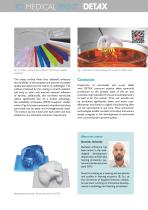
Fig. 5: Colour variety of the luxaprint® 3D Premium plastic materials Fig. 6: Permanent colour sealing with luxaprint® shellac color The classy surface finish thus obtained enhances the durability of the earpiece and ensures increased quality perception by the wearer or audiologist. The surface produced by the coating is scratch-resistant and easy to clean and ensures reduced adhesion of earwax; additionally, the varnished earmoulds yellow significantly less. As a further advantage, the availability of lacquers (DETA luxaprint® shellac colour / Fig. 6) is to be mentioned, whereby colourless earmoulds...
Open the catalog to page 3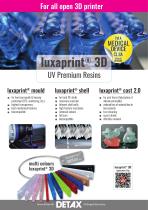
UV Premium Resins luxaprint® mould luxaprint® shell luxaprint® cast 2.0 ■ for hard ITE shells ■ maximum precision ■ thinnest shell walls ■ high fracture resistance ■ intensive colours ■ full cure ■ biocompatible ■ for hard earmoulds & hearing protection (BTE, monitoring, etc.) ■ highest transparency ■ best mechanical features ■ biocompatible ■ for cast forms (fabrication of silicone earmoulds) ■ reduced loss of material due to low viscosity ■ fast cleaning ■ easy to break ■ effortless removal multi colours luxaprint® 3D
Open the catalog to page 4All DETAX catalogs and technical brochures
 audio catalog
68 Pages
 DENTAL CATALOGUE 2018
72 Pages

- 3D printing resin
- Polymer 3D printing resin
- Industrial 3D printing resin
- Dental 3D printing resin
- White 3D printing resin
- Gray 3D printing resin
- Medical 3D printing resin
- Black 3D printing resin
- Mold manufacturing 3D printing resin
- Red 3D printing resin
- Beige 3D printing resin
- Green 3D printing resin
- Blue 3D printing resin
- Hearing aid 3D printing resin
- Orange 3D printing resin
- Yellow 3D printing resin
- Silicone 3D printing resin