- Catalogs
- Despatch Industries
- Industrial Oven Selection Guide

- Products
- Catalogs
- News & Trends
- Exhibitions
Industrial Oven Selection Guide

Industrial Oven Selection Guide
- Batch Ovens: Suitable for varying load sizes and production volumes, offering flexibility in process variables.
- Continuous Ovens: Ideal for high-volume applications with consistent thermal processing needs, reducing material handling and increasing throughput.
- Gravity Convected Heat: Economical, suitable for non-critical uniformity needs.
- Forced Circulating: Uses fans for vertical or horizontal airflow, improving heat transfer and uniformity.
- Forced Recirculating: Ensures precise temperature uniformity, ideal for densely loaded products.
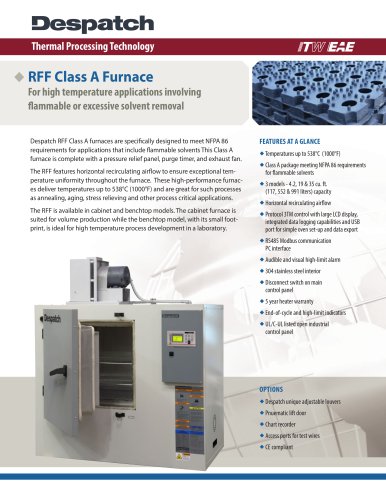
- Class A Ovens: For flammable materials, featuring forced exhaust and explosion relief panels.
- Inert Atmosphere Ovens: Use gases like nitrogen to prevent oxidation.
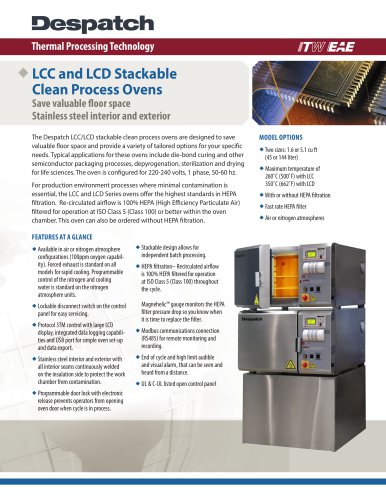
- Clean Process Ovens: Prevent contamination with HEPA filters and special construction.
Catalog excerpts

INSPIRED INNOVATION INDUSTRIAL Oven Selection Guide A guide to selecting the right oven for your processing application
Open the catalog to page 1
a guide to selecting the right oven for your processing application 1. What is your Application? The possibilities are virtually limitless, from the common to the out-of-the-ordinary. Some applications include: Batch Ovens Finish u Sterilization/Depyrogenation u Laboratory Testing u Clean Process Production u Shrink Fitting Treating u Drying u Aging For applications where the load size or production volumes vary substantially, batch processing is a good approach. Batch ovens are also ideal for situations that require a high degree of flexibility in terms of process variables such as temperature...
Open the catalog to page 2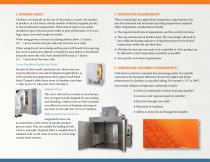
Chamber size depends on the size of the product or parts, the number of products in each batch, and the number of batches required per day to meet production requirements. If the interior space is too small, insufficient space between parts results in poor performance. If it is too large, space, time and energy are wasted. When considering your application’s temperature requirements, first note the minimum and maximum operating temperatures required. Other temperature considerations include: When using gravity or forced circulating airflow, allow 2-3 inches (5.1 - 7.6cm) around each part and...
Open the catalog to page 3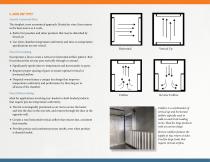
6. Airflow type? Gravity Convected Heat The simplest, most economical approach. Heated air rises, then returns to the heat source as it cools. u erfect P for powders and other products that may be disturbed by forced air. when chamber temperature uniformity and time-to-temperature specifications are not critical. Forced Circulating Reverse Uniflow Incorporates a fan to create a vertical or horizontal airflow pattern. Best for products that air may pass vertically through or around. u ignificantly S speeds time-to-temperature and heat transfer to parts. proper spacing of parts to ensure optimal...
Open the catalog to page 4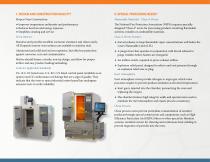
7. design and construction quality? 8. Special processing needs? Proper Oven Construction: Flammable Materials - Class A Ovens temperature uniformity and performance u Reduces heat loss and energy expenses u Simplifies cleaning and service The National Fire Protection Association (NFPA) requires specially designed “Class A” ovens for processing products involving flammable solvents, volatiles or combustible materials. Oven Interior Class A Ovens Feature: Stainless steel provides excellent corrosion resistance and cleans easily. All Despatch interior oven surfaces are available in stainless steel....
Open the catalog to page 5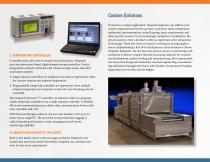
Custom Solutions 9. Temperature controller? Controllers play a key role in overall oven performance. Despatch uses microprocessor-based, digital proportioning controllers. Precise temperature control is achieved with a thermocouple sensor and solid state heater controls. u ingle S setpoint controllers are simplest to use and are appropriate when the process requires one setpoint temperature. ramp/soak controllers are appropriate when multiple setpoint temperatures are required, or when the rate of heating must be controlled. The Despatch Protocol 3TM controller can function either as a programmable...
Open the catalog to page 6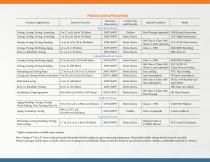
Process Oven Applications Common Applications Maximum Temperature Interior Oven Size Air Flow Type and Direction Special Condition Benchtop Ovens Testing, Curing, Drying, Annealing Testing, Curing, Drying, Annealing Horiz. Recirc. Testing, Curing, Drying, Bonding Horiz. Recirc. ISO Class 5 (Class 100) LCC/LCD Clean Process (Class A, Inert optional) Curing, Drying, Sterilizing, Aging Horiz. Recirc. Burn-in, Reliability Testing Horiz. Recirc. Pass Through (optional) LBB Forced Convection LAC High Performance RAD/RFD Benchtop RBC Burn-in Cabinet/Reach-In Ovens Curing, Drying, Sterilizing, Aging...
Open the catalog to page 7
Service and Support: Global Presence, with Local Expertise Despatch provides expert technical service, a range of installation options and an extensive parts inventory to all of our customers worldwide. And, if that’s not enough, we have the capability to service some competitor’s equipment! At Despatch, we believe in exceeding customer expectations and going above and beyond what an average equipment manufacturer will provide. Worldwide service, installation, parts and advice – we have you covered! WE’RE HERE FOR YOU, WHENEVER, WHEREVER Rest assured that when you call our Service Help Line,...
Open the catalog to page 8All Despatch Industries catalogs and technical brochures
 PWE Walk-In Ovens
2 Pages
 PN Inert Atmosphere Ovens
2 Pages
 RFF Class A Furnace
2 Pages
 RBC
RBC2 Pages
 QMAX
QMAX2 Pages
 LCC AND LCD
2 Pages
 LFC Class A
2 Pages
 RAD/RFD1-42
2 Pages
 LBB forced convection oven
2 Pages
 LAC high-Performance oven
2 Pages
 voc oxidizer
2 Pages
 safire
2 Pages
 dritech
2 Pages
 CFSeriesSinglelane
2 Pages
 RAF-Spec
2 Pages
 Solar Brochure
12 Pages
 Corporate Capabilities Brochure
20 Pages
 Composite Curing Systems
8 Pages
 ACER TECH TM
1 Page
 CFR - Carbon Fiber Research
2 Pages
 Integrated Carbon Fiber Line
2 Pages
 Carbon Fiber Oxidation Oven
2 Pages
 Materials Brochure
4 Pages
 Carbon Fiber Brochure
12 Pages


Archived catalogs
 VOC Thermal Oxidizer
2 Pages
 Standard Products Brochure
12 Pages
 Batch Oven Selection Guide
7 Pages
 Healthcare Brochure
4 Pages
 Electronics Brochure
4 Pages