- Catalogs
- Despatch Industries
- Engineer's Guide to Effective Heat Processing

- Products
- Catalogs
- News & Trends
- Exhibitions
Engineer's Guide to Effective Heat Processing

Engineer's Guide to Effective Heat Processing
Ovens and furnaces are crucial in industries for processes such as curing, drying, and heat treating. Ovens operate up to 1000°F, while furnaces exceed this temperature. Heat sources include fuel combustion, electricity, hot water, or steam, with heat transfer methods like natural and forced convection, and radiant heat.
Choosing the right equipment involves understanding product requirements, such as material quantity, temperature tolerance, and processing type (batch or continuous). Batch ovens are versatile, while continuous ovens are often automated to reduce labor costs.
Key factors include the oven's heating capacity and the product's heat absorption rate. Soak time ensures the product stays at the desired temperature, controlled by programmable controllers. Cool-down is achieved by exhausting heated air, with options for controlled rates.
Consistent temperature across the oven is vital for product quality, requiring effective management of airflow and heat distribution.
Special considerations include managing exhaust volumes and maintaining safe operating conditions.
Efficient systems like conveyorized ovens are essential for continuous operations, reducing manual handling and improving efficiency.
Airflow types, such as forced or natural convection, impact heat distribution and process efficiency.
Ovens in hazardous areas require specific design features for safety, including appropriate electrical requirements and process control systems.
Safety is paramount, with considerations for insurance requirements and adherence to safety standards to prevent accidents.
Air-to-water heat exchangers are suitable for lower temperatures, using a finned, water-cooled coil to regulate cooling rates.
Uniformity is crucial for consistent product quality, affected by factors like wall losses and air distribution. It is tested using a nine-point thermocouple survey.
Required for processing combustible materials, these ovens must have a forced exhaust, airflow proofing, a purge timer, and an explosion relief area.
Systems like trucks and conveyors are used to move products, considering product size, weight, and process time.
Different patterns (horizontal, vertical, uniflow, reverse uniflow) are used based on load configuration to ensure uniform heat distribution.
The type of loading opening affects equipment choice, with options for manual or powered doors and drawers.
Gas heating is generally less expensive than electric, though electric provides better temperature uniformities. Cooling rates can be enhanced with exhaust fans or heat exchangers.
Inert atmosphere ovens maintain low oxygen levels, while humidity can be controlled through steam injection or atomizers.
Ovens require spark-resistant fans, suitably rated motors, sealed wiring, and specific control enclosures to prevent ignition.
This document provides a guide on specifications, procedures, and considerations for process measurement and control, focusing on temperature sensors, controller performance, system dynamics, and oven construction.
Discusses temperature sensors, emphasizing thermocouples and their operating ranges, with factors affecting performance like location and wiring.
Includes a table of thermocouple types and explains the importance of electrical power specifications for industrial ovens.
Discusses digital temperature controllers with PID tuning parameters, highlighting input accuracy, tuning, and output accuracy.
The physical construction of the oven impacts control system performance, with issues like non-uniform airflow affecting performance.
Outlines floor types and construction standards, emphasizing materials like stainless steel for corrosion resistance.
Critical factors for oven installation include power supply, water drains, and access clearance, with advice on working with test facilities.
Stresses the importance of meeting insurance requirements and addresses safety concerns related to oven design.
Catalog excerpts
table.main {} tr.row {} td.cell {} div.block {} div.paragraph {} .font0 { font:46.00pt "Impact", sans-serif; } .font1 { font:11.00pt "Tahoma", sans-serif; } IUSTRIES ENGINEER'S GUIDE TO EFFECTIVE HEAT PROCESSING
Open the catalog to page 1
table.main {} tr.row {} td.cell {} div.block {} div.paragraph {} .font0 { font:31.00pt "Arial", sans-serif; } .font1 { font:11.00pt "Impact", sans-serif; } .font2 { font:9.00pt "Lucida Sans Unicode", sans-serif; } .font3 { font:8.00pt "Tahoma", sans-serif; } About This guide discusses gnral issues related to the s驩lection of industrial equipment for heat processing. Since nearly all products manufactured today require heat application at some point in the process, this guide was created to provide a base knowledge of the complexity of issues related to selection of optimum equipment for any particular...
Open the catalog to page 3
table.main {} tr.row {} td.cell {} div.block {} div.paragraph {} .font0 { font:6.00pt "Impact", sans-serif; } .font1 { font:11.00pt "Impact", sans-serif; } .font2 { font:9.00pt "Lucida Sans Unicode", sans-serif; } .font3 { font:8.00pt "Tahoma", sans-serif; } Batch-Type Ovens These ovens represent the largest category of ovens used to manufacture products Batch-type ovens can be classified as cabinet-style or truck-loaded type. The size can range from small bench top units to large industrial installations with thousands of cubic feet. Heat-Up/Soak/Cool-Down Times Heat-up, soak, and cool-down...
Open the catalog to page 4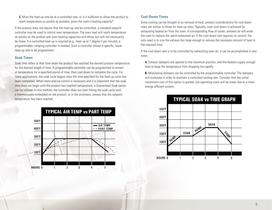
table.main {} tr.row {} td.cell {} div.block {} div.paragraph {} .font0 { font:4.00pt "Impact", sans-serif; } .font1 { font:6.00pt "Impact", sans-serif; } .font2 { font:7.00pt "Impact", sans-serif; } .font3 { font:8.00pt "Impact", sans-serif; } .font4 { font:11.00pt "Impact", sans-serif; } .font5 { font:16.00pt "Impact", sans-serif; } .font6 { font:8.00pt "Lucida Sans Unicode", sans-serif; } .font7 { font:9.00pt "Lucida Sans Unicode", sans-serif; } .font8 { font:42.00pt "Microsoft Sans Serif", sans-serif; } .font9 { font:8.00pt "Tahoma", sans-serif; } .font10 { font:10.00pt "Tahoma", sans-serif;...
Open the catalog to page 5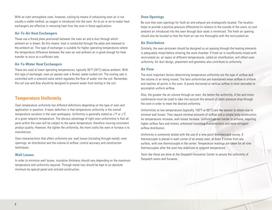
table.main {} tr.row {} td.cell {} div.block {} div.paragraph {} .font0 { font:11.00pt "Impact", sans-serif; } .font1 { font:9.00pt "Lucida Sans Unicode", sans-serif; } .font2 { font:8.00pt "Tahoma", sans-serif; } With an inert atmosphre oven, however, cooling by means of exhausting oven air is not usually a viable method, as oxygen is introduced into the oven. Air-to-air or air-to-water heat exchangers are effective in removing heat from the oven in these applications. Air-To-Air Heat Exchangers These use a finned plate positioned between the oven air and a duct through which ambient air is...
Open the catalog to page 6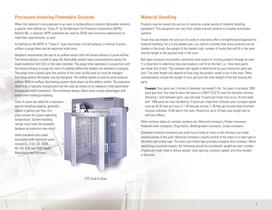
table.main {} tr.row {} td.cell {} div.block {} div.paragraph {} .font0 { font:6.00pt "Impact", sans-serif; } .font1 { font:11.00pt "Impact", sans-serif; } .font2 { font:8.00pt "Tahoma", sans-serif; } .font3 { font:25.00pt "Tahoma", sans-serif; } Processes Involving Flammable Solvents Material Handling When the material to be processed in an oven is combustible or contains flammable solvents, a special oven defined as "Class A" by the National Fire Protection Association (NFPA), Bulletin 86, is required. NFPA standards are used by OSHA and insurance underwriters to meet their requirements, as...
Open the catalog to page 7
table.main {} tr.row {} td.cell {} div.block {} div.paragraph {} .font0 { font:5.00pt "Impact", sans-serif; } .font1 { font:11.00pt "Impact", sans-serif; } .font2 { font:9.00pt "Lucida Sans Unicode", sans-serif; } .font3 { font:8.00pt "Tahoma", sans-serif; } .font4 { font:6.00pt "Verdana", sans-serif; } Types of Airflow When selecting an airflow pattern, the most important considration is the load configuration. The main goal is to minimize obstructions to the airflow for more uniform heat distribution and to maximize the product surface area with which airflow will come into contact. Horizontal...
Open the catalog to page 8
table.main {} tr.row {} td.cell {} div.block {} div.paragraph {} .font0 { font:11.00pt "Impact", sans-serif; } .font1 { font:8.00pt "Tahoma", sans-serif; } .font2 { font:25.00pt "Tahoma", sans-serif; } ren Loading Openings Heating/Cooling The type of oven loading opening is quite important in order to get the right equipment to do the job. For example, standard reach-in front load models are well suited for products which can be loaded onto a shelf. These generally accommodate light weight or easy-to-handle parts. Walk-in front load units are used in truck load type applications or for large,...
Open the catalog to page 9
table.main {} tr.row {} td.cell {} div.block {} div.paragraph {} .font0 { font:7.00pt "Impact", sans-serif; } .font1 { font:11.00pt "Impact", sans-serif; } .font2 { font:8.00pt "Tahoma", sans-serif; } Atmosphre Type Thermal process ovens utilize diffrent atmosph詨res in order to satisfy certain processing criteria. For example, inert atmosphere ovens are generally utilized when a process requires a low oxygen concentration in the oven due to oxidation of the test parts at elevated temperatures. The inert gas is injected into a sealed chamber, pressurizing the oven and replacing the oxygen. With...
Open the catalog to page 10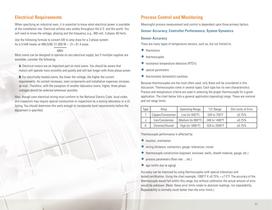
table.main {} tr.row {} td.cell {} div.block {} div.paragraph {} .font0 { font:6.00pt "Impact", sans-serif; } .font1 { font:7.00pt "Impact", sans-serif; } .font2 { font:11.00pt "Impact", sans-serif; } .font3 { font:9.00pt "Lucida Sans Unicode", sans-serif; } .font4 { font:8.00pt "Tahoma", sans-serif; } Electrical Requirements When specifying an industrial oven, it is essential to know what electrical power is available at the installation site. Electrical utilities vary widely throughout the U.S. and the world. You will need to know the voltage, phasing and the frequency, e.g., 480 volt, 3 phase,...
Open the catalog to page 11All Despatch Industries catalogs and technical brochures
 PWE Walk-In Ovens
2 Pages
 PN Inert Atmosphere Ovens
2 Pages
 RFF Class A Furnace
2 Pages
 RBC
RBC2 Pages
 QMAX
QMAX2 Pages
 LCC AND LCD
2 Pages
 LFC Class A
2 Pages
 RAD/RFD1-42
2 Pages
 LBB forced convection oven
2 Pages
 LAC high-Performance oven
2 Pages
 voc oxidizer
2 Pages
 safire
2 Pages
 dritech
2 Pages
 CFSeriesSinglelane
2 Pages
 RAF-Spec
2 Pages
 Solar Brochure
12 Pages
 Corporate Capabilities Brochure
20 Pages
 Composite Curing Systems
8 Pages
 ACER TECH TM
1 Page
 CFR - Carbon Fiber Research
2 Pages
 Integrated Carbon Fiber Line
2 Pages
 Carbon Fiber Oxidation Oven
2 Pages
 Materials Brochure
4 Pages
 Carbon Fiber Brochure
12 Pages


Archived catalogs
 VOC Thermal Oxidizer
2 Pages
 Standard Products Brochure
12 Pages
 Batch Oven Selection Guide
7 Pages
 Healthcare Brochure
4 Pages
 Electronics Brochure
4 Pages