
- Catalogs
- Densitron Technologies
- DensiTouchTM

DensiTouchTM

DensiTouchTM
Haptics is defined as the study of touch and perception through contact, with applications in devices like surgical simulators, gaming joysticks, and cell phones, providing tactile feedback.
This section covers the integration of Projective Capacitive Touch (PCT) technology with haptics, highlighting its precision and suitability for industrial and medical applications. It addresses the challenge of providing tactile feedback with PCT and how haptics can simulate mechanical buttons.
Haptics are generated using actuators such as inertial, piezoelectric, or electrostatic, each with unique characteristics. The document details the operation of linear resonate actuators (LRA) and eccentric rotating mass (ERM) actuators, and the benefits of piezoelectric and electrostatic actuators.
A control system is crucial for driving actuators to create realistic haptic effects, requiring rapid response times and specific algorithms to produce desired effects.
The paper discusses "haptic ready" PCT screens and integrated control systems that simplify haptic implementation in embedded systems, highlighting the Densitron 5.7” Haptic Reference Design as an example.
The document emphasizes the need for minimal clearance in the mechanical design of a haptic system to achieve NEMA 2 sealing with a Poron dust seal, ensuring secondary seals do not interfere with haptic effects.
The control system uses an Immersion Corporation Aries™ Haptics controller, storing necessary waveforms and driving the actuator, reducing processor load and minimizing latency. USB interfaces are used for Windows-based systems.
A Windows-based demonstration system is described, allowing developers to prototype and test user interfaces with haptic menus and touch inputs translated into mouse actions.
The document suggests using a larger PCT than the display to accommodate high-traffic buttons outside the display area, reducing costs and complexity.
Haptics in touch screens compensate for the lack of mechanical buttons, providing tactile feedback. Advances in technology and control systems have simplified design complexity, making haptics more accessible and flexible.
Catalog excerpts

DensiTouchTM White Paper Revision 1.0 B June 23, 2010 Densitron Corporation 2330 Pomona Rincon Road Corona, CA 92880 Phone: 951-284-7600 Fax: 951-284-7699 www.Densitron.com DensiTouchTM White Paper Copyright ©2010 DENSITRON CORPORATION All rights reserved. – Proprietary Data
Open the catalog to page 1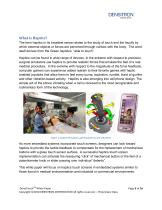
What is Haptics? The term haptics in its broadest sense relates to the study of touch and the faculty by which external objects or forces are perceived through contact with the body. The word itself derives from the Greek haptikos, “able to touch”. Haptics can be found in wide range of devices. In the extreme with respect to precision, surgical simulators use haptics to provide realistic forces that emulate the feel of a real medical procedure. In the extreme with respect to the magnitude of the force feedback, computer gamers can experience added realism to their favorite games with haptic...
Open the catalog to page 3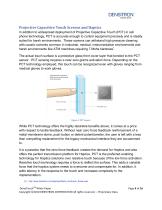
Projective Capacitive Touch Screens and Haptics In addition to widespread deployment of Projective Capacitive Touch (PCT) in cell phone technology, PCT is accurate enough to control equipment precisely and is ideally suited for harsh environments. These screens can withstand high pressure cleaning with caustic solvents common in industrial, medical, instrumentation environments and harsh environments like ATM machines requiring 7 Mohs hardness1. The actual touch surface is a protective glass front cover layer that bonded to the PCT sensor. PCT sensing requires a near zero grams activation force....
Open the catalog to page 4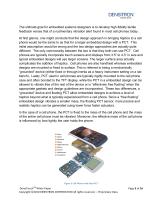
The ultimate goal for embedded systems designers is to develop high-fidelity tactile feedback verses that of a rudimentary vibration alert found in most cell phones today. At first glance, one might conclude that the design approach in bringing haptics to a cell phone would be the same to as that for a larger embedded design with a PCT. This initial assumption would be wrong and the two design approaches are actually quite different. The only commonality between the two is that they both can use PCT. Cell phones are typically incorporate touch screens and displays from 3.5” to 4.3” in size and...
Open the catalog to page 5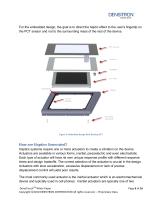
For the embedded design, the goal is to direct the haptic effect to the user’s fingertip on the PCT snesor and not to the surrounding mass of the rest of the device. How are Haptics Generated? Haptics systems require one or more actuators to create a vibration on the device. Actuators are available in various forms, inertial, piezoelectric and even electrostatic. Each type of actuator will have its own unique response profile with different response times and design tradeoffs. The correct selection of the actuator is crucial in the design. Actuators with slow acceleration, excessive displacement...
Open the catalog to page 6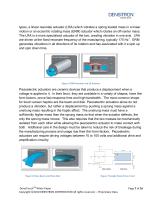
types, a linear resonate actuator (LRA) which vibrates a spring loaded mass in a linear motion or an eccentric rotating mass (ERM) actuator which rotates an off-center mass. The LRA is a more specialized actuator of the two, creating vibration in one axis. LRA are driven at the fixed resonate frequency of the mass/spring, typically 175 Hz1. ERM generates vibrations in all directions of its rotation and has associated with it a spin up and spin down time. Piezoelectric actuators are ceramic devices that produce a displacement when a voltage is applied to it. In their favor, they are available...
Open the catalog to page 7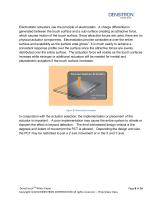
Electrostatic actuators use the principle of electrostatic. A charge differential is generated between the touch surface and a sub-surface creating an attractive force, which causes motion of the touch surface. Since attractive forces are used, there are no physical actuator components. Electrostatics provide consistence over the entire surface and scalability as the surface area grows1. It is much easily to achieve a consistent response profile over the surface since the attractive forces are evenly distributed over the entire surface. The actuation force will scales as the touch surfaces increase...
Open the catalog to page 8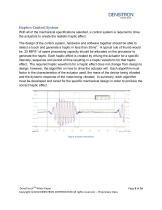
Haptics Control System With all of the mechanical specifications selected, a control system is required to drive the actuators to create the realistic haptic effect. The design of the control system, hardware and software together should be able to detect a touch and generate a haptic in less than 30ms2. A typical rule of thumb would be .25 MIPS1 of spare processing capacity should be allocated on the processor to generate the haptic. Each haptic effect is created by driving the actuator for a specific intensity, sequence and period of time resulting in a haptic waveform for that haptic effect....
Open the catalog to page 9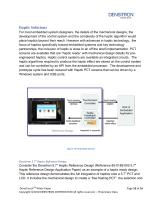
Haptic Solutions For most embedded system designers, the details of the mechanical designs, the development of the control system and the complexity of the haptic algorithm would place haptics beyond their reach. However with advances in haptic technology, the focus of haptics specifically toward embedded systems and key technology partnerships, the inclusion of haptic is close to an off the shelf implementation. PCT screens are available that are “haptic ready” with mechanical design details for preengineered haptics. Haptic control systems are available as integrated circuits. The haptic algorithms...
Open the catalog to page 10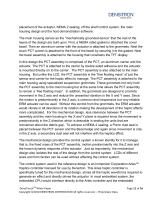
placement of the actuator, NEMA 2 sealing, off the shelf control system, the main housing design and the host demonstration software. The main housing serves as the “mechanically grounded device” that the rest of the layers of the design are built upon. First, a NEMA rated gasket is attached the cover bezel. Then an aluminum carrier with the actuator is attached to the grommets. Next the touch PCT screen is attached to the front of the bezel by securing it to the gasket. Next the bezel assembly is attached to the housing that constrains the TFT display. In this design the PCT assembly is comprised...
Open the catalog to page 11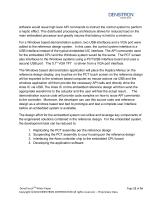
software would issue high level API commands to instruct the control system to perform a haptic effect. This distributed processing architecture allows for reduced load on the main embedded processor and greatly insures that latency is held to a minimum. For a Windows based demonstration system, two USB interfaces and a VGA port were added to the reference design system. In this case, the control system interface is a USB interface instead of the typical embedded I2C interface. The API commands used for the embedded CPU and the Windows system would be the same. The PCT screen also interfaces...
Open the catalog to page 12All Densitron Technologies catalogs and technical brochures
 Densitron-OLED-Brochure
7 Pages
 Densitron UReady Brochure
6 Pages
 Introduction to Touch Solutions
14 Pages
 Backlight Technology Overview
18 Pages


Archived catalogs
 Touch Screens
1 Page
 New 1.69" OLED
1 Page
 New 0.96" OLED
1 Page
 New 7" TFT
1 Page
 Corporate Statement
2 Pages
 Composite Video
1 Page
 Monographic Displays
2 Pages
 Alphanumeric Displays
1 Page
 EL Displays
1 Page
 CSTN
CSTN4 Pages
 TFT Displays
4 Pages
 OLED Displays
2 Pages
 Evaluation Kits
2 Pages
 Open Frame Monitors
2 Pages
 OLED
OLED2 Pages

- LCD display panel
- Touch monitor
- LCD screen
- Industrial display panel
- TFT display module
- USB monitor
- Color display panel
- Touch screen display panel
- LED display panel
- IPS display panel
- TFT-LCD monitor
- Control display system
- Backlit display panel
- HMI
- HMI with touch screen
- Medical equipment display
- RGB display panel
- Ethernet HMI
- USB HMI