

CSTN

CSTN
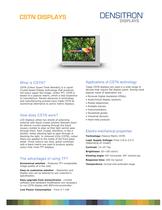
CSTN (Colour Super-Twist Nematic) is a display technology that uses liquid crystals to produce full-color, paper-like images. It is based on a passive matrix, making it more cost-effective to manufacture compared to TFT (Thin Film Transistor) displays. Recent technological advancements have made CSTN a viable economical alternative to active matrix displays.
How CSTN Works
CSTN displays operate by utilizing two sheets of polarizing material with a liquid crystal solution in between. An electric current aligns the crystals, controlling light passage. In colored CSTN displays, color filters are applied to the front glass, using red, blue, and green colors combined with a black matrix to produce high-quality color images.
Advantages of CSTN
- Economical Solution: Offers image quality comparable to TFT at a lower cost.
- Customizable: Resolution and display size can be tailored to customer specifications.
- Easy Upgrade: Minimal software and hardware modifications are needed to transition from monochrome displays.
- Low Power Consumption: Consumes as little as 0.7 mW.
Applications of CSTN Technology
CSTN displays are used in various devices requiring flat display panels, including:
- Personal Digital Assistants (PDAs)
- Audio/Visual display systems
- Mobile phones
- Portable games
- Instrumentation
- Household goods
- Industrial devices
- Handheld products
Electro-mechanical Properties
- Technology: Passive Matrix CSTN
- Logic Supply Voltage: 2.8 to 5.0 V
- Contrast: 15~25 Typ
- Brightness: 50~100 cd/m2
- Viewing Angle: 60° horizontal, 50° vertical
- Response Time: 200 ms typical
- Temperature Range: Normal and extended
Display Modules
The document provides detailed specifications for various CSTN display modules, including screen size, resolution, dimensions, viewing area, and backlight options. These modules are suitable for different applications and can be explored further on Densitron's website.
Additional Display Solutions
Densitron offers a range of other display technologies, including TFT, OLED, Composite Video Displays, and Chassis & Open Frame Monitors, each with unique features suitable for specific applications.
Catalog excerpts
What is CSTN? Applications of CSTN technology How does CSTN work? Electro-mechanical properties The advantages of using TFT >
Open the catalog to page 1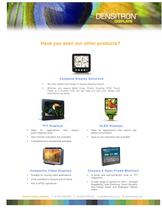
We offer added technology to display based products Օ Whether you require Metal Case, Plastic Housing, PCB, Touch Panel or a Custom LCD, we can help you with your design and manufacturing needs > Ideal for applications that requir e Օ Ideal for applications that require low power consumption quick response time User-friendly evaluation kits available Օ Easy to use evaluation kits available Complementary accessories available > Օ Suitable for moving video applications A quick and self-contained route to TFT integration Օ Units available in housed and kit forms PAL & NTSC operations Օ A wide range...
Open the catalog to page 4All Densitron Technologies catalogs and technical brochures
 Densitron-OLED-Brochure
7 Pages
 Densitron UReady Brochure
6 Pages
 Introduction to Touch Solutions
14 Pages
 DensiTouchTM
16 Pages
 Backlight Technology Overview
18 Pages


Archived catalogs
 Touch Screens
1 Page
 New 1.69" OLED
1 Page
 New 0.96" OLED
1 Page
 New 7" TFT
1 Page
 Corporate Statement
2 Pages
 Composite Video
1 Page
 Monographic Displays
2 Pages
 Alphanumeric Displays
1 Page
 EL Displays
1 Page
 TFT Displays
4 Pages
 OLED Displays
2 Pages
 Evaluation Kits
2 Pages
 Open Frame Monitors
2 Pages
 OLED
OLED2 Pages

- LCD display panel
- Touch monitor
- LCD screen
- Industrial display panel
- TFT display module
- USB monitor
- Color display panel
- Touch screen display panel
- LED display panel
- IPS display panel
- TFT-LCD monitor
- Control display system
- Backlit display panel
- HMI
- HMI with touch screen
- Medical equipment display
- RGB display panel
- Ethernet HMI
- USB HMI