Measurement practise for road markings

Measurement practise for road markings
This document provides a comprehensive guide on measuring retroreflection from road markings using hand-held retroreflectometers, specifically the LTL 2000 series, LTL-X, and LTL-XL models. Retroreflection measurement is crucial for ensuring road markings meet safety specifications.
Retroreflectometer Calibration and Maintenance
Before starting measurements, the retroreflectometer must be checked and calibrated. Key steps include ensuring the calibration unit and mirror are clean and undamaged. Regular servicing and recalibration are recommended, typically every 1-2 years, depending on usage and storage conditions.
Measurement Practice
To assess road marking conditions, a structured measurement program is advised:
- Spot checks for markings that appear fine, with 1-2 measurements per km.
- More frequent measurements (5-10 per km) for markings near minimum requirements.
- Multiple measurements at each point, averaging the results.
- In non-uniform areas, such as turns or uneven markings, increase measurement frequency.
Understanding Results: RL and Qd
Retroreflection is measured in mcd/lx/m², indicating the light seen by drivers. RL measures nighttime retroreflection using car headlights, while Qd measures daytime retroreflection using sunlight or street lighting.
Minimum Retroreflection Levels
Minimum levels depend on national standards, road type, and conditions (e.g., dry or wet). The EU follows EN 1436 standards, while the US uses ASTM E 1710. The US also references the MUTCD for traffic signs, with ongoing work for pavement markings.
Measurement Intervals
There are no uniform guidelines for measurement intervals. Typical schedules include:
- Initial checks within two weeks of new markings.
- Regular checks every 1-2 years or more frequently at critical spots.
- End-of-contract checks, typically 2-4 years after delivery.
Conditions for Accurate Measurements
Ensure the instrument is placed evenly, markings are dry and clean, and measurements are representative. Avoid measuring near strong reflective materials.
Additional Considerations
Retroreflection is primarily due to glass beads in markings. Wet conditions significantly reduce retroreflection due to moisture and mirror reflection. DELTA's instruments can measure both dry and wet conditions without adjustment.
Contact Information
For further assistance, contact DELTA at [email protected] or visit roadsensors.com.
Catalog excerpts
Measurement practise for road markings A hands-onguidefor retroreflectometers LTL 2000 series / LTL-X / LTL-XL We help ideas meet the real world / ROADSENSORS.COM • -ru < - _V . -£* V ->NiC - ■
Open the catalog to page 1
Measuring retroreflection from road markings with a hand-held retroreflectometer Measuring retroreflection from road markings is important to make sure that the markings perform according to specification and thus support safe driving. But how do you compose a measuring program to provide a good overview of the condition of a road marking? What do you have to be aware of when planning and conducting the measurements? The retroreflectometer ·· f the marking is not uniform (e.g. when the road I turns, on rumble stripes, on stop markings and alike or when the marking is otherwise uneven in quality)...
Open the catalog to page 2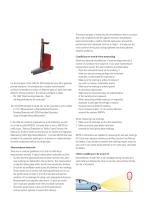
The overall purpose of measuring the retroreflection level is to ensure first of all compliance with the applied minimum retroreflection levels and secondly to confirm that the road owner received the performance level requested. And not to forget – to make sure the road is safe for driving also during nighttime and during adverse weather conditions. Conditions to watch when measuring For the European Union (EU) the CEN standards using 30 m geometry provide directions. The standard also includes recommended minimum retroreflection values on different types of roads and under different driving...
Open the catalog to page 3
Retroreflection is caused mainly by the glass beads imbedded in the road markings. Depending on the quality and amount of glass beads a retroreflection level > 500 mcd/lux/sqm may be reached. A white marking without glass beads will provide limited retroreflection levels. Reflection of dry markings Retroreflection Retroreflected light Glass beads PavementGlass beads marking Pavement marking Retroreflection levels are significantly lower during nighttime driving on wet roads compared to dry roads. Moisture on markings will partly or fully cover for the light, so it will not reach the glass beads...
Open the catalog to page 4All DELTA catalogs and technical brochures
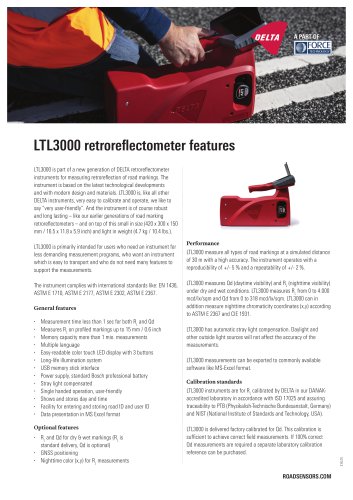 LTL3000 retroreflectometer
2 Pages
 RetroSign GRX
2 Pages
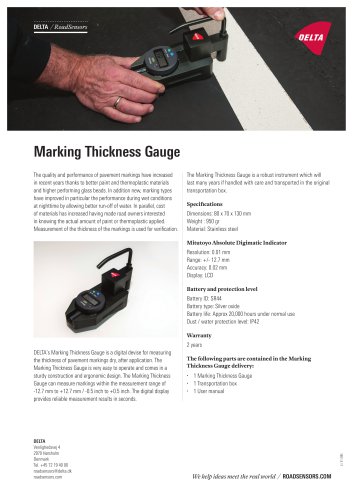 Marking Thickness Gauge
1 Page
 The LTL-XL & LTL-X Mark II
2 Pages