
- Catalogs
- Delta Electronics, Inc.
- Temperature controller DT series

- Products
- Catalogs
- News & Trends
- Exhibitions
Temperature controller DT series

1 / 6 PagesView full catalog
Temperature controller DT series
Product catalog summary
Document Overview
This technical document appears to relate to a control system involving steam heating, cooling water, and PID sensor management. The content includes references to electrical connections, sensor readings, and control parameters.
Main Sections and Key Points
1. Electrical Connections and Control Signals
- Labels such as '+', '-', 'NO', 'NC', and 'COM' suggest relay or switch terminal designations, indicating how components are wired for control.
- These connections are critical for ensuring proper operation of the heating and cooling control system.
2. Process Variables and Control Elements
- Steam Heating and Cooling Water are identified as the primary process elements being controlled.
- PID (Proportional-Integral-Derivative) control is used to regulate these elements, likely based on sensor feedback.
- Sensor readings are indicated, with values such as 90.0, 63.4, and 110.0, which may represent temperature or pressure measurements relevant to the control loop.
3. Control Strategy and Parameters
- The presence of PID control implies a feedback loop designed to maintain process variables at setpoints by adjusting heating or cooling inputs.
- Specific numerical values suggest setpoints or measured values, important for tuning and monitoring system performance.
Summary of Critical Information
- Proper wiring of control terminals (+, -, NO, NC, COM) is essential for system functionality.
- Steam heating and cooling water systems are managed via PID control based on sensor inputs.
- Sensor data values (e.g., 90.0, 63.4, 110.0) are key parameters for system monitoring and control adjustments.
Recommendations and Best Practices
- Ensure accurate wiring according to terminal designations to avoid control faults.
- Regularly calibrate sensors to maintain reliable PID control performance.
- Monitor sensor readings continuously to detect deviations and adjust PID parameters as needed.
See more
Catalog excerpts

+- + > NONCCOM +- + > SteamHeatingCooling Water PID Sensor size="-2">
Open the catalog to page 2All Delta Electronics, Inc. catalogs and technical brochures
 Delta Industrial Automation
108 Pages
 Delta UPS?Ultron Family
2 Pages
 DPS - 12FP A
3 Pages
 Delta MVD 1000
20 Pages
 Delta MVD2000
11 Pages
 Delta MVD3000
9 Pages
 Standard Power Module
128 Pages
 DPS - 100AP - 11 A
3 Pages
 DPS - 50AP - 2 A
3 Pages
 DPS - 40AP - 10 A
3 Pages
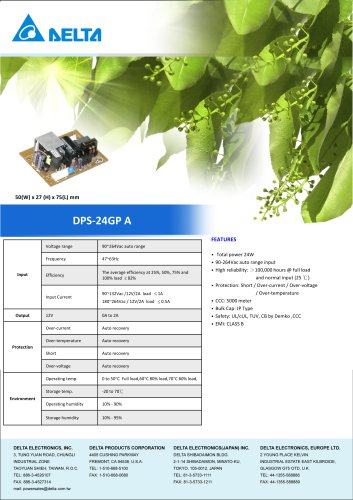 DPS -24GP A
3 Pages
 PS2 EX Series
2 Pages
 DVS
DVS8 Pages
 CTA
CTA2 Pages
 DOP-B
DOP-B20 Pages
 DOP-A
DOP-A12 Pages
 DVP-ES2
14 Pages
 Motion & Control ASDA-A2
72 Pages
 ASDA-A2
72 Pages
 Linear Motor
1 Page
 brochure MVD 1000
16 Pages
 Optical Incremental Encoders
10 Pages
 AC Motor Drives
2 Pages
 DC/DC Converter Catalogue 2009
48 Pages


Related Searches
- Power supply unit
- DC power supply
- AC/DC power supply
- Chiller
- Radial fan
- Air circulation fan
- Digital temperature control
- Single-output power supply
- Power supply for industrial applications
- Pressure probe
- Switched-mode power supply
- Servo-amplifier
- Battery charger
- DC-DC converter
- Temperature controller
- Compact power supply
- Air chiller
- Tabletop power supply
- Programmable logic controller
- Electronic filter
*Prices are pre-tax. They exclude delivery charges and customs duties and do not include additional charges for installation or activation options. Prices are indicative only and may vary by country, with changes to the cost of raw materials and exchange rates.