
- Catalogs
- Delphi Power Train
- Worldwide Emissions Standards Passenger Cars and Light Duty


Worldwide Emissions Standards Passenger Cars and Light Duty

Worldwide Emissions Standards Passenger Cars and Light Duty
The document provides an extensive overview of global emissions standards for passenger cars and light-duty vehicles, focusing on regions such as Europe, the US, Japan, South Korea, and Brazil. It also highlights Delphi's technologies in gasoline direct injection and diesel common rail systems.
- European Union: Details Euro 1-6 standards, including type approval, vehicle categories, and emissions limits for different vehicle classes, focusing on NOx, HC, CO, and PM emissions.
- US Federal and California: Discusses Tier II and Tier III standards, as well as LEV II and LEV III standards, emphasizing driving cycles and emissions limits.
- Japan: Covers emissions standards and driving cycles, highlighting the 10/15+11 mode cycles and JC08 mode cycle.
- Other Regions: Includes standards for South Korea, Brazil, and other areas, emphasizing regional differences in emissions requirements.
- On-Board Diagnostics (OBD): Discusses European and US OBD requirements, including Euro 3-6 and US EPA and CARB OBD II standards.
- Fuel Consumption and CO2 Emissions: Provides an overview of fuel consumption standards and CO2 emissions requirements across different regions.
- Reference Test Fuels: Lists EU and US reference test fuels used for emissions testing.
- Evaporative Emissions: Describes conventional and enhanced evaporative emissions test procedures, including on-board refueling vapor recovery.
Includes emissions standards for motorcycles in the European Union, US, and other regions, focusing on the WMTC and other test cycles.
The document concludes with a glossary of terms and highlights Delphi's advancements in emissions technology, particularly in gasoline direct injection and diesel common rail systems.
The Worldwide Harmonized Light Vehicles Test Cycle (WLTC) is used to measure vehicle emissions and fuel consumption, including phases like low, medium, high, and extra high speed, with specific parameters for each phase.
Euro 6d-Temp and Euro 6d focus on pollutants like NOx and particulate numbers (PN), implemented in phases with specific conformity factors (CF) for different pollutants.
Tier 2 standards apply to cars and trucks up to 8,500 lbs GVWR, with emissions limits that are fuel-neutral. Tier 3 standards, adopted in 2014, phase in from 2017 to 2025, tightening sulfur limits for gasoline and increasing emission durability to 150,000 miles.
Describes various driving cycles used for emissions testing, including the City Cycle (FTP 75), Highway Cycle (HWFET), and others like the SC03 Air Conditioning Cycle and US06 High Speed/High Load Cycle.
Details California's Low Emission Vehicle (LEV) standards, including LEV II and LEV III, focusing on NMOG+NOx emissions and phase-in provisions for particulate matter (PM).
Specifies boundary conditions for testing, such as vehicle test mass, temperature ranges, and altitude limits, and outlines dynamic conditions and the use of Portable Emission Measurement Systems (PEMS) for real-world testing.
1. Vehicle Emission Standards by Region
- Australia: M1 vehicles up to 3.5 tons must comply with Euro 5a standards from November 2013 and Euro 6 from July 2017.
- Canada: Harmonization with US EPA Tier 3 program starting 2017, with flexible phase-in schedules for PM and evaporative emissions.
- Chile: Offers US-based EPA Tier 2 Bin 5 and Euro 5 standards since 2013/2014, with no OBD requirements.
- China: Various CN standards with specific implementation dates for light-duty and heavy-duty vehicles, including sulfur content regulations for fuels.
- India: Bharat Stage IV to VI standards phased in from 2010 to 2022, with nationwide implementation by 2022.
- Indonesia: Euro 2 standards for new models since 2005.
- Mexico: Tier II phase-in with a fuel economy mandate of 14.9 km/l by 2016.
- Russia: Euro 3 to Euro 5 standards phased in from 2008 to 2016.
- South Africa: Euro 1 and Euro 2 standards for new models from 2005 and 2006 respectively.
- Euro 3-4: Introduced OBD systems to identify malfunctions causing emissions to exceed thresholds.
- Euro 5: Expanded monitoring areas and introduced new technical requirements, including mandatory failure detection for certain components.
- Euro 6: Further tightened thresholds and expanded monitoring requirements, with a transition to WLTP cycle for testing.
- Harmonization with CARB OBD II regulations by 2017, with specific exceptions for certain components and systems.
- Comprehensive monitoring requirements for components impacting emissions, with specific conditions for malfunction detection.
- CO, NMHC, NOx, and PM thresholds are specified for different vehicle categories and phases of Euro standards.
- Durability requirements for vehicles in China range from 80,000 km to 160,000 km depending on the standard.
- Idle Control System: Speed control issues include inability to maintain target speed within +/- 30% or within the smallest engine speed tolerance range.
- Glow Plugs/Intake Air Heaters: Malfunctions include improper functional response, circuit continuity faults, and improper current and voltage drop.
- “Wait to Start” Lamp: Failures that prevent illumination.
- Emission Control Components: Failures affecting emission control strategies not covered by CARB regulations.
- Tolerance Compensation: Improper compensation applied by the controller, with monitoring not required if emissions increase is less than 15%.
- Minimum performance ratios are specified for various systems, with exceptions for certain vehicle types.
- OBD systems must track and report ratio information for several components including catalysts and sensors.
- Different thresholds are set for various vehicle types and emission categories, with specific multipliers for NMOG+NOx, CO, and PM.
- EGR and Secondary Air Systems: Monitoring requirements and malfunction conditions are specified.
- Fuel System: Includes conditions for malfunction related to fuel delivery and feedback control.
- Misfire Detection: Continuous monitoring requirements and thresholds for misfire rates are outlined.
- Evaporative System: Monitoring requirements for purge flow and system leaks.
- Exhaust Gas Sensors: Conditions for malfunction include sensor performance and circuit continuity issues.
- Misfire Detection: Specific thresholds and monitoring conditions for misfire detection in diesel vehicles.
- Particulate Matter System: Conditions for malfunction include incomplete regeneration and missing substrate.
- Feedback Control: Monitoring of proper feedback control for various systems.
- Exceptions to Monitoring Requirements: Conditions under which monitoring can be disabled with CARB approval.
California has set greenhouse gas (GHG) emission standards for passenger cars and light-duty trucks (PC/LDT1 and LDT2) from 2009 to 2016, progressively decreasing GHG emissions and increasing fuel economy.
Japan's regulations consider both diesel and gasoline vehicles, with a test cycle called JC08. The average fuel economy targets for different vehicle classes were set for 2015, with significant improvements from 2004 levels.
Brazil's policy includes a star rating system for low emissions of pollutants and CO2, with incentives for vehicles using renewable fuels. The INOVAR-AUTO program aims to improve innovation and energy efficiency in the automotive industry.
China has set fuel consumption limits for passenger cars, with targets to reduce average fuel consumption to about 5L/100 km by 2020.
South Korea has set fuel economy standards for gasoline and diesel engines, with targets for 2016. Taiwan's standards are based on vehicle class and are measured under different test cycles.
This initiative aims to improve global fuel efficiency by 50% by 2050, with interim targets.
Specifications for unleaded gasoline and diesel fuels are provided, including parameters like octane number, sulfur content, and distillation ranges.
Standards for evaporative emissions testing are outlined, including test procedures and conditions.
This document outlines various emissions standards and testing procedures for vehicles, focusing on evaporative emissions and refueling vapor recovery systems.
- Euro 6c/6d Implementation: Discusses the implementation of Euro 6c/6d standards, focusing on emissions conformity and testing procedures for canisters.
- China V Standards: Specifies conformity of production requirements for canisters, including measured BWC and volume, and in-use emissions limits.
- US and EU Testing Procedures: Details the preconditioning, soak, fuel drain/fill, diurnal, exhaust, and hot soak tests required for emissions certification in the US and EU.
- Evaporative Emissions Standards: Outlines the standards for diurnal and hot soak tests, including specific limits for different vehicle categories under EPA and CARB regulations.
- Enhanced Evaporative Emissions: Describes the harmonization of federal limits with CARB LEV II requirements and the phase-in schedules for various vehicle types.
- On-Board Refueling Vapor Recovery (ORVR): Covers the requirements for ORVR systems, including phase-in schedules and testing procedures for refueling emissions.
- Motorcycle Emissions Standards: Provides details on the Euro 2, Euro 3, Euro 4, and Euro 5 emissions limits for motorcycles.
- Emission Limits: Specific g/test limits for various tests and vehicle categories, including diurnal and hot soak tests.
- Testing Procedures: Detailed descriptions of the test sequences, including temperature ranges, fuel specifications, and soak times.
- Implementation Timelines: Phase-in schedules for different standards and vehicle categories, highlighting key dates for compliance.
- Regulatory Harmonization: Efforts to align US EPA and CARB standards, as well as EU regulations, to streamline certification processes.
Catalog excerpts

Worldwide Emissions Standards Passenger Cars and Light Duty
Open the catalog to page 1
Nothing beats our direct approach. Delphi gasoline direct injection. The Delphi Multeo® GDi system has a low noise signature and superior resistance to deposits. Its unique non-thermal, laser-drilled flow holes and closed loop control provide high precision spray and flow control. Includes low noise, high pressure pump and controller.
Open the catalog to page 2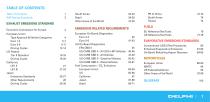
exhaust emissions standard Economic Commission for Europe 4 European Union Type Approval & Vehicle Categories 4 Other Areas of the World 37-39 emissions related requirements European On-Board Diagnostics Euro 3-4 40 Fuel Consumption - CO2 Emissions European Union 63-64 evaporative emissions standards Conventional US/EU Test Procedures 80 Enhanced Evaporative Emissions 81-83 On-Board Refuelling Vapour Recovery 84-85 Other Areas of the World 97-99
Open the catalog to page 3
Wonder why our Diesel common rail systems are so popular? Delphi’s light duty Diesel common rail systems offer attractive features to help meet Euro6c and Euro6d emissions standards and beyond. Such as a range of state-of-the-art injectors and a new generation of pumps, driven by powerful controllers with advanced control strategies.
Open the catalog to page 4
TOXIC EMISSIONS STANDARDS PASSENGER VEHICLES STANDARDS JAPAN Standards on 10/15+11 mode cycles 1995 2000 New Short Term Standards 10/15+11mode cycles 2000 2005 New Short Term Standards 10/15+11 mode cycles 2005 2009 Post New Long Term Standards JC08 mode cycle 2009 Revised ECE + EUDC cycle 1995 2004 LEV II LEV ULEV SULEV PZEV
Open the catalog to page 5
exhaust emissions standards vehicle categories ECE regulations are similar to EU directives, A base regulation is updated with a consecutive series of amendments, Dates of implementation differ from country to country, depending on the approval status of the respective amendment in that country, The series of ECE-R-83 regulations is reflecting the Euro 1-6 regulations, A world harmonized procedure / cycle (WLTP; WLTC) is in preparation (see page 13), European union type approval Directive 70/156/Ec, as amended by Directive 2007/46/Ec Test Description See pages 5-11 Test cycle: see pages 12-14 Determination...
Open the catalog to page 6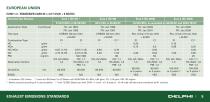
European union euro 1-4 - passenger cars M (s 2,5 T GVW, s 6 SEATS) Directive Text Number Application Date month/year TA: JuI 1992 Test type Combustion Type HC NOx HC+NOx CO pm Deteriation factors URBAN (40 sec idle) URBAN (40 sec idle) +EUDC +EUDC Rev. Urban (10 sec idle) + EUDC Rev. Urban (10 sec idle) + EUDC Durability eobd 1) In brackets: COP values 2) Limits for IDl Diesel. For Dl Diesel until 30/09/1999: HC+NOx: 0,90 g/km, CO: 1,00 g/km, PM: 100 mg/km 3) Newly required recording of in-use durability 4) Until 12/2002 Diesel cars with GVW > 2 t and - a) > 6 seats or - b) off road...
Open the catalog to page 7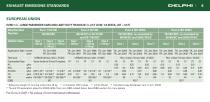
exhaust emissions standards D€LPHI I 6 European union euro 1-4 - large passenger cars and light DUTYTRUCKS N1 (> 2,5 T GVW, 7-9 SEATS, LDT £ 3,5 T) Application Date month /year Test type - CombustionType HC g/km TA: Oct 1993 FR: Oct 1994 URBAN (40 sec idle) + EUDC Same limits for SI and Cl engines FR: Oct 1997 FR: Oct 1998 FR: Oct 1999 URBAN (40 sec idle) + EUDC PI Cl PI Cl PI Cl Rev. Urban (10 sec idle) + EUDC CI PI CI PI CI Rev. Urban (10 sec idle) + EUDC PI CI PI CI PI CI 1 Reference weight in running order plus 25 kg 2) in brackets: COP values 3) Limits Diesel 4)...
Open the catalog to page 8
EUROPEAN UNION OTHER EURO 3-4 REQUIREMENTS • • • • On-board diagnostics requirements for gasoline, LPG, NG and diesel Enhanced evaporative emissions requirements Low temperature test for gasoline vehicles Quality of market gasoline & diesel fuels (Dir 98/70/EC as amended by 2003/17/EC) Measurement of HC and CO at -7°C (266 K) during the urban part of the revised NEDC (780 seconds) Deterioration factors are not applied Reference Fuel option with higher RVP and density Gaseous Fuel (LPG or NG) vehicles are exempt from the low temperature test
Open the catalog to page 9
The benefits of Diesel common rail. Now available for small engines. The Delphi Unit Pump Common Rail System leverages advanced Diesel common rail technology for small engines. It's a cost-effective, robust solution to help manufacturers achieve optimal efficiency and meet stringent emissions standards. Innovation for the Real World
Open the catalog to page 10
EUROPEAN UNION EURO 5-6 REGULATION - Vehicle scope M1 and M2, N1 and N2 vehicles as defined in Directive 70/156/EC with reference mass ≤ 2.610 kg Extension possible at the manufacturer’s request to M1, M2, N1, N2 with reference mass ≤ 2.840 kg - Exempted vehicles at Euro 5 stage Diesel M1 Vehicles designed to fulfill specific social needs: - Special purpose vehicles with reference mass > 2.000 kg (ambulance, hearse, motor caravan…) - Vehicles with reference mass > 2.000 kg and designed to carry at least 7 occupants From 01 Sep 12, no more valid for ”true” off-road vehicle - Vehicles with reference...
Open the catalog to page 11
exhaust emissions standards D€LPHI I 10 European union euro 5-6 spark ignition emission limits | Euro 6c/6d | Euro 5a |EUTQ^b/b^ Euro 6b 11 No exemption for gasoline Passenger Car 21 Applicable to gasoline Dl engines only 3) Test procedure defined in UN Reg 83 Suppl 7 4) Until 3 years after the dates for type approval / 1st registration particle emission limit of 6,0 x E12 may be applied to Euro 6 spark ignition Dl vehicles upon request of manufacturer euro 5-6 compression ignition emission limits Euro 5a Euro 5b/b+ Euro 6b/6c/6d-TEMP/6d Nb/km Exempted M1 vehicles have to comply with N1CI3 test...
Open the catalog to page 12
euro 5-6 implementation roadmap ^ewlypesH New Vehicles ^WlYpesB New Vehicles Durability Requirements starting Euro 5: 160.000 km Assigned Euro 5 DFs: PI: CO: 1,5;THC and NMHC: 1,3; NOx: 1,6; PM: 1,0 Cl: CO: 1,5; NOx andTHC+NOx: 1,1; PM/PN: 1,0 Alternatives: Calculated DFs based on Standard Road CYcle (SRC) Test ageing bench: PI based on Standard Bench CYcle (SBC) Cl based on Standard Diesel Bench CYcle (SDBC) Assigned Euro 6 DFs: PI: no change Cl: TBD Or certification with aged (or rapid aged) exhaust sYstem mandatorY (t.b.c.) In-Service Conformity Up to 100.000 km or 5 Years Low Temperature...
Open the catalog to page 13All Delphi Power Train catalogs and technical brochures
 Friction, Discs & Drums
1028 Pages
 Engine Management, Ignition & Fuel
1460 Pages
 Turbochargers & DPF
114 Pages
 Filtration & DPF
709 Pages
 Air Conditioning & Engine Cooling
771 Pages
 Delphi Diesel Fuel Injectors
2 Pages
 Delphi Low Pressure Sensors
3 Pages
 Delphi Ammonia Sensor
2 Pages
 Delphi Multi-Charge Ignition
2 Pages
 Delphi OCS Sealed Connectors
4 Pages
 srs overview
12 Pages
 Delphi Grounding Systems
2 Pages
 Delphi Ethernet Connectivity
2 Pages
 Delphi Smart Injector
2 Pages
 Heavy Duty & Off-Road Vehicles
100 Pages
 Passenger Cars & Light Duty Vehicles
100 Pages
 Delphi Velocity? Tool Suite
2 Pages
 Ignition Products Catalog
24 Pages
 Product & Service Solutions
8 Pages
 Hybrid & Electric
8 Pages




Archived catalogs
 Delphi Hybrid Cluster
1 Page
 Delphi FAKRA Connectors
2 Pages
 Powertrain Cooling Systems
8 Pages
 E/E Architecture
8 Pages
 Delphi corporate brochure
24 Pages
 Evaporative Emissions
8 Pages
 Sensors
12 Pages
 Fuel Handling Systems
6 Pages
 Valve Train Systems
8 Pages
 Ignition Systems
8 Pages
 Exhaust Sensors
8 Pages


- Industrial pump
- Valve
- Stationary pump
- Piping
- Self-priming pump
- Stainless valve
- Control valve
- Compressor stage
- Air compressor
- Cylinder
- Temperature probe
- Stationary compressor
- Positive-displacement compressor
- Regulating valve
- Industrial compressor
- Management software solution
- Electrically-powered compressor
- Structure hose
- Resistance temperature sensor