
- Catalogs
- Delphi Power Train
- Worldwide Emissions Standards Heavy Duty and Off-Highway Vehicles


Worldwide Emissions Standards Heavy Duty and Off-Highway Vehicles

Worldwide Emissions Standards Heavy Duty and Off-Highway Vehicles
- Economic Commission for Europe (ECE): The ECE R49 regulations are updated through amendments, with implementation dates varying by country. The Worldwide Harmonised Heavy Duty Emissions Certification Procedure (GTR 4) includes two test cycles: WHTC (Transient Test Cycle) and WHSC (Steady-State Test Cycle), measuring emissions like CO, HC, NMHC, NOx, PM, and CO2 in g/kWh.
- European Union: Emission standards are categorized by Euro levels (I-VI), with specific test cycles and emission limits for each. Euro VI includes world harmonized driving cycles (WHTC, WHSC) and covers CO, THC, NMHC, CH4, NOx, NH3, PM, and particle number emissions.
- US Federal (EPA) and California (CARB): Standards are set for vehicle classification, compression ignition, and spark ignition engines, with specific test cycles and emissions limits.
- Japan, China, South Korea, and Other Regions: Each region has its own set of emissions standards and test cycles.
- On-board Diagnostics: Requirements for European, US, and Worldwide Harmonised (WWH) on-board diagnostics are outlined.
- Fuel Consumption and CO2 Emissions: Standards for measuring and reporting fuel consumption and CO2 emissions are provided.
- Reference test fuels for the EU, US, and Japan are specified for emissions testing.
- European Union: Standards for compression ignition (C.I.) engines, agricultural and forestry tractors, and spark ignition (S.I.) engines are detailed.
- US Federal (EPA) and California (CARB): Emissions standards for off-road and non-road engines are specified.
- Japan, South Korea, China, and Other Regions: Emissions standards for NRMM are outlined.
- Various test cycles such as NRSC, Ramped Modal Testing, and NRTC are used for emissions testing.
- Monitors NMHC, NOx, and CO emissions at 2.0 times the standard under low flow rates, and PM emissions at standard + 0.02 grams/bhp-hr under high flow rates.
- Issues include slow response and EGR cooler performance, requiring approval for monitoring multiple coolers.
- Feedback control failures include delayed control initiation, open loop operation, and inability to reach control targets.
- Monitors NMHC, NOx, and CO emissions at 2.0 times the standard, and PM emissions at standard + 0.02 grams/bhp-hr.
- Challenges include underboost, overboost, slow response, and charge air undercooling.
- Feedback control issues similar to EGR system.
- Monitors NMHC emissions at 2.0 times the standard and NOx emissions at standard + 0.2 g/bhp-hr.
- Conversion efficiency issues include insufficient exotherm generation for regeneration and inadequate feedgas for SCR operation.
- PM emissions requirements vary by model year, with stricter standards phased in from 2014 to 2017.
- Frequent and incomplete regeneration issues, NMHC conversion inefficiencies, and missing substrate problems are highlighted.
- NOx converting catalyst and SCR systems have specific phase-in requirements for NOx and NMHC emissions.
- Feedback control issues include delayed control initiation and inability to reach control targets.
- Performance standards vary by model year, with phase-in options for manufacturers.
- Issues include lack of circuit continuity, out-of-range performance, and feedback control failures.
- Monitors NMHC, CO, and NOx emissions at 2.0 times the standard, and PM emissions at standard + 0.02 g/bhp-hr.
- Monitors deterioration and system capability, with fault codes isolating cold start related failures.
- Monitors reduction and excessive secondary flow, with a requirement to monitor control system limits.
- Monitors NMHC and NOx emissions at 1.75 times the standard, with conversion efficiency below 50%.
- Monitors purge flow and system leaks, with specific requirements for alternate fuel engines.
- Monitoring required for components impacting emissions under reasonable driving conditions.
- Monitors engine coolant temperature, with specific requirements for thermostat operation.
1. Faults in heater systems can cause discrepancies between commanded and actual states. Variable Valve Timing (VVT) issues include target errors and slow responses.
2. California (CARB) On-Board Diagnostics (OBD) requires monitoring of hybrid components, vehicle speed, input components, and output components for malfunctions.
3. Specific conditions for malfunction include lack of circuit continuity, out-of-range values, and improper functional responses.
Emissions Related Requirements:
1. CARB OBD systems must detect and store information on malfunctions, with specific classifications for different levels of emission impact.
2. Monitoring areas include variable valve timing systems, engine cooling systems, and various emission control components.
3. Performance requirements evolve with harmonization of test cycles and emission limits.
Fuel Consumption and CO2 Emissions:
1. The European Union is developing the VECTO simulation tool to estimate CO2 emissions from heavy-duty vehicles (HDVs).
2. US Federal standards for CO2 and fuel consumption are set by the EPA and NHTSA, with specific standards for combination tractors, pickup trucks, vans, and vocational vehicles.
3. Standards include differentiated targets based on vehicle attributes and phase-in schedules for compliance.
Testing and Compliance:
1. Testing for tractors and vocational vehicles includes engine and vehicle standards, with specific test cycles for each.
2. Compliance is determined using the Greenhouse gas Emission Model (GEM) developed by the EPA.
3. The regulation does not require chassis testing due to the variety of vehicle configurations.
To evaluate real-world vehicle performance, various characteristics such as aerodynamic features, weight, tire rolling resistance, and idle-reducing technology are measured. These inputs are crucial for modeling and improving truck efficiency.
US Federal Standards
N2O and CH4 Emissions: Standards for nitrous oxide and methane emissions are set at 0.10 g/bhp-hr for engines and 0.05 g/mi for chassis testing, effective from MY 2015.
A/C Leakage: Standards ensure low-leakage components in air conditioning systems for heavy-duty vehicles.
Useful Life: CO2 emissions standards must be met over the vehicle's useful life, defined similarly to criteria pollutant standards.
Fuel Consumption and CO2 Emissions
Implementation dates for new and in-production vehicles are set for July 2014 and July 2015, respectively. The C-WVTC cycle is used for testing fuel consumption.
Fuel Specifications
Diesel Fuel: Parameters include cetane number, density, distillation points, flash point, and sulfur content. Specific limits are set for each parameter to ensure fuel quality.
EU Reference Test Fuels: Specifications for ethanol and diesel fuels are outlined, including alcohol content, density, and sulfur limits.
Emissions Standards for Non-Road Mobile Machinery (NRMM)
EU Stages I-IV: Emissions limits for CO, HC, NOx, and PM are specified for different engine power categories. Implementation dates vary by engine type and application.
Automotive Fuel Quality Regulations
US and Japan reference test fuels are detailed, including limits for sulfur, benzene, and other components to ensure compliance with emissions standards.
Technological Solutions
Delphi's Diesel Common Rail Systems offer advanced technology for efficient combustion and emissions compliance, suitable for small engines and emerging markets.
- Additive DFs are used for pollutants in C.I. engines without aftertreatment devices, while multiplicative DFs apply to those with such devices. DFs are determined by manufacturers through specific test procedures lasting at least 1/4 of the EDP.
- EDP varies by engine power and type, ranging from 3,000 to 8,000 hours.
- Detailed timelines and power categories are provided for Stages I to IV, with specific dates for compliance.
- Stage V introduces new limits for smaller (<19 kW) and larger (>560 kW) engines, with a focus on particulate mass and number limits.
- Two tests are required: steady speed and free acceleration, with specific measurement criteria and limits.
- Various amendments delay the implementation of certain stages for specific tractor categories.
- Stage V legislation will be implemented through Delegated and Implemented Acts, affecting all EU member states immediately.
- Covers off-road C.I. engines with standards expressed in g/bhp.h.
- Tier 1 to Tier 4 standards are outlined, with specific emission limits and testing procedures.
- Includes provisions for averaging, banking, and trading of emission credits.
The document outlines various emissions standards for engines, focusing on smoke emissions, particulate matter (PM), nitrogen oxides (NOx), non-methane hydrocarbons (NMHC), and carbon monoxide (CO). These standards are applicable over the entire useful life of the engine, with specific opacity limits for different modes of operation: acceleration (20%), lugging (15%), and peak (50%).
Engine Useful Life and Warranty
The useful life and warranty periods are defined in terms of hours and years, whichever comes first. For example, constant speed engines with a rated speed of 3,000 rpm or higher have a useful life of 5 years or 3,000 hours and a warranty period of 2 years or 1,500 hours.
Tier Standards
The document details Tier 3 and Tier 4 emissions standards, with specific requirements for different engine power categories. Tier 4 standards apply after all transition provisions expire post-2014. Interim Tier 4 standards maintain the useful life from Tier 3, while Final Tier 4 standards specify emissions limits for engines up to 560 kW.
Phase-Out and Compliance
Manufacturers have options to comply with either Tier 3 or Tier 4 standards, with phase-out standards allowing only 50% of production to meet these standards during the phase-out period. Full compliance with PM/CO standards is required from 2011, with NOx/HC compliance phased in over several years.
Non-Road Spark-Ignition Engines
Emissions standards for non-road spark-ignition engines are outlined, including evaporative emissions standards and permeation requirements for fuel lines and tanks. These standards apply to both handheld and non-handheld equipment, with specific useful life and warranty periods.
California (CARB) Regulations
California's regulations align with US-EPA standards but include additional provisions for in-use engines and fleet average standards for NOx and PM. Large fleets must meet declining PM and NOx standards starting in 2010, with medium and small fleets following in subsequent years.
Test Procedures and Certification
The document specifies test procedures for emissions certification, including steady-state and transient test cycles. Certification fuels have transitioned to lower sulfur content, and manufacturers are required to perform in-use testing to ensure compliance.
Various countries have implemented emission standards for non-road diesel engines. Russia proposed EU Stage III standards for new vehicles starting January 2014. Singapore requires newly imported non-road diesel engines to meet EU Stage II, US Tier II, or Japan Tier I standards since July 2012. Switzerland mandates new engines for off-road vehicles to meet current EU standards and requires diesel engines on large construction sites to have Diesel Particulate Filters (DPF). Turkey has specific power range requirements effective from January and October 2014.
The document outlines several test cycles for emissions testing, including the Non-Road Steady-State Cycle (NRSC) and the Non-Road Transient Cycle (NRTC). The NRSC involves measuring raw exhaust emissions with a warm engine across various speed and load modes. The NRTC, developed by the US EPA and EU authorities, is used for US EPA Tier 4 and EU Stage III and IV regulations, involving cold and hot start cycles.
The document provides a comprehensive glossary of terms related to emissions standards, including abbreviations like CI (Compression Ignition Engine), PM (Particulate Matter), and SCR (Selective Catalytic Reduction).
Contact details for Delphi's regional offices in North America, Asia Pacific, Europe, Middle East, Africa, and South America are provided. Additionally, information about the Delphi Emissions app and how to access their Worldwide Emissions Standards Booklets is included.
Catalog excerpts

Worldwide Emissions Standards Heavy Duty and Off-Highway Vehicles
Open the catalog to page 1
Ramped Modal Testing 98 NON-ROAD MOBILE MACHINERY 64-99 HD - EXHAUST EMISSIONS STANDARDS Economic Commission for Europe Test Cycles 2-3 European Union Vehicle Categories / Euro I / Euro II 5 California (CARB) Emissions Standards 25-28 PR of China / Beijing Area / South Korea 39 Other Areas of the World 40 HD - EMISSIONS RELATED REQUIREMENTS European On-board Diagnostics 42-43 Fuel Consumption - CO2 Emissions 53-57 Japan ReferenceTest Fuels 63 NRMM - EMISSIONS STANDARDS European Union C.I. Engines 65-66 Large Off-Road S.I. Engines 88-90 South Korea / PR of China...
Open the catalog to page 3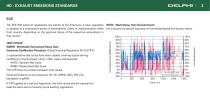
HD - EXHAUST EMISSIONS STANDARDS 2 representative test cycles have been created covering typical driving conditions in the European Union, USA, Japan and Australia: - WHTC: Transient Test Cycle - WHSC: Steady-State Test Cycle The GTR does not contain emission limit values. Exhaust Emissions to be measured: CO, HC, NMHC, NOx, PM, CO2, expressed in g/kWh. If GTR applied in a national legislation, the limit values should represent at least the same level of severity as its existing regulations. M_norm_WHTC, final n_norm_WHTC, final normalized speed TEST CYCLES WWHD - Worldwide Harmonised Heavy Duty...
Open the catalog to page 4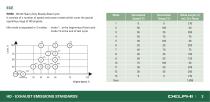
WHSC - World Heavy Duty Steady-State Cycle It consists of a number of speed and power modes which cover the typical operating range of HD engines. mode is separated in 2 modes: mode 1 at the beginning of test cycle mode 13 at the end of test cycle HD - EXHAUST EMISSIONS STANDARDS
Open the catalog to page 5
Robust, high value Delphi controllers. Delphi controllers help CV Diesel engines operate efficiently, reliably and economically. And, Delphi supports CNG applications. All our controllers operate in harsh environments. So commercial and off-highway vehicles meet emissions, fuel economy and performance objectives.
Open the catalog to page 6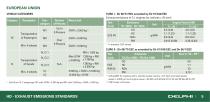
EUROPEAN UNION Category Description Subcategory Mass Limit M1 Transpo rtation M of Passengers M 2 Min. 4 wheels M3 EURO I - Dir 88/77/EEC amended by Dir 91/542/EEC Exhaust emissions of C.I. engines for vehicles > 25 km/h Transportation of Goods Min. 4 wheels EURO II - Dir 88/77/EEC as amended by Dir 91/542/EEC and Dir 96/1/EEC Test Emissions 11 Until Euro IV: 2 subgroups: M1 with GVW s 2.500 kg and M1 with 2.500 kg < GVW s 3.500 kg 11 0,25 g/kWh for engines with a cylinder swept volume < 0,7 liters and rated power speed > 3.000 rpm and engine power < 85 kW until 30 Sep 97 for TA and 30 Sep...
Open the catalog to page 7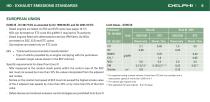
HD - EXHAUST EMISSIONS STANDARDSEUROPEAN UNION Emissions TA: 10/2000 EURO III - Dir 88/77/EC as amended by Dir 1999/96/EC and Dir 2001/27/EC - Diesel engines are tested on ESC and ELR cycles (see pages 16-17). NOx can be tested on ETC cycle (6,5 g/kWh) if required byTA authority - Diesel engines fitted with aftertreatment devices (PM filters, De-NOx) are tested on ESC, ELR and ETC cycles. - Gas engines are tested only on ETC cycle EEV = "Enhanced Environmentally Friendly Vehicle" = Type of vehicle propelled by an engine complying with the permissive emission target values shown in the EEV columns Specific...
Open the catalog to page 8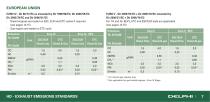
EUROPEAN UNION EURO IV - Dir 88/77/EC as amended by Dir 1999/96/EC, Dir 2005/55/EC Dir 2005/78/EC and Dir 2006/51/EC - Diesel engines are tested on ESC, ELR and ETC cycles if required (see pages 14-15) - Gas engine are tested on ETC cycle EURO V - Dir 2005/55/EC + Dir 2005/78/EC amended by Dir 2006/51/EC + Dir 2008/74/EC For TA and for EEV's, ETC and ESC/ELR tests are applicable (see pages 14-15) Unit ESC/ELR ETC ESC/ELR Diesel only Diesel & Gas Diesel only ESC/ELR Diesel Only ESC/ELR Diesel Only 1) For natural gas engines only 2) Not applicable for gas fuelled engines - Euro IV Stage HD...
Open the catalog to page 9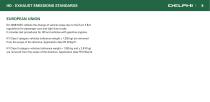
HD - EXHAUST EMISSIONS STANDARDS EUROPEAN UNION Dir 2008/74/EC reflects the change of vehicle scope due to the Euro 5 & 6 regulations for passenger cars and light duty trucks. It includes test procedures for HD and vehicles with gasoline engines. N1 Class I category vehicles (reference weight ≤ 1.305 kg) are removed from the scope of the directive. Application date FR 01Sep11. N1 Class II category vehicles (reference weight > 1.305 kg and ≤ 2.610 kg) are removed from the scope of the directive. Application date FR 01Sep12.
Open the catalog to page 10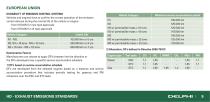
DURABILITY OF EMISSION CONTROL SYSTEMS Vehicles and engines have to confirm the correct operation of the emission control devices during the normal life of the vehicle or engine - from 01Oct05 for new type approvals - from 01Oct06 for all type approvals Vehicle Category Useful Life Deterioration Factors Manufacturers can choose to apply DF's foreseen into the directive or the DF's developed over a specific service accumulation schedule 1) DF's based on service accumulation schedule DF's are developed from the selected engines based on a distance and service accumulation procedure that includes...
Open the catalog to page 11
HD - EXHAUST EMISSIONS STANDARDS EUROPEAN UNION EURO VI (Reg EC No: 595/2009 and implementing regulations (EU) No 582/2011 and 64/2012) Scope: M1, M2, N1, N2 with RM > 2.610 kg Application dates: TA 31DEC12 - FR 31DEC13 C.I. Compression Ignition P.I. Positive Ignition WHSC, WHTC (see pages 2-3) 11 Admissible level of NO2 may be defined later 2) Measurement procedure to be introduced at a later date 31 Particle number limit and date of implementation not confirmed yet Regulation covers: - Only world harmonized driving cycles (WHTC, WHSC) are applicable as defined in ECE Regulation Annex 4B. -...
Open the catalog to page 12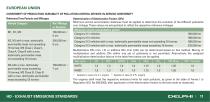
EUROPEAN UNION CONFORMITY OF PRODUCTION; DURABILITY OF POLLUTION CONTROL DEVICES; IN-SERVICE CONFORMITY Reference Time Periods and Mileages Vehicle Category Determination of Deterioration Factors (DFs) Minimum service accumulation distances must be applied to determine the evolution of the different pollutants over mileage.These values are extrapolated to reflect the respective reference mileages N2, N3 with a max. technically permissible mass not exceeding 16 tonnes; M3 Class I, Class II, Class A, Class B with a max. technically permissible mass not exceeding 7,5 tonnes N3 with a max. technically permissible...
Open the catalog to page 13All Delphi Power Train catalogs and technical brochures
 Friction, Discs & Drums
1028 Pages
 Engine Management, Ignition & Fuel
1460 Pages
 Turbochargers & DPF
114 Pages
 Filtration & DPF
709 Pages
 Air Conditioning & Engine Cooling
771 Pages
 Delphi Diesel Fuel Injectors
2 Pages
 Delphi Low Pressure Sensors
3 Pages
 Delphi Ammonia Sensor
2 Pages
 Delphi Multi-Charge Ignition
2 Pages
 Delphi OCS Sealed Connectors
4 Pages
 srs overview
12 Pages
 Delphi Grounding Systems
2 Pages
 Delphi Ethernet Connectivity
2 Pages
 Delphi Smart Injector
2 Pages
 Heavy Duty & Off-Road Vehicles
100 Pages
 Passenger Cars & Light Duty Vehicles
100 Pages
 Delphi Velocity? Tool Suite
2 Pages
 Ignition Products Catalog
24 Pages
 Product & Service Solutions
8 Pages
 Hybrid & Electric
8 Pages




Archived catalogs
 Delphi Hybrid Cluster
1 Page
 Delphi FAKRA Connectors
2 Pages
 Powertrain Cooling Systems
8 Pages
 E/E Architecture
8 Pages
 Delphi corporate brochure
24 Pages
 Evaporative Emissions
8 Pages
 Sensors
12 Pages
 Fuel Handling Systems
6 Pages
 Valve Train Systems
8 Pages
 Ignition Systems
8 Pages
 Exhaust Sensors
8 Pages


- Pump
- Industrial pump
- Stationary pump
- Piping
- Self-priming pump
- Control valve
- Stainless valve
- Compressor stage
- Air compressor
- Temperature probe
- Stationary compressor
- Positive-displacement compressor
- Regulating valve
- Industrial compressor
- Management software solution
- Electrically-powered compressor
- Structure hose
- Resistance temperature sensor