
- Catalogs
- Delphi Power Train
- Delphi Switching Oxygen Sensors


Delphi Switching Oxygen Sensors
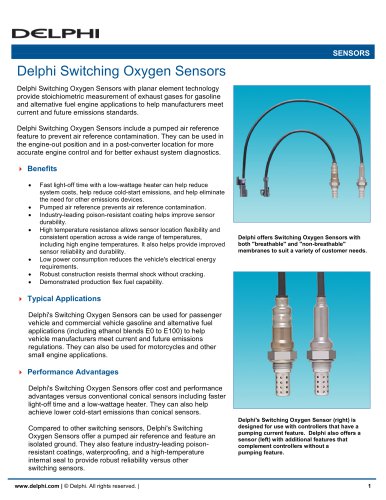
Delphi Switching Oxygen Sensors
Delphi Switching Oxygen Sensors utilize planar element technology to measure exhaust gases in gasoline and alternative fuel engines, aiding manufacturers in meeting emissions standards. These sensors feature a pumped air reference to prevent contamination and can be positioned both engine-out and post-converter for enhanced engine control and diagnostics.
- Fast light-off time with low-wattage heater reduces system costs and cold-start emissions.
- Pumped air reference prevents contamination.
- Poison-resistant coating enhances durability.
- High temperature resistance allows flexible sensor placement and consistent operation.
- Low power consumption reduces electrical energy requirements.
- Robust construction resists thermal shock.
- Supports flex fuel capability.
These sensors are suitable for passenger and commercial vehicles using gasoline or alternative fuels, including ethanol blends (E0 to E100), as well as motorcycles and small engines, helping meet emissions regulations.
Delphi's sensors offer faster light-off times and lower cold-start emissions compared to conventional sensors. They feature a pumped air reference, isolated ground, poison-resistant coatings, waterproofing, and high-temperature seals for enhanced reliability.
- Rich voltage: >720 mV
- Lean voltage: <120 mV
- Rich to lean response time: <100 ms
- Lean to rich response time: <80 ms
- Static lambda: 1.005 (± 0.003)
- Sensor light-off: <12 seconds
- Sensor time to activity: <8 seconds
- Heater power: 7 watts
- Heater in-rush current: <1.7 amps max
Delphi offers a comprehensive portfolio of sensors with over 30 years of experience in powertrain sensor research and production. As a global leader, Delphi supports manufacturers in meeting emissions requirements, improving fuel economy, and enhancing performance through high-value solutions and collaborative engineering.
Catalog excerpts

Delphi Switching Oxygen Sensors Delphi Switching Oxygen Sensors with planar element technology provide stoichiometric measurement of exhaust gases for gasoline and alternative fuel engine applications to help manufacturers meet current and future emissions standards. Delphi Switching Oxygen Sensors include a pumped air reference feature to prevent air reference contamination. They can be used in the engine-out position and in a post-converter location for more accurate engine control and for better exhaust system diagnostics. Fast light-off time with a low-wattage heater can help reduce system costs, help reduce cold-start emissions, and help eliminate the need for other emissions devices. Pumped air reference prevents air reference contamination. Industry-leading poison-resistant coating helps improve sensor durability. High temperature resistance allows sensor location flexibility and consistent operation across a wide range of temperatures, including high engine temperatures. It also helps provide improved sensor reliability and durability. Low power consumption reduces the vehicle's electrical energy requirements. Robust construction resists thermal shock without cracking. Demonstrated production flex fuel capability. Delphi offers Switching Oxygen Sensors with both "breathable" and "non-breathable" membranes to suit a variety of customer needs. Typical Applications Delphi's Switching Oxygen Sensors can be used for passenger vehicle and commercial vehicle gasoline and alternative fuel applications (including ethanol blends E0 to E100) to help vehicle manufacturers meet current and future emissions regulations. They can also be used for motorcycles and other small engine applications. Performance Advantages Delphi's Switching Oxygen Sensors offer cost and performance advantages versus conventional conical sensors including faster light-off time and a low-wattage heater. They can also help achieve lower cold-start emissions than conical sensors. Compared to other switching sensors, Delphi's Switching Oxygen Sensors offer a pumped air reference and feature an isolated ground. They also feature industry-leading poisonresistant coatings, waterproofing, and a high-temperature internal seal to provide robust reliability versus other switching sensors. www.delphi.com | © Delphi. All rights reserved. | Delphi's Switching Oxygen Sensor (right) is designed for use with controllers that have a pumping current feature. Delphi also offers a sensor (left) with additional features that complement controllers without a pumping feature.
Open the catalog to page 1
Delphi Switching Oxygen Sensors Light-Off Signal Time This chart shows the fast typical light-off signal of the Delphi Switching Oxygen Sensor. Specifications (At 450°C engine dynamometer) Rich voltage Lean voltage Rich to lean response time Lean to rich response time Static lambda Sensor light-off (450° C, as above) Sensor time to activity (cross 300 mV) Heater power at 13.5 V, 450°C exhaust Heater in-rush current at 21°C, 13.5 V >720 mV <120 mV <100 ms < 80 ms 1.005 (± 0.003) <12 seconds <8 seconds 7 watts <1.7 amps max The Delphi Advantage Delphi has one of the industry's most complete portfolios...
Open the catalog to page 2All Delphi Power Train catalogs and technical brochures
 Friction, Discs & Drums
1028 Pages
 Engine Management, Ignition & Fuel
1460 Pages
 Turbochargers & DPF
114 Pages
 Filtration & DPF
709 Pages
 Air Conditioning & Engine Cooling
771 Pages
 Delphi Diesel Fuel Injectors
2 Pages
 Delphi Low Pressure Sensors
3 Pages
 Delphi Ammonia Sensor
2 Pages
 Delphi Multi-Charge Ignition
2 Pages
 Delphi OCS Sealed Connectors
4 Pages
 srs overview
12 Pages
 Delphi Grounding Systems
2 Pages
 Delphi Ethernet Connectivity
2 Pages
 Delphi Smart Injector
2 Pages
 Heavy Duty & Off-Road Vehicles
100 Pages
 Passenger Cars & Light Duty Vehicles
100 Pages
 Delphi Velocity? Tool Suite
2 Pages
 Ignition Products Catalog
24 Pages
 Product & Service Solutions
8 Pages
 Hybrid & Electric
8 Pages


Archived catalogs
 Delphi Hybrid Cluster
1 Page
 Delphi FAKRA Connectors
2 Pages
 Powertrain Cooling Systems
8 Pages
 E/E Architecture
8 Pages
 Delphi corporate brochure
24 Pages
 Evaporative Emissions
8 Pages
 Sensors
12 Pages
 Fuel Handling Systems
6 Pages
 Valve Train Systems
8 Pages
 Ignition Systems
8 Pages
 Exhaust Sensors
8 Pages


- Pump
- Industrial pump
- Valve
- Stationary pump
- Piping
- Self-priming pump
- Control valve
- Stainless valve
- Compressor stage
- Air compressor
- Cylinder
- Temperature probe
- Stationary compressor
- Positive-displacement compressor
- Regulating valve
- Industrial compressor
- Management software solution
- Electrically-powered compressor
- Structure hose
- Resistance temperature sensor