

TRI-2

TRI-2
- The TRI-2 Panorama Rudder Indicator by DEIF is designed for marine applications, providing class 1 accuracy in its CAN version and readability from up to 5 meters.
- It features a moving coil system for fast response and is available in two versions: Analogue and CAN.
- The device is CE-marked for various environments and housed in a splash-proof case.
- Available with white or black scales, with starboard marked in green and port in red.
- Equipped with long-life LEDs for illumination, with options for yellow or red light for better night vision.
- Includes a built-in dimmer for light intensity adjustment, with options for remote dimming and CANbus control.
- Mounting requires six 5 mm screws, ensuring the deck is level to avoid deformation.
- Cable entry is through PG 13.5 cable glands.
- Terminals are available for both CAN and analogue versions, with specific pin functions detailed for each.
- Technical specifications include power supply options, interface types, galvanic separation, and safety standards.
- Designed to operate within specific temperature, humidity, and vibration ranges, with IP54 protection.
- Order specifications require details such as item number, type, variant, protection, input type, and scale design.
- For TRI-2 CAN, parameters like source ID, CAN transmitter bit resolution, and backlight must be defined.
- DEIF reserves the right to change document contents without notice, with the English version being the most accurate.
Catalog excerpts

Panorama Rudder Indicator Data sheet
Open the catalog to page 1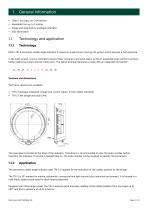
Class 1 accuracy on CAN version Readable from up to 5 metres Single and dual CAN or analogue interface DEIF’s TRI-2 panorama rudder angle indicator is based on a well-known moving coil system which secures a fast response. In the CAN version, a micro controller ensures class 1 accuracy and even opens up for an expanded scale centre to achieve better readout accuracy around rudder zero. The below example illustrates a scale with an expanded mid section. 40….30….20….10….5….0….5….10….20….30….40 Versions and dimensions Two basic versions are available: • TRI-2 Analogue (standard voltage and current...
Open the catalog to page 3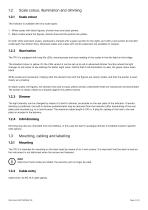
Scale colour, illumination and dimming Scale colour The indicator is available with two scale types: 1. White scales with black figures, division lines and black pointer. 2. Black scales where the figures, division lines and the pointer are yellow. On both white and black scales, starboard is marked with a green section (to the right), port with a red section (to the left) underneath the division lines. Reversed scales and scales with centre expansion are available on request. The TRI-2 is equipped with long-life LEDs, ensuring easy and clear reading of the scales in the dim light on the bridge....
Open the catalog to page 4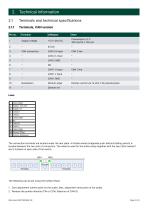
Terminals and technical specifications Supply voltage Dimmer wiper Dimmer control via 1k ohm 2 W potentiometer The connection terminals are located under the rear plate. A fumble wheel (integrated push-button/rotating switch) is located between the two sets of connectors. The wheel is used for the entire setup together with the two LEDs marked 1 and 2 located on each side of the switch. The following can be set using the fumble wheel: 1. Zero adjustment (centre point on the scale). Max. adjustment (end point on the scale). 2. Reverse the pointer direction CW or CCW. Selection of CAN ID.
Open the catalog to page 5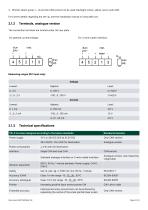
3. Dimmer select group 1…..8 and the CAN protocol to be used. Backlight colour, yellow, red or auto shift. For further details regarding the set-up, see the installation manual on www.deif.com. Terminals, analogue version The connection terminals are located under the rear plate. For 3-wire rudder interface: Measuring ranges (DC input only): Voltage Lowest: Technical specifications TRI-2 has been designed according to the below standards Power supply Analogue version Power consumption < 4 W with full illumination Standard analogue interface or 3-wire rudder interface Analogue version, see measuring...
Open the catalog to page 6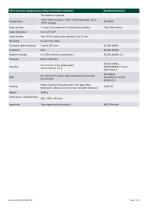
TRI-2 has been designed according to the below standards The feature is optional Temperature -10 to +55°C nominal, -25 to +70°C operating, -25 to +70°C storage Start-up time < 5 sec. from power on to valid pointer position Cable dimension Cable entries Two PG13.5 cable outer diameter 6 to 12 mm Compass safety distance Relative humidity CE-marked for marine, light industrial and industrial environment Plastic housing: Polycarbonate +10% glass fibre Metal parts: Made out of corrosion-resistant materials Dimensions, cardboard box Approvals
Open the catalog to page 7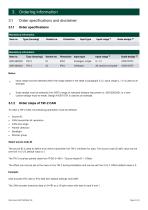
Order specifications and disclaimer Order specifications Mandatory information Item no. Type (housing) Input type Mandatory information Item no. Type (housing) Input type Analogue, single Input range must be selected within the range stated in the table in paragraph 2.1.2. Input range 0...1 V is used as an example. Scale design must be selected from DEIF's range of standard designs (document no. 4921290030), or a new custom design must be made. Design 4155110751 is used as an example. To order a TRI-2 CAN, the following parameters must be defined: • Pointer direction Dimmer group Select source...
Open the catalog to page 8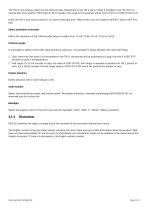
The TRI-2 now receives data from the CAN encoder. Adjustment in the TRI-2 menu makes it possible to set the TRI-2 to receive data from another TPDO than 0x181 if needed. The range in this example will be from 0x181 to 0x188 (0x181+0x7). Order the TRI-2 with source node ID 1 to receive CAN data from TPDO 0x181, from for instance DEIF RTC 300 or DEIF RTC 600. Select resolution of encoder Define the resolution of the CAN encoder values to select from: 12-bit, 13-bit, 14-bit, 15-bit or 16-bit. CAN zero angle It is possible to define which CAN value should be used as 0. It is possible to select between...
Open the catalog to page 9All DEIF catalogs and technical brochures
 EQ96-sw4, EQ96-sw7, VDQ96-sw
4 Pages
 CGC 400
10 Pages
 AGC-4 Mk II
4 Pages
 IMD 100
12 Pages
 KBU
KBU9 Pages
 ASR
ASR77 Pages
 DCP2
DCP24 Pages
 DBC-1
DBC-115 Pages
 Battery chargers TOP
3 Pages
 AGC-4
AGC-430 Pages
 Alarm panel – type AL8-2
8 Pages
 Shunt resistors
2 Pages
 ENGINE & GEN-SET CONTROLS
2 Pages
 G59 protection relay package
3 Pages


- Transformer
- Measuring device
- Dry transformer
- Digital I/O
- IO module
- Digital indicator
- Digital IO module
- DC-DC converter
- Battery charger
- Protection relay
- Current transformer
- Encapsulated transformer
- Fieldbus I/O module
- Floor-standing transformer
- Instrument transformer
- Lead battery charger
- Isolated DC-DC converter
- Industrial DC/DC converter module
- Position indicator