


K

K
Overview
This technical document from DC Swiss SA focuses on swarf breaker threading tools, specifically taps with TiCN coating designed for efficient chip breaking and removal during thread cutting operations. It includes material specifications, application guidelines, tool dimensions, cutting parameters, and safety recommendations.
1. Material Specifications and Application Groups
The document lists a comprehensive range of materials categorized by tensile strength and type, including free-cutting steels, structural steels, carbon steels, alloy steels (both soft and hardened), cast irons (grey, spheroidal graphite, malleable), brass, bronze, copper alloys, and aluminum alloys with silicon or magnesium. Materials are identified by standard numbers (e.g., 1.0711, 0.6015) and corresponding common names or grades (e.g., S235JR, GG 15).
Materials are grouped by tensile strength ranges (e.g., <850 N/mm², 850-1150 N/mm²) to guide tool selection and cutting parameters.
2. Application Range and Use Cases
The swarf breaker taps are recommended for machining rotors, wheel hubs, gear wheels, and other parts with blind holes having tapping depths less than 4 times the nominal diameter (D1), including counterbores. Suitable materials include structural and cementation steels, spheroidal graphite and malleable cast iron, alloy steels up to 1150 N/mm² tensile strength, grey cast iron, and aluminum alloys.
The design prevents swarf nesting by breaking chips into small fragments that are flushed out by coolant through extended straight flutes, ensuring a clean and reliable tapping process. This is especially advantageous for horizontal machining operations.
3. Tool Design and Cutting Geometry
DC Swiss taps feature a TiCN coating and a special cutting geometry optimized for swarf breaking. The geometry supports both classical thread cutting with axial compensation and rigid (synchronous) tapping.
Key tool dimensions and parameters are provided for various metric thread sizes (M6 to M42), including pitch (P), overall length (l1), flute length (l2), thread length (l9), shank diameter (d2), and chamfer angle (a). Recommended cutting speeds (Vc) vary by thread size and material hardness.
4. Cutting Parameters and Requirements
- Minimum coolant pressure of 20 bar at the tap exit is required for optimal chip evacuation and tool performance.
- Cutting speeds are specified according to thread size ranges and material hardness categories.
- Both internal coolant supply and tool holders with through-spindle coolant capability are recommended.
5. Safety and Handling
The document emphasizes strict adherence to safety regulations due to the risk of tool breakage or shattering, which can endanger operators. Wearing safety glasses is mandatory. Grinding of threading tools must be conducted under rigorous safety standards to avoid hazardous dust exposure.
6. Technical Questionnaire
A detailed technical questionnaire is included for customers to provide information about tool type, thread size, material group and hardness, thread type (blind or through hole), cutting speed, feed, machine setup, lubrication, and reasons for tool change. This facilitates tailored tool recommendations and troubleshooting.
7. Contact and Legal Notices
Contact details for DC Swiss offices in Germany, Italy, Switzerland, and the UK are provided. The document includes disclaimers about possible technical data errors and prohibits unauthorized reproduction of content.
Catalog excerpts

SPANBRECHER – SWARF BREAKER
Open the catalog to page 1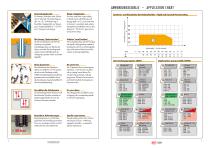
ANWENDUNGSTABELLE – APPLICATION CHART Die Lösung: "Späne brechen" DC hat Gewindebohrer, mit TiCN-Beschichtung, mit spezieller Schneidengeometrie zum Brechen der Späne, entwickelt. Die Spanfragmente werden mit dem Kühlmittel durch die verlängerten, geraden Nuten nach hinten abgeführt. Range of application For rotors, wheel hubs or gear wheels, in all kind of parts with blind holes with tapping depth < 4 x D1, and counter bore, in structural or cementation steels, spheroidal graphite and malleable cast iron, alloy steels up to 1'150 N/mm2, grey cast iron and aluminium alloys. Synchron- und klassisches...
Open the catalog to page 2
THREADING TECHNO
Open the catalog to page 3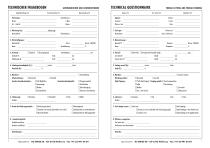
TECHNISCHER FRAGEBOGEN Angebotsanfrage GEWINDEBOHRER UND GEWINDEFORMER Versuchsresultat TECHNICAL QUESTIONNAIRE THREAD CUTTING AND THREAD FORMING Test result Vertretung : Kontaktperson : Kunde : E-Mail : Tel.- /Fax-Nr : Datum : Agency : Customer : Phone or fax : 1. Werkzeug-Typ : Abmessung : Besonderheit : 1. Tool type : Thread size : Particularity : Class of tolerance : Härte : N/mm2 /HB/HRC Bruchdehnung : % 2. Material group : Material N° : Norm : 2. Werkstoffgruppe : Werkstoff-Nr : Norm : 3. Gewinde : Sackloch Durchgangsloch Gewindelänge : Kernloch-Ø : Tiefe : mm Aufbohrungs-Ø : Tiefe...
Open the catalog to page 4
Warnung Gewindewerkzeuge können durch technisches Versagen oder durch Fahrlässigkeit brechen oder zersplittern und die Gesundheit des Mitarbeitenden gefährden. Befolgen Sie daher die gesetzlichen Sicherheits- und Gesundheitsvorschriften. Zudem ist das Tragen der Schutzbrille unerlässlich. Das Schleifen von Gewindewerkzeugen verursacht gefährlichen Staub und darf nur unter gewissenhaftesten Sicherheitsrichtlinien verrichtet werden. Warning Thread tools can break or shatter either through technical failure or negligence, and can endanger the health of the operator. Always obey the safety and health...
Open the catalog to page 5All DC SWISS SA catalogs and technical brochures
 FPS-FAS
11 Pages
 NANO THREAD
97 Pages
 GWi5000
3 Pages
 NANO QUALITY
6 Pages
 QTAP
QTAP32 Pages
 AERO
AERO36 Pages
 ZBGF
ZBGF4 Pages
 GWi
GWi17 Pages
 RTS
RTS11 Pages
 Z70
Z709 Pages
 Catalogue TC
478 Pages
 Catalogue TM
212 Pages
- DC milling cutter
- Chuck
- DC solid milling cutter
- DC drill bit
- DC steel milling cutter
- DC solid drill bit
- DC metal milling cutter
- DC cast iron milling cutter
- Solid carbide milling cutter
- DC coated milling cutter
- Twist drill bit
- High-speed steel drill bit
- DC aluminum milling cutter
- DC stainless steel milling cutter
- Steel drill bit
- DC plastic milling cutter
- DC CNC machine milling cutter
- Cast iron drill bit
- Hardened steel milling cutter
- Stainless steel drill bit