
- Catalogs
- DC SWISS SA
- FPS-FAS


FPS-FAS

FPS-FAS
This document provides comprehensive technical details on thread forming technology, focusing on various thread formers and their applications. It includes specifications, advantages, limitations, and recommendations for use.
The document lists several thread formers, including FS-DL, FS-VS, FPS-CN, FPS-VS, and FAS-VS, each designed for specific thread sizes and materials. These tools are suitable for materials with a minimum elongation of 10% and tensile strength up to 1,150 N/mm², such as steels, stainless steels, titanium, aluminum, copper, and brass.
The thread forming process involves the teeth of the thread former piercing the material and displacing it into the tool profile, creating a thread profile with a characteristic groove.
- Higher process security due to the absence of shavings.
- Single tool usage for both through and blind holes.
- Optimal for deep threads.
- Threads with higher resistance to stripping under static and dynamic loads.
Thread forming in thin-walled workpieces requires careful handling due to physical constraints.
Adequate lubrication is crucial to prevent tool failure due to cold welding. The tool must be protected by a continuous film of lubricant.
- FS-DL: Universal thread former for small threads (Ø ≥ 1 - < 3 mm) with a wear-protective coating for stainless steels and pure copper.
- FS-VS: Similar to FS-DL but with a different protective coating.
- FPS-CN: For Ø ≥ 3 mm, designed for abrasive materials with a CrN coating for better gliding.
- FPS-VS: For materials with low elongation, featuring a wear-protective coating with thermal and chemical resistance.
- FAS-VS: For tough materials with high elongation, offering excellent lubrication and sliding properties.
The document lists numerous materials compatible with the thread formers, including various steels, aluminum alloys, copper alloys, and other metals and polymers like Delrin, Teflon, and Nylon.
The document provides a comprehensive list of various metal and alloy grades, each identified by a unique numerical code and corresponding chemical composition or trade name. These materials are used in various industrial applications, including construction, manufacturing, and engineering.
- Steel and Stainless Steel Grades: Lists various steel grades, including carbon steels, alloy steels, and stainless steels, each identified by a numerical code and chemical composition.
- Cast Iron Grades: Includes grades used for casting applications, characterized by their graphite content and mechanical properties.
- Non-Ferrous Metals: Lists various non-ferrous metals and alloys, known for their corrosion resistance and lightweight properties.
- Nickel and Cobalt Alloys: Includes high-performance alloys used in high-temperature and corrosive environments.
- Plastics and Composites: Lists engineering plastics used for their insulating properties and mechanical strength.
The document provides a detailed reference for selecting materials based on their chemical composition and mechanical properties, crucial for engineers and designers in choosing the right material for specific applications.
The document provides detailed specifications for threading tools, including measurements such as diameter, pitch, and various lengths, along with tolerances. The data is organized by different standards, indicating precision requirements for manufacturing and quality control.
The document references several standards related to threading specifications and manufacturing processes, ensuring consistency and compatibility in tool production and application.
Explicit warnings regarding the potential hazards associated with threading tools are provided, emphasizing the importance of adhering to safety and health regulations.
Contact details for DC SWISS SA and its subsidiaries are provided for inquiries and customer support.
The document includes a disclaimer about potential errors in technical data and prohibits the reproduction of its content without permission.
Catalog excerpts

GEWINDEFORMEN – THREAD FORMING
Open the catalog to page 1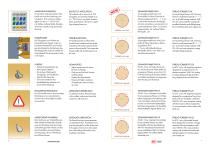
ANWENDUNGSBEREICH Für sämtliche kaltverformbaren Werkstoffe mit einer Bruchdehnung von mindestens 10 % und einer Zugfestigkeit von bis zu 1’150 N/mm2, z.B. Stähle, rostfreie Stähle, Reintitan, Aluminium, Kupfer, lang-spanendes Messing. RANGE OF APPLICATION All materials with a minimum of 10 % elongation and a tensile strength of up to 1’150 N/mm2, e.g. steels, stainless steels, pure titanium, aluminium, copper, long chipping brass, etc. FORMPROZESS Die Zahnspitzen und -flanken des Gewindeformers dringen in den verformbaren Werkstoff ein und verdrängen das Material in die Freiräume des Werkzeugprofils....
Open the catalog to page 2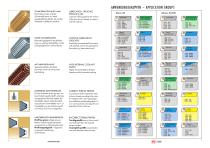
SCHMIERNUTEN AB Ø 3 MM Dank dieser Nuten wird der Schmierstoff besser zur Werkzeugoberfläche geführt, die mit dem Werkstoff in direktem Kontakt ist. LUBRICATION GROOVES FROM Ø 3 MM 12 11 Lubricant will be guided to the surface 15 of the tool which is directly in contact 1.0037 1.0711 9S20 1.3553 with the material. 9SMn28 1.0050 1.0715 1.6580 1.0718 9SMnPb28 1.0726 35S20 1.0737 9SMnPb36 WITHOUT LUBRICATION GROOVES Especially recommended for forming soft materials and for through holes in 11 24 23 41 11 thin parts (e.g. sheet metal work). 12 15 Pure titanium MIT INNENKÜHLUNG 11 Speziell empfohlen...
Open the catalog to page 3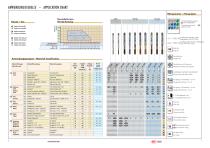
ANWENDUNGSTABELLE – APPLICATION CHART Piktogramme – Pictographs Optimal mit Schneidöl Geeignet mit Schneidöl Optimal mit Emulsion Geeignet mit Emulsion Bruchdehnung Elongation Optimal with emulsion Suitable with emulsion Durchfallender Schaft, ~DIN 2174 / ~2189 Reduced shank, ~ DIN 2174 / ~2189 Verstärkter Schaft, ~DIN 2174 / 2184-1 Reinforced shank, ~DIN 2174 / 2184-1 Zugfestigkeit N/mm2 Tensile strength N/mm 2 Härte ˆ HB = Hardnessˆ HB = Für Werkstoffgruppen gemäss -Anwendungstabelle For material groups as per application chart Optimal with cutting oil Suitable with cutting oil Gewindeformen...
Open the catalog to page 4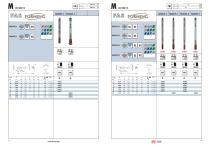
THREADING TECHNOL
Open the catalog to page 8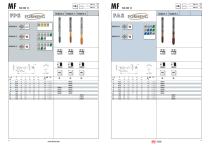
THREADING TECHNOL
Open the catalog to page 9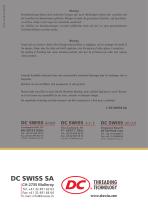
Warnung Gewindewerkzeuge können durch technisches Versagen oder durch Fahrlässigkeit brechen oder zersplittern und die Gesundheit des Mitarbeitenden gefährden. Befolgen Sie daher die gesetzlichen Sicherheits- und Gesundheitsvorschriften. Zudem ist das Tragen der Schutzbrille unerlässlich. Das Schleifen von Gewindewerkzeugen verursacht gefährlichen Staub und darf nur unter gewissenhaftesten Sicherheitsrichtlinien verrichtet werden. Warning Thread tools can break or shatter either through technical failure or negligence, and can endanger the health of the operator. Always obey the safety and health...
Open the catalog to page 11All DC SWISS SA catalogs and technical brochures
 K
K5 Pages
 NANO THREAD
97 Pages
 GWi5000
3 Pages
 NANO QUALITY
6 Pages
 QTAP
QTAP32 Pages
 AERO
AERO36 Pages
 ZBGF
ZBGF4 Pages
 GWi
GWi17 Pages
 RTS
RTS11 Pages
 Z70
Z709 Pages
 Catalogue TC
478 Pages
 Catalogue TM
212 Pages
- DC milling cutter
- Chuck
- DC solid milling cutter
- DC drill bit
- DC steel milling cutter
- DC solid drill bit
- DC metal milling cutter
- DC cast iron milling cutter
- Solid carbide milling cutter
- DC coated milling cutter
- Twist drill bit
- High-speed steel drill bit
- DC aluminum milling cutter
- DC stainless steel milling cutter
- Steel drill bit
- DC plastic milling cutter
- DC CNC machine milling cutter
- Cast iron drill bit
- Hardened steel milling cutter
- Stainless steel drill bit