
- Catalogs
- Daygas Heating Systems
- RADIUM TUBULAR RADIANT SERIES

RADIUM TUBULAR RADIANT SERIES
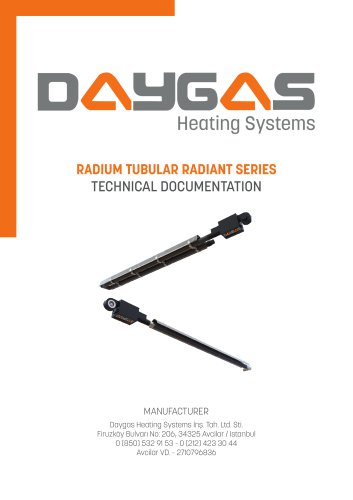
RADIUM TUBULAR RADIANT SERIES
- Operates in two stages with remote control or thermostat.
- Displays step and fault notifications.
- Heats by radiation without air rotation.
- Available in I and U types.
- High security with a safe gas valve system.
- Simple service and assembly.
- Low energy consumption and emissions.
Catalog excerpts
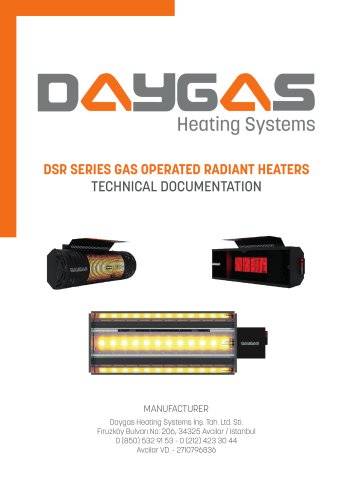
RADIUM TUBULAR RADIANT SERIES TECHNICAL DOCUMENTATION MANUFACTURER Daygas Heating Systems İnş. Tah. Ltd. Sti. Firuzköy Bulvarı No: 206, 34325 Avcilar / Istanbul 0 (850) 532 91 53 - 0 (212) 423 30 44 Avcilar VD. - 271079683
Open the catalog to page 1
Radium Tubular Radiant Heater Series Daygas Radium tubular radiant heaters are modern devices designed to heat spaces with high ceilings and large volumes. Radium heats the environment by reflecting the heat energy obtained by the combustion of the air-gas mixture in the radiant tubes to the desired environment, thanks to the parabolic designed aluminum reflectors. Radium tube type radiants heat people and objects without heating the air. In this way, warming provides optimum comfort. Radium Tube Type Series Features » Possibility to operate in 2 stages with remote control or with thermostat...
Open the catalog to page 2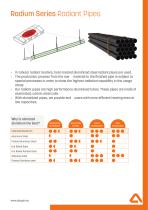
» In tubular radiant heaters, heat-treated aluminized steel radiant pipes are used. » The production process from the raw material to the finished pipe is subject to special processes in order to show the highest radiation capability in the usage areas. » Our radiant pipes are high performance aluminized tubes. These pipes are made of aluminized, caloric steel coils. » With aluminized pipes, we provide end users with more efficient heating even at low capacities.
Open the catalog to page 3
Radium Series Heat Dissipation Y.I.B : INTENSIVE RADIATIONZONE S.I.B : SQUARE RADIATION ZONE *Radium Tube Radiant Heat Dissipation Izohips Curve The Radium Tubular radiant device Y.I.B. in the heat distribution isohips curve. The fact that (intense radiation region) can be addressed to a large area as in the curve is due to the high radiant efficiency of the radiant pipe material that will radiate. We use aluminized steel special radiant pipes with 92% radiant efficiency (polished smooth surface). We achieve high efficiency by minimizing losses. *Radiant Efficiency Importance of Pipe in Tubular...
Open the catalog to page 4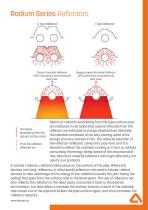
Radium Series Reflectors U Type Reflector Classic Parabolic Reflector 25% Convection (conventional) Heat Loss. Daygas Angled Parabolic Reflector 16% Convection (conventional) Heat Loss. Beams of radiation emanating from the pipe surface area are indicated in red (solid line), beams reflected from the The beam reflector are indicated in orange (dashed line). Normally, emanating from the tubular surface area. the radiation continues on its way, leaving some of its energy on every surface it hits. The material selection of the reflector (reflector) comes into play here, and it is From the reflector...
Open the catalog to page 5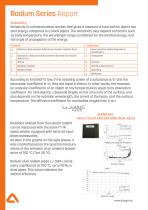
Emissivity is a dimensionless number that gives a measure of how well an object can emit energy compared to a black object. The emissivity may depend on factors such as body temperature, the wavelength range considered for the emitted energy, and the angle of propagation of the energy. According to Kirchhoff's law, if the radiating power of a substance is 'E' and the absorption coefficient is 'a', they are equal in theory. In other words, the emission (or emission coefficient) of an object at any temperature is equal to its absorption coefficient. For real objects, £ depends largely on the structure...
Open the catalog to page 6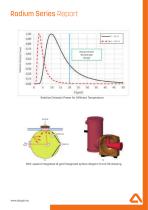
Relative Emission Power Relative Emission Power for Different Temperature PIKE upward integrated IR gold integrated sphere diagram 5 and 3D drawing.
Open the catalog to page 7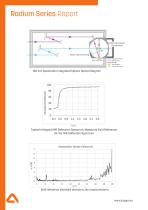
Gold reference standard deviation, ten measurements. www.daygas.eu
Open the catalog to page 8
Electrical Signal Cables Connection Details C14 SOKET » Radium Tubular Radiant » Electrical Connection: 230 V / 50 Hz » Electrical Operating Power: ≤ 100 VA Automation Terminal: (RS485 Port) Our devices have Modbus RTU communication protocol. » When making automation signal cable end connections, the end points should not overlap between the devices. Modbus connections are serially (B-B, A-A,GND-GND) between devices, jumping over each other and gathered at the node. » In tubular u radiant devices, as in other product groups, 1.5 m F type cable set for electrical connection is included in the...
Open the catalog to page 9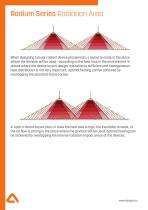
Radium Series Radiation Area When designing tubular radiant device placements, a layout is made in the place where the devices will be used - according to the heat loss in the environment. In places where the device layout design, insulation is sufficient and homogeneous heat distribution is not very important, optimal heating can be achieved by overlapping the standard impact areas. In such a device layout plan, in case the heat loss is high, the insulation is weak, or the air flow is strong in the place where the devices will be used, optimal heating can be achieved by overlapping the intense...
Open the catalog to page 10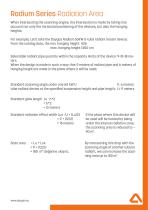
Radium Series Radiation Area When intersecting the scanning angles, the intersection is made by taking into account not only the horizontal positioning of the devices, but also the hanging heights. For example; Let’s take the Daygas Radium 60kW U-tube radiant heater device; From the catalog data, the min. hanging height: 425 max. hanging height 1350 cm Selectable radiant pipe quantity within the capacity limits of the device: 9-15-18 meters. When the design is made in such a way that 9 meters of radiant pipe and 6 meters of hanging height are made in the place where it will be used; Standard...
Open the catalog to page 11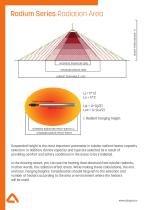
HEIGHT FROM GROUND - h Radium Series Radiation Area INTENSIVE RADIATION ZONE STANDARD RADIUS ZONE LARGEST SCAN ANGLE = 120 ° Lj = h*1.2 Lu = h*2 Daygas Tubular Type Radiant Radiant Pipe Length: Li Ljx = Li+(Lj/2) Lux = Li+(Lu/2) r: Radiant hanging height. INTENSIVE RADIATION EFFECT WIDTH: Lix STANDARD RADIUS EFFECT WIDTH: Suspended height is the most important parameter in tubular radiant heater capacity selection. In addition, device capacity and type are selected as a result of providing comfort and safety conditions in the areas to be irradiated. In the drawing above, you can see the heating...
Open the catalog to page 12
While selecting the tubular radiant device capacity, a number of values (device hanging height, openness to the outside environment and the outdoor winter average temperature of the place, etc.) are taken into consideration. The selection of radiant pipe length is as important as the selection of device capacity. Pipe size selection for tubular radiant devices is not limited to the device capacity, but is included in the calculation in the conditions where the devices will be hanged, so that the optimal pipe length and device capacity are matched. As can be seen from the table above, certain...
Open the catalog to page 13All Daygas Heating Systems catalogs and technical brochures
 BROCHURE
12 Pages
 LODOS GAS UNIT HEATERS
10 Pages
 DSR Premium Series
12 Pages
- Electric power radiant heater
- Gas heater
- Heating radiant heater
- Industrial radiant heating circuit
- Hot air generator
- Gas radiant heater
- Stationary hot air generator
- Gas hot air generator
- Industrial hot air generator
- Mobile hot air generator
- Stainless steel radiant heater
- Mobile radiant heater
- AC radiant heater
- High-temperature heater
- Outside radiant heater
- Single-phase radiant heater
- Natural gas radiant heater