

Technical documentation

Technical documentation
Cleanroom garments are crucial for preventing contamination, primarily caused by humans. Important factors in garment selection include fabric technical features, comfort, physiological characteristics, and construction quality.
Aligning garment specifications with user needs is essential for optimal performance. Dastex provides expertise and procedures, including standardized fabric tests and collaborations with independent institutes, to assist in selecting suitable products.
In the absence of universal standards, Dastex has developed its own in collaboration with approved institutes. These standards facilitate objective assessments and product comparisons, focusing on decontamination cycles, air permeability, triboelectrical behavior, and filter testbed evaluations.
Dastex's investment in the Body-Box test cabin allows for the evaluation of garment systems and components for particle shedding rates, ensuring reproducibility of results.
Fabrics like ION-NOSTAT VI.2, ION-NOSTAT V, and DASTAT-V are tested for air permeability, water vapor diffusion resistance, particle retention, and electrostatic behavior by independent institutes, providing reliable performance data.
Dastex offers comprehensive documentation and testing to ensure cleanroom garment quality and effectiveness, maintaining high levels of product protection and user satisfaction.
- Fabric Types: Includes ASTAT-D, ASTAT-C, and ASTAT-V in various colors.
- Special Finishes: Water repellent, anti-microbiological, hydrophilic finishes, and flame-resistant fabric ION-NOSTAT BS are available.
- Nano Finish: A dirt-resistant Nano finish is under development with promising results.
- Protection Needs: Custom solutions using Nomex® and Kevlar® for flame and cut protection.
- Garment Options: ESD/EPA garments like ION-NOSTAT-VI.2 and ION-NOSTAT Plus meet ESD demands and offer higher air permeability for low cleanroom environments.
- Testing and Certification: Fabrics and coats are tested and certified according to EN61340-5-1 standards.
Catalog excerpts
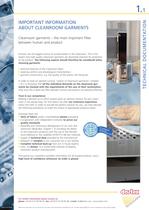
IMPORTANT INFORMATION ABOUT CLEANROOM GARMENTS Cleanroom garments – the most important filter between human and product Humans are the biggest source of contamination in the cleanroom. This is the reason why high quality cleanroom garments are absolutely essential for protection of the product. The following aspects should therefore be considered when choosing garments: technical features of the Cleanroom fabric wearing comfort and physiological characteristics garment construction, e.g. the quality of the seams, the fitting etc. In order to have an optimal running “system of cleanroom garments” (chapter 1.3) it is necessary that all the individual demands on the cleanroom garments be checked with the requirements of the user at their workstation. Only once this is done the filter between human and product can become effective. Trust in our competence Making a decision as to which system gives an optimal solution for your cleanroom is not always easy. For this reason we offer our extensive experience within the field. In order to provide the perfect solution for you, we have devised the following procedures to make the choice of appropriate products easier. Amongst them are: Tests of fabrics under a standardised dastex procedure Co-operation with independent institutes to prove our quality standards Assembly and continuous development of our own test cleanroom (Body-Box, chapter 1.3) including the ability to test cleanroom products with the use of the HelmkeDrum-Method or the modified ASTM F51-68 test methods Supply of technical data provided by the manufacturer Despatch of samples to our customers for in situ testing Complete technical back-up from our in house experts Links, via dastex, to a world-wide network of leading cleanroom product manufacturers This grants our customers complete information for all quoted products, and a high level of confidence whenever an order is placed. For further information please contact us: phone +49 (0)72 22-96 96-60 · fax +49 (0)72 22-96 96-88 · e-mail [email protected] · www.dastex.com Version 07/ 2008 Whilst we take every care to ensure the accuracy of the information provided we can not take responsibility for errors introduced at the printing stage. TECHNICAL DOCUMENTATION 1.1 1.1
Open the catalog to page 1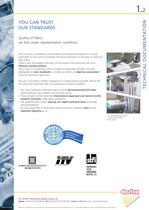
YOU CAN TRUST OUR STANDARDS Quality of fabric: we test under representative conditions Due to a lack of standards and regulations for cleanroom products it is nearly impossible for end users to evaluate cleanroom garments on the basis of technical data sheets. There is also the problem that each of the product manufacturers will use a different testing method. This is why, in co-operation with a number of approved institutes, we have developed our own standards to enable our clients an objective assessment of all our cleanroom garments. Our aim is to make a realistic comparison of single products...
Open the catalog to page 2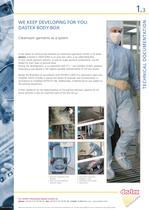
WE KEEP DEVELOPING FOR YOU: DASTEX BODY-BOX Cleanroom garments as a system In the desire to continuously develop our cleanroom garments further in all areas, dastex invested in 2004 / 2005 in an own test cabin, a so called Body-Box. In here whole garment systems, as well as single garment components, can be tested for their rates of particle shed. During the development, in co-operation with CCI – von Kahlden GmbH, greatest importance was placed in the highest possible reproducibility of the test results. Beside the Body-Box (in accordance with IEST-RP-CC003.3) a cleanroom cabin was installed,...
Open the catalog to page 3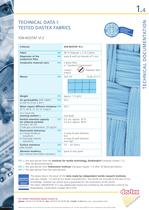
TECHNICAL DATA I: TESTED DASTEX FABRICS ION-NOSTAT VI.2 Criterion ION-NOSTAT VI.2 Fabric HA 98 % Polyester + 2 % Carbon Dispersion of the conductive fibre HA warp & weft by intervals of 5 mm Conductive material / yarn HA Carbon-Fibre in “Sandwich-Construction” Carbon interim Polyester fibre (Scale of 2:1) Weave HA Twill 3/2 Weight ITV approx. 113 g/m2 Air permeability (DIN 53887) at 200 Pa (l/min x dm2) ITV 29.2 Water vapour diffusion resistance FIH 35 °C 40 % r.F. 10-3 m2 mbar/V 28.3 As a result the wearing comfort is very good Particle retention capacity ITV for airborne particles Duration:...
Open the catalog to page 4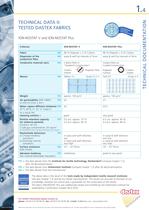
TECHNICAL DATA II: TESTED DASTEX FABRICS ION-NOSTAT V and ION-NOSTAT Plus Criterion ION-NOSTAT V ION-NOSTAT Plus Fabric HA 98 % Polyester + 2 % Carbon 96 % Polyester + 4 % Carbon Dispersion of the conductive fibre HA warp & weft by intervals of 5mm warp & weft by intervals of 3mm Conductive material / yarn HA Carbon-Fibre in “Sandwich-Construction” Carbon-Fibre as Coated Construction Carbon interim Polyester fibre Polyester nucleus (Scale of 2:1) Twill 2/1 Carbon coated Weave HA Taffeta 1/1 Weight ITV approx. 105 g /m2 approx. 100 g /m2 Air permeability (DIN 53887) at 200 Pa (l/min x dm2) ITV...
Open the catalog to page 5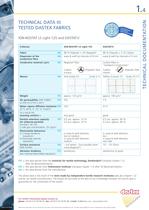
TECHNICAL DATA III: TESTED DASTEX FABRICS ION-NOSTAT LS Light-125 and DASTAT-V Criterion Fabric Dispersion of the conductive fibre Conductive material / yarn ION-NOSTAT LS Light-125 DASTAT-V HA HA 98 % Polyester + 2% Negastat® warp & weft by intervals of 8 mm 98 % Polyester + 2 % Carbon warp & weft by intervals of 5 mm HA Negastat® fibre Carbon-Fibre in “Sandwich-Construction” Carbon nucleus Polyester fibre Polyester fibre Weave HA Twill (body) 2/1 Weight ITV approx. 125 g / m2 approx. 100 g / m2 Air permeability (DIN 53887) at 200 Pa (l / min x dm2) ITV 352 7.9 Water vapour diffusion resistance...
Open the catalog to page 6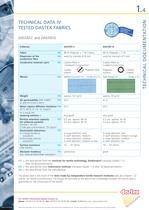
TECHNICAL DATA IV: TESTED DASTEX FABRICS DASTAT-C and DASTAT-D Criterion DASTAT-D HA HA 99 % Polyester + 1 % Carbon warp by intervals of 8 mm 99 % Polyester + 1 % warp by intervals of 5 mm HA Carbon-Fibre in “Sandwich-Construction“ Carbon-Fibre as Coated Construction Carbon interim Fabric Dispersion of the conductive fibre Conductive material / yarn DASTAT-C Polyester nucleus Polyester fibre Weave HA Taffeta (Canvas) 1/1 Weight ITV approx. 121 g / m2 approx. 95 g / m2 Air permeability (DIN 53887) at 200 Pa (l / min x dm2) ITV 36.5 41.9 Water vapour diffusion resistance FIH 35 °C 40 % r.F. 10-3...
Open the catalog to page 7All Dastex catalogs and technical brochures
 TACKY MATS
5 Pages
 DISPENSERS
5 Pages
 Miscellaneous products
8 Pages
 Cleaning products
7 Pages
 Cleanroom wipes
10 Pages
 Gloves and finger cots
11 Pages
 Shoes
Shoes8 Pages
 Cleanroom service
2 Pages
 Undergarments
10 Pages
 Cleanroom garments
26 Pages


- Electric vacuum cleaner
- Dry vacuum cleaner
- Shoes
- Mobile vacuum cleaner
- Mechanical protection protection gloves
- Anti-slip safety shoes
- Electrical protection safety shoes
- Single-component adhesive
- Anti-static safety shoes
- Metal adhesive
- Waterproof clothing
- Work jacket
- Materials handling manipulator
- Chemical protection safety gloves
- Single-phase vacuum cleaner
- Fabric safety shoes
- ESD safety shoes
- Chemical protection clothing
- Plastic adhesive
- Thermal protection safety gloves