
- Catalogs
- Dantherm Group
- I N T R O D U C TO R Y G U I D E BUG AND PEST CONTROL


- Company
- Products
- Catalogs
- News & Trends
- Exhibitions
I N T R O D U C TO R Y G U I D E BUG AND PEST CONTROL
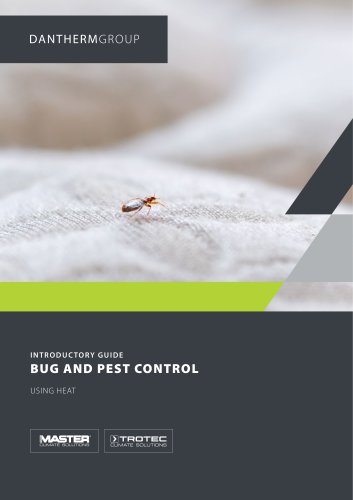
I N T R O D U C TO R Y G U I D E BUG AND PEST CONTROL
Dantherm Group specializes in climate control solutions, focusing on sustainability and energy efficiency across heating, cooling, dehumidification, air cleaning, and ventilation.
Introduction
The document highlights the issue of pest infestations due to global trade, advocating for heat treatment as an eco-friendly alternative to chemical pest control methods.
Insect Bug Pest Control Methods
Heat treatment is emphasized as an effective method for exterminating pests by exposing them to temperatures around 50°C for at least one hour.
Most Common Insects and Bugs
Common pests include bed bugs, flour beetles, and dust mites, with details on their characteristics and optimal extermination temperatures.
Pest Control Methods
Traditional chemical methods are criticized for environmental harm, while heat treatment is presented as a safer, more effective alternative.
Advantages of Heat Treatment
Benefits include no need for evacuation, no toxic residues, complete eradication, and immediate re-entry post-treatment.
Applications
Heat treatment is applicable in hotels, bakeries, and food factories, with biotests verifying treatment success.
Parasite Prevention and Monitoring
Preventive measures include cleanliness, sealing cracks, and using traps, with regular monitoring recommended.
Conclusion
Heat treatment is a viable, environmentally friendly pest control solution.
Heat Treatment Applications
Applications include hotels, transportation, farms, antique preservation, and more, with specific recommendations for each setting.
Heating Equipment Specifications
Details on various heaters like Master EKO and MASTER-HEYLO DE 20 SH, highlighting their features and safety measures.
Remote Climate Control System
The Simplify Solution includes an app and sensors for remote climate monitoring, reducing costs and improving efficiency.
Simplify Benefits
Allows real-time monitoring and control of climate processes, reducing project management costs.
Installation
The Simplify App enables quick setup and archiving of claims.
How It Works
Involves setup with the app, data transmission to the cloud, and dashboard availability for monitoring.
Contact Information
Contact details for Dantherm offices in multiple countries are provided.
Catalog excerpts
BUG AND PEST CONTROL USING HEAT
Open the catalog to page 1
Danttierm' CLIMATE SOLUTIONS CLIMATE SOLUTIONS About the Dantherm Group Dantherm Group is a European leader in portable and Why partner with us installed climate control solutions for a wide range of industries and uses. Based on the heritage of the variety ef European design quality of brands we own, our climate control experts build and manufacture hundreds of thousands of exceptional er Experts in climate control heating, cooling, dehumidification, air cleaning and ventilation units in our own factories in Europe every year. er Extensive range of solutions All of them are designed to create...
Open the catalog to page 2
Insect bug pest control methods 04 Most common insects and bugs 05 Pest control methods 07 Remote climate control 22
Open the catalog to page 3
INSEC T BUG PEST CONTROL ME THODS In this ever-increasing drive to use environmentally friendly methods it is important to highlight the ecological potential of bug extermination by using heat. In this brochure we look at different types of bug infestations and how our heat treatments resolve them better than anything else. In recent years we have witnessed an increasingly rapid growth of people moving between continents and a growing number of traffic in goods. This has led to the unwanted spread of insects and parasites. Chemicals have many side effects. This is why other methods have needed...
Open the catalog to page 4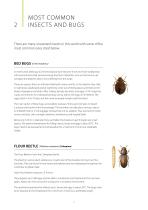
MOST COMMON INSEC TS AND BUGS There are many unwanted insects in this world with some of the most common ones cited below. BED BUGS (Cimex lectularius) In recent years bed bugs (Cimex lectularius) have become more and more widespread with environments that were previously free from infestation such as hotel rooms, rail carriages and airplane cabins now suffering from this surge. These are species that can withstand fasting for many months. In the daytime they hide in mattresses, baseboards and at night they come out of hiding places and feed on the blood of people and animals. After mating, females...
Open the catalog to page 5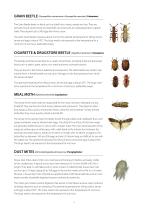
GRAIN BEETLE (Oryzaephilus surinamensis e Oryzaephilus mercator) (Coleoptera) The Grain Beetle feeds on foods such as dried fruits, meats, cereals and rice. They are primarily found where these dry foodstuffs are stored and are widespread due to global trade. They deposit up to 500 eggs four times a year. The adult Grain Beetle measures about 3.5mm.The optimal temperature for killing insects, larvae and eggs is about 50°C. The bugs need to be exposed to the temperature for a minimum of one hour, preferably longer. CIGARETTE & DRUGSTORE BEETLE (Stegobium paniceum) (Coleoptera) The beetles and...
Open the catalog to page 6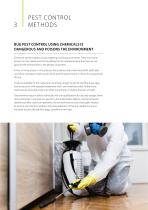
PEST CONTROL ME THODS BUG PEST CONTROL USING CHEMICALS IS DANGEROUS AND POISONS THE ENVIRONMENT Chemicals are the traditional way of getting rid of bugs and insects. There are several poisons on the market used for bug killing but the drawback being that they are not good for the environment or the people using them. In fact, in living spaces or in businesses that produce and market foodstuffs, pesticides cannot be used due to high toxicity levels and the poison being in the air for long periods of time. Products available on the market are not strong enough to get rid of all the bugs, eggs and...
Open the catalog to page 7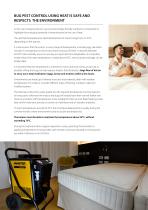
BUG PEST CONTROL USING HEAT IS SAFE AND RESPECTS THE ENVIRONMENT In this ever increasing drive to use environmentally friendly methods it is important to highlight the ecological potential of extermination by the use of heat. The optimal temperature for rapid development of insects range from 27-33°C, depending on the species. It is also known that the insects, in every stage of development, including egg, die within minutes if a temperature in the environment of around 50-60°C is reached. Between 40-50°C total mortality occurs in one day as insects die from dehydration. It is therefore evident...
Open the catalog to page 8
It is possible that, in particular, mobile adult insects tend to escape to reach more favourable environments. Therefore, it is advisable to plug any holes, cracks or gaps in the tiled floor or doors that will prevent the insects from escaping. Biotests can also be used to gauge the success of the operation. The biotests are small boxes containing insects, larvae and eggs that can be placed inside the room. Their death will be proof of the effectiveness of the treatment. At present, both in Europe and in other parts of the world, exterminations are carried out with heating the entire building,...
Open the catalog to page 9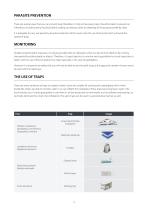
PARASITE PREVENTION There are several ways that you can prevent bug infestations. Firstly, all necessary steps should be taken to prevent an infestations including removing food debris, sealing up nesting cracks and keeping all living spaces perfectly clean. It is advisable to carry out periodic preventive treatment of the rooms with the use of dry heat which will avoid the spread of bugs. MONITORING Despite all preventative measures, it is always possible that an infestation will occur due to their ability to fly or being transported by either people or objects. Therefore, it is good practice...
Open the catalog to page 10
HOSPITALS & HOSTELS The most common pest in hotels is Cimex lectularius. In the day time it nestles in the seams of mattresses, in door and window frames, carpets, skirting boards and picture frames as well as in wooden furniture joints. Like with the hotel rooms above the most common pest affecting hospitals and hostels is Cimex lectularius. Monthly treatments are necessary with heat at 50-60°C in individual rooms as again you have to take into account escaping pests into other rooms. To help prevent this happening sealing off any possible escape routes is essential with double-sided adhesive...
Open the catalog to page 12
More and more passengers are complaining that they were attacked by bed bugs on trains and airplanes. It is essential to eradicate these pests first-hand with periodic heat treatments. Cimex lectularius is again the most frequent pest in this application. Treatments with extended heat for two hours at 50-60°C are recommended. TRAIN CARRIAGES POLICE CARS & VANS Train carriages or sleeping berths have frequently had bed bug infestation problems due to the high amount on travellers in this transportation mode. Periodic heat treatments are recommended. Police cars and vans are often used to transport...
Open the catalog to page 13All Dantherm Group catalogs and technical brochures
 SUSTAINABILITY REPORT 2025
18 Pages
 SUSTAINABILITY REPORT 2024
18 Pages
 SUSTAINABILITY REPORT 2023
15 Pages
 SUSTAINABLE BUSINESS PRINCIPLES
12 Pages



Archived catalogs
 WORKSHOPS
2 Pages
 AGRICULTURE
2 Pages
 CF 75 spark
3 Pages
 DC 61
3 Pages
 PORTABLE CLIMATE SOLUTIONS
108 Pages

- Chiller
- Drying system
- Radial fan
- Propeller fan
- Dantherm air circulation fan
- Industrial fan
- Air blower
- AC fan
- Wireless remote control
- Centrifugal blower
- Industrial remote control
- Single-stage blower
- Electrically-powered fan
- Centrifugal classifier
- Air chiller
- Liquids separator
- Waterproof fan
- Dantherm air dehumidifier
- 230VAC fan